Let’s take a look at the budget deficits again, keeping in mind that the last Republican budget was the 2007 budget. In January of 2007, the Democrats took control of the House and Senate, and all spending was in Democrat control until January of 2011, when the Republicans took back the House.
Obama Budget Deficit 2011
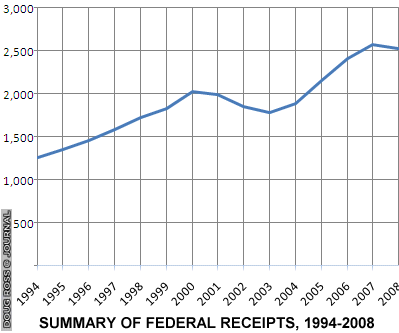
Next, let’s see what impact the Bush tax cuts from 2001 and 2003 had on tax revenue:
Federal receipts (1994-2008)
From the chart:
Revenue in 2001 was 2.0 trillion in the year of the first round of tax cuts
Revenue in 2003 was 1.8 trillion in the year of the second round of tax cuts
Revenue then rose in each subsequent year, ending at 2.6 trillion in 2007, when the Democrats took over the House and Senate
In 2007, Bush was only spending about 2.8 trillion – very close to what he was taking receiving in tax revenues
The budget deficit went down in each year after both tax cuts were in place (2004), until the Democrats took over the House and Senate
Obama is currently spending over 3.8 trillion per year, but he is only receiving about 2.2 trillion in revenue.
According to the OMB’s own figures, the Bush tax cuts resulted in an explosion of revenue to the U.S. government.
That’s not to say Bush wasn’t a profligate spender — he was. But in virtually no cases were Democrats arguing that he spend less (unless you count national security).
In fact, fiscal conservatives opposed Bush’s absurd policies on spending, amnesty and the expansion of Medicare.
Which is why they are certain to be rejected by the diminishing cadre of Obama-Democrat drones, who appear to be completely immune to facts, logic and reason.
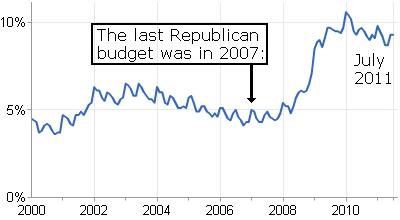
And let’s just see what happened to the unemployment rate since the Democrats took over spending in January of 2007:
Unemployment Rate (Not seasonally adusted)
There are a lot of people who don’t know about these numbers because they watch Jon Stewart and Stephen Colbert on the Comedy Channel, or Rachel Maddow and Ed Schulz on MSNBC.
I actually spoke to someone who voted for Obama about these numbers. He said that 2.6 trillion in tax revenues was worse than 2.0 trillion in tax revenues. And he said that a 4.3% unemployment rate was WORSE than a 9.2% unemployment rate. And he also said that a $160 billion dollar deficit was WORSE than a $1650 billion dollar deficit. Ok I just made that up, but still. That’s how Democrats think. Tax and spend.
Senate Democrats have drafted a sweeping debt-reduction plan that would slice $4 trillion from projected borrowing over the next decade without touching the expensive health and retirement programs targeted by President Obama.
Instead, Senate Democrats are proposing to stabilize borrowing through sharp cuts at the Pentagon and other government agencies, as well as $2 trillion in new taxes…
[…]Republicans dismissed the Democratic blueprint, saying higher taxes would be devastating to an economy already weighed down by a 9.2 percent unemployment rate. In their spending plan, House Republicans proposed to save $4 trillion entirely through spending cuts; they would also eliminate Medicare as an open-ended entitlement after 2021.
“If they’re calling for $2 trillion in tax hikes in the middle of a jobs crisis, it’s little wonder that it’s been 800 days since Senate Democrats passed a budget,” said McConnell spokesman Don Stewart.
Since early this year, Senate Democrats have struggled to draft a spending plan. Moderates refused to endorse any blueprint that included big annual budget deficits or big tax hikes. Liberals, meanwhile, opposed sharp cuts to social programs. Sen. Jeff Sessions (R-Ala.), the senior Budget Committee Republican, has relentlessly hammered Democrats for their failure to adopt a budget.
Although the new document is unlikely to be officially adopted, it was embraced by a majority of Senate Democrats when Conrad presented it at a closed-door luncheon earlier this week, aides said.
Under the blueprint, the top income tax rate would rise to 39.6 percent for individuals earning more than $500,000 a year and families earning more than $1 million. That group, which constitutes the nation’s richest 1 percent of households, would also pay a 20 percent rate on capital gains and dividends, rather than the 15 percent rate now in effect.
Speaker John A. Boehner told President Obama on Saturday night he will not agree to the president’s most ambitious plan for deficit reduction, citing the administration’s pursuit of tax increases as one of the main hurdles.
The Democrats want to tax investors and job creators. Is it any wonder that this administration has been unable to create jobs? They keep taxing and regulating the small businesses and investors who enable the creation of the majority of new private sector jobs, then are shocked to find that no new jobs are being created. When will they learn that “taxing the rich” just means “taxing the job creators”?
Why are companies not hiring?
Companies are not hiring because the Democrats spent too much, and now they want to raise taxes. Higher taxes makes companies not hire workers.
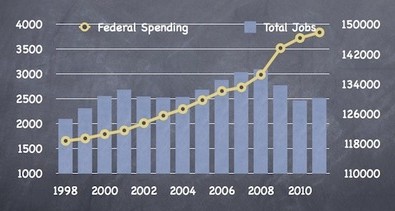
Look at this diagram:
Republican control of House = low unemployment
Compare the unemployment rates when Republican Newt Gingrich was in charge of the House, to when Nancy Pelosi was in charge:
Unemployment: Gingrich ('95-'99) vs Pelosi ('07-'10)
Nancy Pelosi added 5.34 trillion to the national debt in 4 years! If you are running a business, then you STOP hiring when you see that the government is spending so much that new taxes are inevitable. You cannot argue with these facts – more spending means higher unemployment, BECAUSE more spending raises fears of higher taxes on job creators. And that’s exactly what Obama is now threatening, and why the unemployment rate is going UP not DOWN. Newt Gingrich added only ONE TRILLION to the national debt between 1994 and 1999. ONE TRILLION. That’s bad, but it’s not FIVE TRILLION as under Pelosi.
Prior to January 2007, George W. Bush’s unemployment rate was down below 5%. Job creators knew that he wasn’t going to come after them with tax hikes and burdensome regulations. You can’t create jobs by punishing job creators. The trade-off of low tax rates for the wealthy is a low unemployment rate. Those are the facts, and we have to live with reality as it is.
How amusing to watch Democrats wring their hands over what they can do to get businesses to create jobs, when one of the biggest job killers is the minimum wage they keep hiking.
Recall that it was Democrats who raised the federal wage floor a whopping $2.10 an hour in the middle of the recession. The record 41% increase has led to record unemployment among young people, especially black teens.
Congress started ratcheting up the minimum wage from $5.15 an hour in mid-2007, arguing it would help abate poverty. But retailers looking to slash costs eliminated low-skilled, entry-level jobs rather than pay the mandated increases.
Now 1.5 million fewer teens are working. Last year’s unemployment rate for workers ages 16 to 19 shot up to 26% from 2007’s 15%.
As for black teens, their joblessness soared to a record 43% after the final raise to $7.25 took effect in mid-2009. It helped put more than half of young black men out of work — a first.
The president proposes cranking the minimum wage even higher to $9.50. Then he wants to raise it every year thereafter as a “living wage” indexed to inflation.
Yes, this is the problem that happens when you elect someone who knows nothing whatsoever about economics. And when I say nothing, I mean he is in disagreement with virtually all economists across the ideological spectrum.
Here’s Greg’s list, together with the percentage of economists who agree:
A ceiling on rents reduces the quantity and quality of housing available. (93%)
Tariffs and import quotas usually reduce general economic welfare. (93%)
Flexible and floating exchange rates offer an effective international monetary arrangement. (90%)
Fiscal policy (e.g., tax cut and/or government expenditure increase) has a significant stimulative impact on a less than fully employed economy. (90%)
The United States should not restrict employers from outsourcing work to foreign countries. (90%)
The United States should eliminate agricultural subsidies. (85%)
Local and state governments should eliminate subsidies to professional sports franchises. (85%)
If the federal budget is to be balanced, it should be done over the business cycle rather than yearly. (85%)
The gap between Social Security funds and expenditures will become unsustainably large within the next fifty years if current policies remain unchanged. (85%)
Cash payments increase the welfare of recipients to a greater degree than do transfers-in-kind of equal cash value. (84%)
A large federal budget deficit has an adverse effect on the economy. (83%)
A minimum wage increases unemployment among young and unskilled workers. (79%)
The government should restructure the welfare system along the lines of a “negative income tax.” (79%)
Effluent taxes and marketable pollution permits represent a better approach to pollution control than imposition of pollution ceilings. (78%)
From CNBC, we get this article showing that any increase in the minimum wage will raise the unemployment rate for young people.
Excerpt:
A quarter of teenagers were jobless in March, representing a surprising increase from February, even as the unemployment rate for the rest of the population decreased.
This figure may only get worse if budget-strapped states raise the minimum wage, and it could also be a sign of greater structural damage underlying our economy, analysts said.
The unemployment rate for 16- to 19-year olds jumped back up to 24.5 percent in March, up from 23.9 percent the prior month, according to the latest jobs data from the Labor Department.
[…]“Even when comprehending that teen employment is volatile in nature, the data that exists serves up some shock and awe,” said Brian Sozzi, a retail research analyst with Wall Street Strategies, in a note Wednesday. “If these (wage) increases do go through, the prospect for teen employment will remain grim as employers search for workers with advanced skills to fill positions.”
Twelve states, including Illinois and Pennsylvania, are considering a hike in the minimum wage. While this has been the subject of a long-running debate, many economists and analysts say raising this pay bar may cause more teen layoffs, even as it helps teens who manage to stay employed make more.
“Minimum wage increases over the past few years has definitely made it worse,” said Peter Boockvar, chief equities strategist at Miller Tabak. “In fact, there should be zero minimum wage for teenagers, or at most, something much less than the current rate.”
Teens typically are the first to be fired and the last to be hired back in a normal economic cycle, so this rate can be considered a kind of leading indicator of employment.
* The minimum wage encourages employers to hire illegal aliens.
Beranek (1982).
* Few workers are permanently stuck at the minimum wage.
Brozen (1969), Smith and Vavrichek (1992).
* The minimum wage has reduced employment in foreign countries.Canada: Forrest (1982); Chile: Corbo (1981); Costa Rica: Gregory (1981); France: Rosa (1981).
This is why it is important for voters to understand economics. When you raise the price of labor, fewer employers will purchase labor. Supply and demand.




 WINTERY KNIGHT