
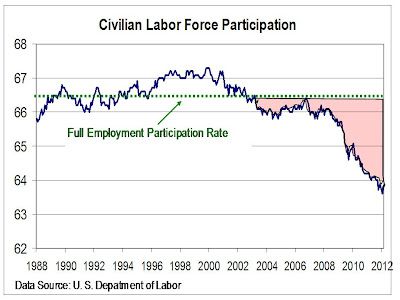
I noticed that the latest jobs report showed that the percentage of work-eligible Americans working was at a 38-year-low.
CNS News reports:
A record 93,626,000 Americans 16 or older did not participate in the nation’s labor force in June, as the labor force participation rate dropped to 62.6 percent, a 38-year low, according to the Bureau of Labor Statistics.
In June, according to BLS, the nation’s civilian noninstitutional population, consisting of all people 16 or older who were not in the military or an institution, hit 250,663,000. Of those, 157,037,000 participated in the labor force by either holding a job or actively seeking one.
Now, let me ask you this. Does paying people to not work cause more people to not work? It seems to me that whatever you subsidize, you get more of, and whatever you tax, you get less of.
Now look at this article from the radically-leftist New York Times.
It says:
Before this recession, most economists probably thought that some amount of unemployment benefits were just and compassionate, and offered a sense of security even to people who were lucky enough to retain their jobs, despite the fact that the program would raise unemployment rates and reduce both employment and economic output.
In other words, unemployment benefits shrink the economy to some degree, but shrinking the economy a bit may be a price worth paying.
Unemployment benefits were thought to reduce employment and output because, by definition, working people were ineligible for the benefits. In particular, an unemployed person who finds and starts a new job, or returns to working at his previous job, is supposed to give up his unemployment benefits. Economists had found that a large fraction of unemployed people delay going back to work solely because the unemployment insurance program was paying them for not working.
Here’s a new study explaining how the “generosity” of the big government Democrat Party actually encourages people to avoid working, and to remain dependent on the government for their “income”.
A study published by two labor economists, Stepan Jurajda and Frederick J. Tannery, looked at employment histories for unemployment insurance recipients in Pittsburgh in the early 1980s. Unemployment rates got quite high in Pittsburgh in those days, reaching 16 percent at one point, and staying over 10 percent for two and a half years.
The chart below summarizes their findings for Pittsburgh.
The chart displays the fraction of persons (in Pittsburgh) receiving unemployment benefits who began working again, as a function of the number of weeks until their unemployment benefits were scheduled to be exhausted. For example, a “hazard” value of “0.04″ for week “-14″ means that, among unemployed persons with 14 weeks remaining until their benefit exhaustion date, 4 percent of them either began working a new job or returned to their previous job.
The chart:

The most troubling thing about this is what is not said in the chart or the study – think about the children growing up in these households where their parents, especially the fathers, are not working. What are they learning about self-sufficiency and the role of government? They are the ones who we are going to task with paying for our lavish entitlement programs in the future. Are people who think that dependency on government is normal being trained to pay for the exploding costs of Social Security and Medicare?
 WINTERY KNIGHT