Tag Archives: Uncertainty

Women in business report that regulatory uncertainty hurts job growth

The Independent Women’s Forum explains what happened at a panel discussion of women CEOs.

Excerpt:

Rep. Cathy McMorris-Rodgers hosted a panel discussion on Capitol Hill today that focused on the economy and job creation.  All of the panelists were CEOs.  All of them were women.

In their opening remarks, one word was mentioned by every panelist: uncertainty.

Another word, that went hand-in-hand with the uncertainty that America’s job creators are facing was “regulations.”  This word was also mentioned by every panelist.

Sandra Parrillo, President & CEO of Providence Mutual Fire Insurance, said that, as a property and casuality insurance company, they are very familiar with risk.  This year has been unprecedented in the amount of claims they’ve paid out due to an usually high number of natural disasters.  But Parrillo said her company faces enough uncertainty from nature; they don’t need uncertainty coming from Washington, DC, where hundreds of new rules are being written – often to solve problems that don’t really exist.

Lisa Hook, President & CEO, Neustar, Inc., said, “The outcome of the budget is less important to us than that there is a budget.”  Her company is traded on the stock market, and she says that the uncertainty fueling the ups and downs of the market, often driven by headlines from D.C., affects her business and her borrowing costs.

Several of the panelists derided Congress for failing to pass a budget for FY 2011.  They want to know that Congress is working to get its fiscal house in order.   They want to know what to expect from the executive branch as well, rather than having to readjust their budgets to deal with costly new regulations as soon as they are written.

Alison Brown, President & CEO, NAVSYS Corporation, went on to explain how difficult it is for small businesses to find access to working capital.  She said, “I have had to become my own bank.”  Her company isn’t publicly traded, and she pointed to Dodd-Frank and Sarbanes-Oxley as two laws that have wrestled working capital from the hands of small business.

Catherine Heigel, President of Duke Energy South Carolina, echoed the sentiments of the other panelists.  She also pointed out Duke Energy would like to repatriate their foreign earnings, but without reform, they would face an effective tax rate of over 50 percent.  All of the panelists agreed that certainty (that often comes from having more cash available) could be restored to the American economy with regulatory reform, tax reform, and health care reform.  They pointed to these three areas as the areas that currently are most burdensome to businesses.

In many ways the panel today was depressing.  All of the CEOs recognized that we are in a tough time, and all of them expressed disappointment that they could not expand and add more jobs in the current business climate.

There is a problem on the left where they have this idea that they can seize profits, control businesses, impose politically correct agendas, and engage in judicial activism and businesses will just keep hiring, producing and so on. It’s the ultimate narcissism. Bureaucrats are so busy spending other people’s money and making speeches about how generous they are that they completely forget who is paying the bill.

Has Obama succeeded in spreading the wealth around?

Obama Economic Record November 2011

From Investors Business Daily.

Excerpt:

According to an IBD review of various economic data, while corporations and Wall Street investors have made significant gains under Obama’s economic leadership, average Americans have seen their fortunes steadily decline.

Since the start of the Obama administration, corporate profits have climbed 68% (about 59% after inflation), and are now 19% above their pre-recession peak, according to the latest Commerce Department data out Tuesday morning.

Meanwhile, companies are sitting on a pile of cash that’s grown 38% from Q1 2009 to Q2 2011, according to the Federal Reserve’s quarterly “Flow of Funds” report.

And since Obama’s inauguration, the Dow Jones Industrial Average has climbed 45%.

However, these solid gains haven’t translated into prosperity down the economic ladder.

Since Obama took office, median weekly earnings have dropped almost 5% after inflation, according to the Bureau of Labor Statistics. Home prices are below their January 2009 levels; unemployment is higher, as is the inflation rate. Gas prices alone have more than doubled since January 2009.

[…]Household income: Since the recovery started, household income has fallen 6.7%, according to a study by former Census Bureau officials. That’s a bigger decline than during the 18-month recession, when income fell 3.2%.

Jobs: Despite job growth since the recession ended, there are still 1.4 million fewer private sector jobs today than when Obama was sworn in, according to the Bureau of Labor Statistics. And the pace of growth — 1.6 million new jobs over the past two years — is far below what’s needed just to keep up with growth in the labor force.

Income inequality: After remaining essentially flat under President Bush, the gap between rich and poor has climbed in each of Obama’s first two years, according to the Census Bureau.

Consumer confidence: The Consumer Confidence Index dropped to 39.8 in October, down almost 10 points from when the recession ended, and almost right where it stood when Obama took office.

Misery Index: This index, which combines the unemployment rate with the inflation rate and is meant as a proxy of middle class pain, is 60% higher than when Obama took office, and it’s at a level not seen since mid-1983.

Home prices: The median price for existing home sales has dropped 4.6% since January 2009, according to monthly National Association of Realtors data. And the number of underwater mortgages is up, according to Core Logic.

Union membership: The share of private sector workers who belong to a union fell to 6.9% in 2010, compared with 7.6% the year before Obama took office, according to the Bureau of Labor Statistics.

The article explains why Obama’s rhetoric differs from reality – it turns out that the very policies he enacted created the poverty he claims he was going to reduce. Because he’s not an economist. He’s trying to do things that sound good so that people will like him. But those things don’t work.

Did George W. Bush’s tax cuts cause Obama’s trillion dollar budget deficits?

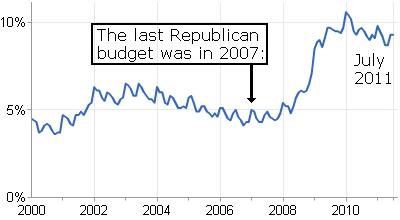
Let’s take a look at the budget deficits again, keeping in mind that the last Republican budget was the 2007 budget. In January of 2007, the Democrats took control of the House and Senate, and all spending was in Democrat control until January of 2011, when the Republicans took back the House.

Obama Budget Deficit 2011

Next, let’s see what impact the Bush tax cuts from 2001 and 2003 had on tax revenue:

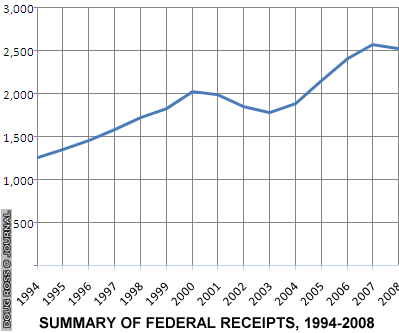
Federal receipts after Bush tax cuts
Federal receipts (1994-2008)

From the chart:

  • Revenue in 2001 was 2.0 trillion in the year of the first round of tax cuts
  • Revenue in 2003 was 1.8 trillion in the year of the second round of tax cuts
  • Revenue then rose in each subsequent year, ending at 2.6 trillion in 2007, when the Democrats took over the House and Senate
  • In 2007, Bush was only spending about 2.8 trillion – very close to what he was taking receiving in tax revenues
  • The budget deficit went down in each year after both tax cuts were in place (2004), until the Democrats took over the House and Senate
  • Obama is currently spending over 3.8 trillion per year, but he is only receiving about 2.2 trillion in revenue.
  • It’s a spending problem, not a revenue problem

Doug Ross explains:

According to the OMB’s own figures, the Bush tax cuts resulted in an explosion of revenue to the U.S. government.

That’s not to say Bush wasn’t a profligate spender — he was. But in virtually no cases were Democrats arguing that he spend less (unless you count national security).

In fact, fiscal conservatives opposed Bush’s absurd policies on spending, amnesty and the expansion of Medicare.

But no one in world history has ever spent money like Barack Obama.

These statements are indisputable.

Which is why they are certain to be rejected by the diminishing cadre of Obama-Democrat drones, who appear to be completely immune to facts, logic and reason.

And let’s just see what happened to the unemployment rate since the Democrats took over spending in January of 2007:

Unemployment Rate (Not seasonally adusted)

There are a lot of people who don’t know about these numbers because they watch Jon Stewart and Stephen Colbert on the Comedy Channel, or Rachel Maddow and Ed Schulz on MSNBC.

I actually spoke to someone who voted for Obama about these numbers. He said that 2.6 trillion in tax revenues was worse than 2.0 trillion in tax revenues. And he said that a 4.3% unemployment rate was WORSE than a 9.2% unemployment rate. And he also said that a $160 billion dollar deficit was WORSE than a $1650 billion dollar deficit. Ok I just made that up, but still. That’s how Democrats think. Tax and spend.