Tag Archives: Tory

Conservative Stephen Harper will cut taxes for families

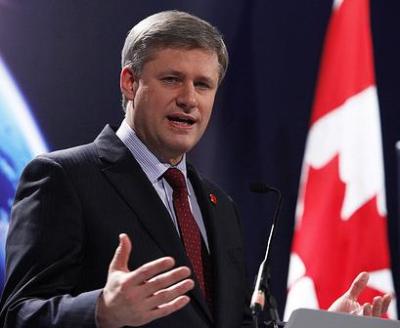
Prime Minister Stephen Harper

Conservative Party leader Stephen Harper announces his tax cut plan for families.

Excerpt:

Prime Minister Stephen Harper announced today that a re-elected Conservative Government will continue to implement low-tax measures to improve the quality of life of Canadian families.

“The Conservative Party believes in low taxes for Canadian families, because we know household budgets are tight,” said Mr. Harper. “A re-elected Conservative Government will continue to keep taxes down for families so they can keep more of their hard-earned money to spend on what matters to them.”

Budget 2011, the Next Phase of Canada’s Economic Action Plan, included concrete measures to keep taxes down for Canadian families. These include a new Family Caregiver Tax Credit to help around 500,000 families with the cost of caring for an infirm child or an aging parent, and the elimination of the $10,000 cap on the Medical Expense Tax Credit for any expenses incurred in caring for a financially-dependent relative. Our 2011 Budget — opposed by the Ignatieff Liberals and their Coalition partners, the NDP and Bloc Québécois — would also create a new $500 Children’s Arts Tax Credit to help parents cover the cost of putting their children in artistic, cultural, recreational and developmental activities.

“It is important for a Conservative Government to make Canadian families one of our key priorities,” said Mr. Harper. “That is why we will introduce measures to help caregivers, people who make sacrifices for their families, with concrete, affordable measures.”

Prime Minister Harper also reiterated his commitment to double to $1,000 the amount of the Children’s Fitness Tax Credit and to introduce the Family Tax Cut, income-sharing for families with children under the age of 18 years old, once the Government eliminates the deficit in 2014.

Stephen Harper’s Conservative Government cut taxes for Canadian families by more than $3,000 on average.

Prime Minister Harper observed that the Coalition of the Ignatieff Liberals, the NDP and the Bloc Québécois has the wrong priorities with their plan to raise taxes on Canadian families and ignore the choices that families make. “The choice is clear,” Mr. Harper said. “Canadians can choose between our low-tax plan for families and their high-tax agenda that will set you and your family back.”

Stephen Harper would also pass a bill to get tough on crime and criminals, in order to protect law-abiding Canadian families.

Related posts

NDP leader Jack Layton gets medical care at private clinic instead of public hospital

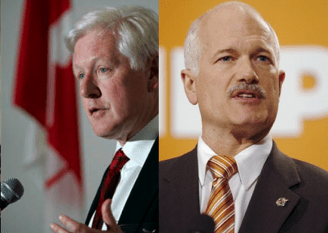
NDP leaders Bob Rae and Jack Layton

From CTV News:

NDP Leader Jack Layton, who’s campaigning as the defender of public health care, had surgery at a private clinic in the 1990s, The Canadian Press has learned.

Layton had hernia surgery at the Shouldice Hospital, a private facility in the Toronto suburb of Thornhill, while he was serving as a Toronto city councillor. The NDP leader said he wasn’t aware the clinic was private when he went for his surgery in the mid-1990s.

CBC News has more on Layton’s reasons for jumping the queue:

Earlier in the campaign, Layton said he would not go to a private clinic nor would he send a loved one to a private clinic, even if he could get faster treatment.

He would have had a longer wait at a public hospital, and he didn’t want to wait in line behind ordinary people.

How did former NDP leader Bob Rae govern in Ontario?

If you want to know what New Democrats do to an economy, you can read about how NDP leader Bob Rae wrecked the Ontario economy in the 1990s.

Excerpt:

The Liberal government had forecast a small surplus earlier in the year, but a worsening North American economy led to a $700 million deficit before Rae took office. In October, the NDP projected a $2.5 billion deficit for the fiscal year ending on March 31, 1991.[40] Some economists projected soaring deficits for the upcoming years, even if the Rae government implemented austerity measures.[41] Rae himself was critical of the Bank of Canada’s high interest rate policy, arguing that it would lead to increased unemployment throughout the country.[42] He also criticized the 1991 federal budget, arguing the Finance Minister Michael Wilson was shifting the federal debt to the provinces.[43]

The Rae government’s first budget, introduced in 1991, increased social spending to mitigate the economic slowdown and projected a record deficit of $9.1 billion. Finance Minister Floyd Laughren argued that Ontario made a decision to target the effects of the recession rather than the deficit, and said that the budget would create or protect 70,000 jobs. It targeted more money to social assistance, social housing and child benefits, and raised taxes for high-income earners while lowering rates for 700,000 low-income Ontarians.[44]

A few years later, journalist Thomas Walkom described the budget as following a Keynesian orthodoxy, spending money in the public sector to stimulate employment and productivity. Unfortunately, it did not achieve its stated purpose. The recession was still severe. Walkom described the budget as “the worst of both worlds”, angering the business community but not doing enough to provide for public relief.

[…]Rae’s government attempted to introduce a variety of socially progressive measures during its time in office, though its success in this field was mixed. In 1994, the government introduced legislation, Bill 167, which would have provided for same-sex partnership benefits in the province. At the time, this legislation was seen as a revolutionary step forward for same-sex recognition.

[…]The Rae government established an employment equity commission in 1991,[49] and two years later introduced affirmative action to improve the numbers of women, non-whites, aboriginals and disabled persons working in the public sector.

[…]In November 1990, the Rae government announced that it would restrict most rent increases to 4.6% for the present year and 5.4% for 1991. The provisions for 1990 were made retroactive. Tenants’ groups supported these changes, while landlord representatives were generally opposed.

Be careful who you vote for, Canada. We voted for Obama, and now we have a 14.5 trillion dollar debt and a 1.65 trillion deficit – TEN TIMES the last Republican budget deficit of 160 billion under George W. Bush in 2007. TEN TIMES WORSE THAN BUSH.

Related posts

NDP leader Jack Layton promises to promote greater access to abortion

NDP leaders Bob Rae and Jack Layton

From Life Site News.

Excerpt:

As Canada’s New Democratic Party (NDP) surges in the polls in the lead up to Monday’s federal election – raising the once-unimaginable specter of a coalition government headed by NDP leader Jack Layton – the party has emphasized their plan to push Canada beyond the status quo of state-funded abortion-on-demand, promising to actually promote greater access to abortion across the country.

NDP leader Jack Layton emphasized the party’s commitment to abortion – and questioned the Conservative party’s commitment – in Gatineau, Quebec on Monday as part of a pitch to win over women voters.  “The cabinet of the prime minister is still questioning the right of women to choose,” said Layton, according to the Toronto Star.

In a statement to Campaign Life Coalition, the political arm of Canada’s pro-life movement, the NDP said they are committed as a party to “universal access to abortion services and guaranteed reproductive freedoms for all Canadian women, regardless of income or where they live.”

The party emphasized that this is a position demanded of all NDP candidates.  “All New Democrat candidates agree to adhere to these principles when they agree to accept the nomination from their riding association,” said the statement.

Notably, last year every NDP Member of Parliament, except four who did not vote, opposed Bill C-510 (Roxanne’s Law), which would have protected women who choose to keep their unborn babies from being coerced into abortion.

[…]The polling firm suggests the party could win as many as 100 seats, allowing them to team up with the Liberals to form a coalition government that would make Layton Canada’s Prime Minister.  They report that the NDP’s popularity has particularly surged in Quebec, where they say there has been “a wholesale transfer of Bloc Quebecois supporters.”

Though Layton did not give details at the Gatineau rally on the party’s plan to promote abortion, an NDP policy official told the Toronto Star that the party would negotiate with the provinces and territories to make abortion easily accessible to every woman who wants one.  The official suggested this could involve adding to the number of hospitals and family doctors committing abortions.

Two provinces that would likely be affected are New Brunswick and Prince Edward Island, frequent targets of abortion advocates.  New Brunswick has successfully avoided funding private abortion facilities so far, and P.E.I. residents must currently obtain abortions in other provinces.  Both would undoubtedly come under pressure from an NDP-led government.

Social conservatives should not be voting for Jack Layton. He is a pro-abortion radical.

How did former NDP leader Bob Rae govern in Ontario?

If you want to know what New Democrats do to an economy, you can read about how NDP leader Bob Rae wrecked the Ontario economy in the 1990s.

Excerpt:

The Liberal government had forecast a small surplus earlier in the year, but a worsening North American economy led to a $700 million deficit before Rae took office. In October, the NDP projected a $2.5 billion deficit for the fiscal year ending on March 31, 1991.[40] Some economists projected soaring deficits for the upcoming years, even if the Rae government implemented austerity measures.[41] Rae himself was critical of the Bank of Canada’s high interest rate policy, arguing that it would lead to increased unemployment throughout the country.[42] He also criticized the 1991 federal budget, arguing the Finance Minister Michael Wilson was shifting the federal debt to the provinces.[43]

The Rae government’s first budget, introduced in 1991, increased social spending to mitigate the economic slowdown and projected a record deficit of $9.1 billion. Finance Minister Floyd Laughren argued that Ontario made a decision to target the effects of the recession rather than the deficit, and said that the budget would create or protect 70,000 jobs. It targeted more money to social assistance, social housing and child benefits, and raised taxes for high-income earners while lowering rates for 700,000 low-income Ontarians.[44]

A few years later, journalist Thomas Walkom described the budget as following a Keynesian orthodoxy, spending money in the public sector to stimulate employment and productivity. Unfortunately, it did not achieve its stated purpose. The recession was still severe. Walkom described the budget as “the worst of both worlds”, angering the business community but not doing enough to provide for public relief.

[…]Rae’s government attempted to introduce a variety of socially progressive measures during its time in office, though its success in this field was mixed. In 1994, the government introduced legislation, Bill 167, which would have provided for same-sex partnership benefits in the province. At the time, this legislation was seen as a revolutionary step forward for same-sex recognition.

[…]The Rae government established an employment equity commission in 1991,[49] and two years later introduced affirmative action to improve the numbers of women, non-whites, aboriginals and disabled persons working in the public sector.

[…]In November 1990, the Rae government announced that it would restrict most rent increases to 4.6% for the present year and 5.4% for 1991. The provisions for 1990 were made retroactive. Tenants’ groups supported these changes, while landlord representatives were generally opposed.

Be careful who you vote for, Canada. We voted for Obama, and now we have a 14.5 trillion dollar debt and a 1.65 trillion deficit – TEN TIMES the last Republican budget deficit of 160 billion under George W. Bush in 2007. TEN TIMES WORSE THAN BUSH.

UPDATE: This post linked by Blazing Cat Fur.

Related posts