Tag Archives: Tom Sowell

Tom Sowell on gun control and judicial activism

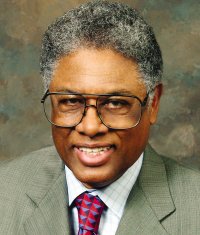
Thomas Sowell

His latest column is here.

Excerpt:

Now that the Supreme Court of the United States has decided that the Second Amendment to the Constitution means that individual Americans have a right to bear arms, what can we expect?

Those who have no confidence in ordinary Americans may expect a bloodbath, as the benighted masses start shooting each other, now that they can no longer be denied guns by their betters. People who think we shouldn’t be allowed to make our own medical decisions, or decisions about which schools our children attend, certainly are not likely to be happy with the idea that we can make our own decisions about how to defend ourselves.

When you stop and think about it, there is no obvious reason why issues like gun control should be ideological issues in the first place. It is ultimately an empirical question whether allowing ordinary citizens to have firearms will increase or decrease the amount of violence.

[…]If the end of gun control leads to a bloodbath of runaway shootings, then the Second Amendment can be repealed, just as other Constitutional Amendments have been repealed. Laws exist for people, not people for laws.

There is no point arguing, as many people do, that it is difficult to amend the Constitution. The fact that it doesn’t happen very often doesn’t mean that it is difficult. The people may not want it to happen, even if the intelligentsia are itching to change it.

When the people wanted it to happen, the Constitution was amended 4 times in 8 years, from 1913 through 1920.

The whole point of strict gun control or lax gun control is to reduce violent crime rates. All we have to do is look and see whether stricter gun control, like the UK handgun ban of 1997, raises or lowers violent crime rates. It’s not for judges to make that assessment – it’s for the people, and their legislators, to decide. I used to be a judicial activist supporter when I was younger. But not after I read Tom Sowell’s “Conflict of Visions” book.

This point about judges interpreting the law also applies to businesses and capitalism. If judges can change the rules that businesses operate under arbitrarily, then fewer people will start businesses. It’s bad enough that they have to put up with so many taxes and regulations. If one loopy judge can take away everything you own by legislating from the bench, then what is the point of even trying to start a business?

If you want jobs, you need small business. If you want small business, you need strict constructionist judges. If you want strict constructionist judges, you vote Republican. (And you get pro-life and pro-marriage for FREE!)

Thomas Sowell is my #1 favorite economist.

UPDATE: Hot Air wonders how the liberal SCOTUS guys can oppose the clear meaning of the Constitution so openly.

Five videos on Thomas Sowell’s most difficult book

“A Conflict of Visions” is the most difficult Thomas Sowell book I ever read. So I hope these five videos from the Hoover Institute at Stanford University will give you all of the benefits without so much of the hard work.

Here’s a little written summary to get you started.

Excerpt:

In “A Conflict of Visions”, Thomas Sowell proposed that the fundamental difference between the policies of the left and the right derive from their respective views of human nature.

The left sees man in general as perfectly malleable. It sees every individual’s problems as being caused by society as a whole. Criminal behavior under this theory is merely a response to injustice; poverty is a condition brought on by greed; depression, drunkenness and illness are all seen as a fault of the medical system or our general “awareness”. Since individual problems are the fault of the whole of society, the solution must be to fix society by massive government intervention.

People on the right take an inverse view of the situation. Conservatives believe in individual responsibility. This means, if someone commits murder, he is bad. If someone is poor he has declined to take advantage of opportunities manifest within a free market system. If someone is uneducated, he has not worked hard enough to secure education for himself. This attitude among conservatives means that the perceived solution is not to change society in a general way but to get government out of the business of regulating the people in mass and making them take responsibility for their actions in particular. Social man then is not malleable, but the individual can be guided by market forces.

And here are the videos.

Part 1:

Part 2:

Part 3:

Part 4:

Part 5:

If you’re interested in learning how the world really works, you can’t do much better than Tom Sowell.

How I got interested in the relationship between Christianity and economics

I listened to all the lectures of this course by the Christian philosopher Ronald H. Nash. He presents a view of economics that is consistent with the laws of logic and the Bible. And this course is comprehensive. I’ve moved on from Dr. Nash’s course to read F. A. Hayek and Thomas Sowell. And I found that Dr. Nash’s course was excellent preparation for these more advanced books.

Take a look at some of the topics:

  • the role of the government in regulating commerce
  • the meaning of justice
  • capitalism and socialism
  • interventionism vs free market capitalism
  • introduction to economics
  • marxism
  • wealth and poverty
  • liberation theology and the religious left
  • judicial activism vs legal positivism
  • pollution
  • public education

You can grab the lectures here.

A little blurb about Dr. Nash

Nash taught theology and philosophy for four decades at three schools. He was chairman of the department of philosophy and religion and director of graduate studies in humanities at Western Kentucky University, where he was on faculty from 1964-91. He was a professor at Reformed Theological Seminary from 1991-2002 and at Southern Baptist Theological Seminary from 1998-2005.

Nash wrote more than 35 books on philosophy, theology and apologetics, including “Faith & Reason: Searching for a Rational Faith,” “Life’s Ultimate Questions” and “Is Jesus the Only Savior?” Nash received his Ph.D. from Syracuse University; his master’s degree from Brown University; and his undergraduate degree from Barrington College.

From this Baptist Press article.