Tag Archives: Taxes

House Republicans unanimously support No Taxpayer Funding for Abortion Act

Unborn baby scheming about defunding abortion

The Dailer Caller reports on the roll call for the No Taxpayer Funding for Abortion Act. (H/T Mary)

Excerpt:

The House of Representatives on Wednesday passed a bill that would prohibit all federal funding for abortions. The bill was approved by a vote of 251-175.

The “No Taxpayer Funding for Abortion Act” amends the existing Hyde amendment. The Hyde amendment currently prohibits most federal funding for abortions.

In a press release, bill sponsor Republican Rep. Christopher Smith of New Jersey wrote, “one thing is clear: federal funding of abortion will lead to more abortions.”

Smith wrote, “In 2009, there were only 220 government-financed abortions. The Congressional Budget Office has estimated that the federal government would pay for as many as 675,000 abortions each year without the Hyde Amendment and other provisions that prevent federal funding of abortion.”

[…]Smith’s statement said that the bill “simply protects taxpayers from having to fund or subsidize something they morally oppose.”

All House Republicans who voted supported the legislation; they were joined by 16 House Democrats.

The White House strongly opposes the bill. In a policy statement, the administration wrote that the bill “intrudes on women’s reproductive freedom and access to health care; increases the tax burden on many Americans; unnecessarily restricts the private insurance choices that consumers have today; and restricts the District of Columbia’s use of local funds, which undermines home rule.”

Life News reports that the public supports banning funding for abortions:

A majority of Americans object to the use of taxpayer money for funding abortion, according to numerous polls — including a survey CNN conducted in early April showing Americans oppose public funding of abortion by a margin of 61% to 35%.

And also notes that cutting off funding makes a big difference in the number of abortions:

Congressman Chris Smith, a New Jersey Republican who is the lead sponsor of the bill, informed the House that a study by the Guttmacher Institute, the pro-abortion former research apparatus of Planned Parenthood, released a study noting that one-quarter of women who otherwise would have had abortions chose to give birth when taxpayer dollars were not available to pay for abortions of their children.

The Heritage Foundation explains what the No Taxpayer Funding for Abortion Act does.

Excerpt:

H.R. 3 seeks to prohibit federal funding of abortion by permanently codifying an array of protections against government subsidies for abortions.

[…]H.R. 3 would permanently prohibit the use of taxpayer dollars to subsidize elective abortions. In addition to addressing the various loopholes for federal abortion funding, the bill prevents funding for:

  • Elective abortion through appropriations for the U.S. Department of Health and Human Services;
  • International aid for contraceptive programs where abortion is used as a method of family planning;
  • Insurance coverage for federal employees that includes elective abortions; and
  • Subsidized abortion with monies congressionally appropriated for the District of Columbia, as well as locally generated tax dollars.

[…]H.R. 3… also addresses the conscience rights of pro-life medical professionals and institutions. Both the weak conscience protections in the PPACA and the Obama Administration’s recent decision to partially rescind federal conscience regulations have placed the rights of doctors, pharmacists, and hospitals in a precarious situation. Codifying the annual Hyde–Weldon clause, H.R. 3 provides protection from discrimination in federally funded programs to medical professionals and institutions that decline participation in abortion.

The Weekly Standard notes that the tally could have been even higher. Five Republicans did not vote, and they are all pro-life.
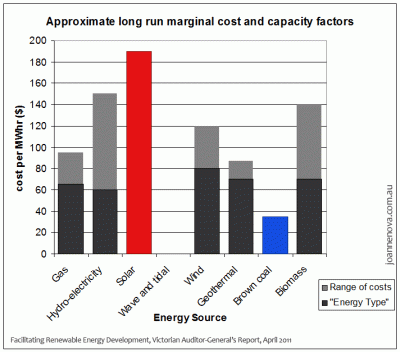
New report compares cost of coal power to renewable wind and solar power

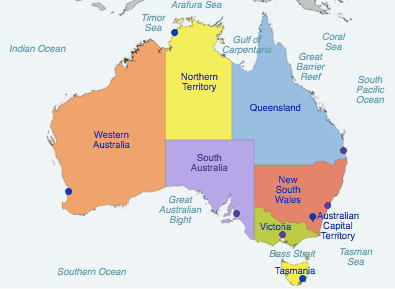
Map of Australia
Map of Australia

From the Victorian Auditor-General’s Report, April 2011. (H/T Joanne Nova)

Here’s the chart:

Cost of renewable wind and solar energy

Click here for a bigger version.

Compared to coal, wind power is incredibly expensive, and solar power is even worse.

What happened when the Canadians embraced wind and solar power?

What happened to consumer energy prices in Ontario when the Liberal government embraced unproven wind and solar power?

The Globe and Mail explains:

If you haven’t opened your September hydro bill yet, you’re in for a shock. Rates have risen 18 per cent this year to date, and that’s just the start. By this time next year – election time – Ontario power consumers will be forking over about twice as much (in nominal terms) as they did when Dalton McGuinty took office in 2003.

[…]Power expert Tom Adams may know more about this subject than any other living being. And he’s steamed. Ontario’s rates, he says, have already surpassed the U.S. average and are headed for European levels – “just because of public policy.”

The policy is to go all out on renewables – wind and solar– whether or not it makes sense. The province is paying sky-high rates for power it doesn’t need so we can have wind turbines marching on and on to the horizon, just like Denmark does. “Power demand has been dropping since 2005,” says Mr. Adams. In fact, we have so much excess supply that, from time to time, it threatens to crash the system. Because of this, we’re even paying the neighbours to take the power off our hands.

“Ontario will need new power supplies in the future,” Mr. Adams says. “But why not buy it when we need it?” Instead of waiting, the power authority is signing long-term contracts at the rate of about $1-billion a week, while paying enormous premiums to attract wind and solar producers. In other words, it’s making 20-year commitments to pay stunningly high prices for power we don’t need.

On top of that, the province is building new transmission lines to nowhere while neglecting to ensure that Toronto’s hospitals and banks can keep the lights on. In July, Toronto experienced what Mr. Adams calls “Ontario’s first green blackout.” That blackout occurred because the city’s downtown core is badly underpowered. It has the weakest power system of any financial centre in the developed world.

Why haven’t we done anything about it? Because the green lobby has been campaigning for conservation, instead. And so, when the government started picking sites for transmission upgrades, it decided to build a power line up the shore of Lake Nipigon to connect remote wind turbines to Thunder Bay.

Ever since the days of Adam Beck, the father of public power in Ontario, the province’s energy policy has been linked to economic policy. The motto was reliable power at cost. Now energy policy has been entirely decoupled from economic policy and attached to the runaway train of environmental policy. Everyone in the power system knows it. But they’re so terrified to raise their hands, most of the public is still in the dark.

The National Post wrote about how the Ontario government wastes taxpayer money to subsidize big corporations who experiment with unproven, expensive energy programs, like solar power.

Excerpt:

The Swedish retail giant IKEA announced yesterday it will invest $4.6-million to install 3,790 solar panels on three Toronto area stores, giving IKEA the electric-power-producing capacity of 960,000 kilowatt hours (kWh) per year. According to IKEA, that’s enough electricity to power 100 homes. Amazing development. Even more amazing is the economics of this project. Under the Ontario government’s feed-in-tariff solar power scheme, IKEA will receive 71.3¢ for each kilowatt of power produced, which works out to about $6,800 a year for each of the 100 hypothetical homes. Since the average Toronto home currently pays about $1,200 for the same quantity of electricity, that implies that IKEA is being overpaid by $5,400 per home equivalent.

Welcome to the wonderful world of green economics and the magical business of carbon emission reduction. Each year, IKEA will receive $684,408 under Premier Dalton McGuinty’s green energy monster — for power that today retails for about $115,000. At that rate, IKEA will recoup $4.6-million in less than seven years — not bad for an investment that can be amortized over 20.

No wonder solar power is such a hot industry. No wonder, too, that the province of Ontario is in a headlong rush into a likely economic crisis brought on by skyrocketing electricity prices. To make up the money paid to IKEA to promote itself as a carbon-free zone, Ontario consumers and industries are on their way to experiencing the highest electricity rates in North America, if not most of the world.
The government’s regulator, the Ontario Energy Board, has prepared secret forecasts of how much Ontario consumers are going to have to pay for electricity over the next five years. The government won’t allow the report to be released. The next best estimate comes from Aegent Energy Advisors Inc., in a study it did for the Canadian Manufactures and Exporters group. Residential rates are expected to jump by 60% between 2010 and 2015. Industrial customers will be looking at a 55% increase.

Going back to 2003, based on numbers dug up by consultant Tom Adams, the price of residential electricity in Ontario hovered around 8.5¢ a kWh in 2003 — the first year of the McGuinty Liberal regime. By 2015, Aegent Energy estimates the price will be up to 21¢, an increase of 135%. Doubling the price of electricity in a decade is no way to spur growth and investment. In this age of global economic competition IKEA may end up with fewer sales of its Billy bookshelves in Toronto because its customers will be bogged down with soaring power bills and a sliding economy.

How about wind power in a coastal province like New Brunswick? Is that any better? The National post explains the costs and drawbacks of wind power.

Excerpt:

A $200-million wind farm in northern New Brunswick is frozen solid, cutting off a potential supply of renewable energy for NB Power.

The 25-kilometre stretch of wind turbines, located 70 kilometres northwest of Bathurst, N.B. has been completely shutdown for several weeks due to heavy ice covering the blades.

[…]Wintery conditions also temporarily shutdown the site last winter, just months after its completion. Some or all of the turbines were offline for several days, with “particularly severe icing” blamed.

The accumulated ice alters the aerodynamics of the blades, rendering them ineffective as airfoils. The added weight further immobilizes the structures.

[…]Melissa Morton, a spokeswoman for the utility, says the contract isn’t based on power delivered during a specific period, but rather on an annual basis.

“Our hopes is that it will balance out over the 12-month period and, historically, that has been the case.”

Despite running into problems in consecutive winters, Ms. Morton says NB Power doesn’t have concerns about the reliability of the supply from the Caribou Mountain site.

It’s a waste of taxpayer money.

New study finds that US rich pay a larger share of taxes than in any other country

Michele Bachmann posted this Wall Street Journal article about a new OECD study that shows how the rich pay most of the total tax burden.

Excerpt:

As President Barack Obama pushes to raise income taxes on high earners, opponents are seizing on data that indicates these U.S. households already pay a large and growing share of taxes, even compared with high-tax European countries. And a new congressional study concludes that the percentage of U.S. households owing no federal income tax climbed to 51% for 2009.

Republicans are expected to highlight these figures at a congressional hearing Tuesday. They oppose Mr. Obama’s proposal to increase taxes for high earners, defined as families making more than $250,000 per year, as a way to help close large federal budget deficits.

[…]Upper-income taxpayers have paid a growing share of the federal tax burden over the last 25 years.

A 2008 study by the Organization for Economic Cooperation and Development, for example, found that the highest-earning 10% of the U.S. population paid the largest share among 24 countries examined, even after adjusting for their relatively higher incomes. “Taxation is most progressively distributed in the United States,” the OECD study concluded.

Meanwhile, the percentage of U.S. households paying no federal income tax has been climbing, and reached 51% for 2009, according to a new analysis by the Joint Committee on Taxation. That was the first time since at least 1992 that more than half of households owed no federal income tax, according to JCT estimates.; earlier data were unavailable on Monday.

Here’s a useful graphic that shows who really pays the most taxes.

When 51% of the population doesn’t pay federal taxes, you have a situation where the majority of the people have no incentive to cut spending. This is a bad situation.