
Tag Archives: Tax the Rich

Number of Americans not in labor force hits record high of 87,897,000

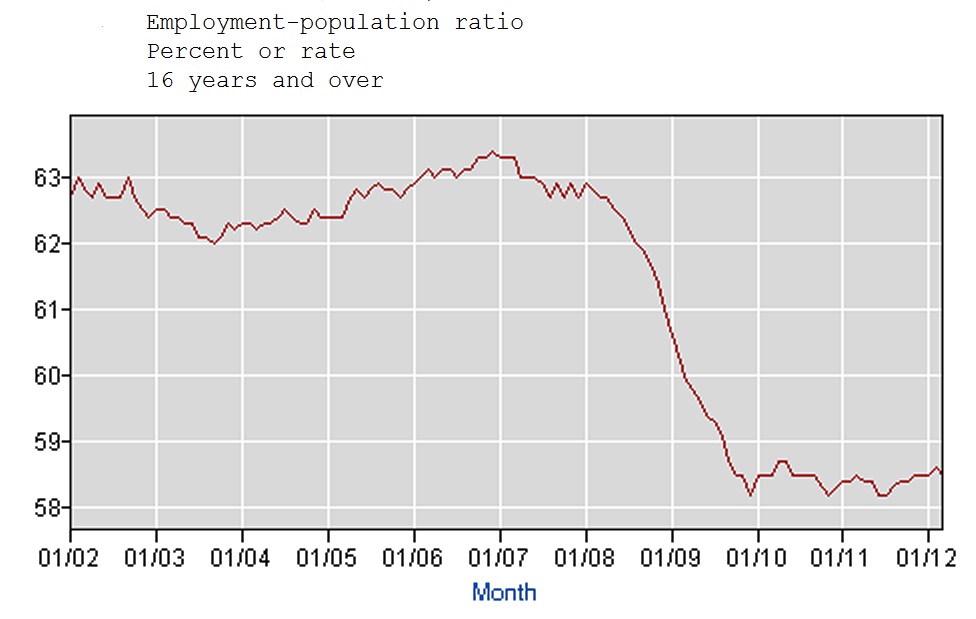
Employment to population ratio down 4.5% since Democrats took the House and Senate in January 2007
Employment to population ratio down 4.5% since Democrats took control of the House and Senate in January 2007

The Obama administration has pursued an economic policy of raising taxes on job creators, imposing regulatory burdens on businesses and shoveling mountains of taxpayer money into the hands of green energy firms which are often linked to Democrat fundraisers. Does it work to create jobs? Let’s see.

A record number of Americans are unemployed

From Breitbart.

Excerpt:

Amid disappointing unemployment numbers that fell 80,000 jobs short of projections, another number is raising eyebrows: the number of Americans not in the labor force has hit a record high 87,897,000.

This figure explains why overall unemployment dropped from 8.3% to 8.2%, as the Department of Labor’s unemployment figure does not include people who have given up hope and are not actively seeking employment.

When the number of individuals who have stopped looking for a job and/or who are working part-time but desire full-time employment is included–a figure known as the “underemployment rate”–real unemployment stands at 19.1%.

If you want to know if the President is doing a good job of creating jobs, just count the number of people who are unemployed. If the number of people who are unemployed is at a RECORD HIGH, then you need to elect a new President. Preferably someone who understands basic economics.

The real unemployment rate is 14.5%

From the American Enterprise Institute.

Excerpt:

Recall that back in 2009, White House economists Jared Bernstein and Christina Romer used their old-fashioned Keynesian model to predict how the $800 billion stimulus would affect employment. According to their model—as displayed in the above chart, updated—unemployment should be around 5.8% today.

But the true measure of U.S. unemployment is far worse:

1. If the size of the U.S. labor force as a share of the total population was the same as it was when Barack Obama took office—65.7% then vs. 63.8% today down from last month—the U-3 unemployment rate would be 10.9%.

2. But what if you take into the account the aging of the Baby Boomers, which means the labor force participation (LFP) rate should be trending lower. Indeed, it has been doing just that since 2000. Before the Great Recession, the Congressional Budget Office predicted what the LFP would be in 2012, assuming such demographic changes. Using that number, the real unemployment rate would be 10.5%.

3. Of course, the LFP rate usually falls during recessions. Yet even if you discount for that and the aging issue, the real unemployment rate would be 9.4%.

4. Then there’s the broader, U-6 measure of unemployment which includes the discouraged plus part-timers who wish they had full time work. That unemployment rate, perhaps the truest measure of the labor market’s health, is still a sky-high 14.5%.

5. The employment-population ratio dipped to 58.5% vs. 61% in December 2008. An historically low level of the U.S. population is actually working.

People keep talking about intelligent Barack Obama is. But shouldn’t we judge a person’s intelligence based on what they can produce? If you measure Obama’s intelligence based on his results – adding trillions and trillions of dollars to the debt while lowering the number of people who have jobs to a record low – then a fair-minded observer would say that Barack Obama is a person of low intelligence. He simply is out of his league. He would be out of his league if he tried to run a lemonade stand. If no one – Republican or Democrat – would hire this man to work in a private business that they owned, why would we ever elect him to be President?

Why does Warren Buffett pay less in taxes than his secretary?

Let’s take a look at this article from the libertarian Cato Institute.

Excerpt:

In 2007, Buffett said that he paid a 17.7 percent tax rate. Alan Reynolds notes that Buffett earns large amounts of capital gains, which are taxed at a maximum federal rate of 15 percent. People in the top income groups do report a lot of capital gains, which reduces their overall effective tax rate. However, capital gains are included in chart 1, above, and you can see that the top income groups still pay much higher tax rates than others on average. One reason is that a large amount of income at the top is small business income, which is hit by ordinary income tax rates of up to 35 percent.

You have to go to the extreme top end of the income spectrum in order for capital gains realizations to really push down overall effective tax rates. The IRS publishes data for the 400 highest-income taxpayers. For these taxpayers, the average effective income tax rate in 2008 was 18.1 percent.

Since the beginning of the income tax, we have nearly always had special treatment of capital gains for some very good reasons, as I discuss here. I point out that virtually all high-income nations recognize that capital gains are different and that special rules are needed. A number of OECD nations have long-term capital gains tax rates of zero, including New Zealand and the Netherlands.

Another important aspect to this debate regards the link between capital gains and dynamism in the economy and dynamism in tax payments. The political left makes it seem as if there were a permanent aristocracy at the top end of the income spectrum in America. However, IRS data show the exact opposite—the top 400 are a highly dynamic group. Notice first in IRS Table 1 that 57 percent of AGI for these taxpayers is capital gains. That is a key reason why the people in this group are constantly changing—large capital gains realizations are occasional events that rocket people to the top of the AGI heap. One example is when an entrepreneur sells her successful and longstanding business and retires.

The last table in the IRS document reveals the dynamism. The IRS traced the identities of all taxpayers who showed up in the top 400 anytime between 1992 and 2008. The IRS found that there were a huge 3,672 different taxpayers who appeared during that timeframe. Of these 3,672, fully 73 percent only appeared once in the top 400! And 85 percent appeared only once or twice.

So at the top end of our capitalist system is a continual generation of new wealth and new wealthy people, and that dynamism reflects the still-energetic and free-wheeling nature of our economy.

Another thing to keep in mind is that Warren Buffett is a big hypocrite.

Excerpt:

Two weeks ago, when billionaire Warren Buffett called for higher taxes on rich people like him, the liberal media predictably gushed and fawned.

Yet when Americans for Limited Government revealed last week that Buffett’s company Berkshire Hathaway has been in an almost decade-long dispute with the IRS over how much taxes it owes, these same press members couldn’t care less:

According to Berkshire Hathaway’s own annual report — see Note 15 on pp. 54-56 — the company has been in a years-long dispute over its federal tax bills.

According to the report, “We anticipate that we will resolve all adjustments proposed by the U.S. Internal Revenue Service (‘IRS’) for the 2002 through 2004 tax years at the IRS Appeals Division within the next 12 months. The IRS has completed its examination of our consolidated U.S. federal income tax returns for the 2005 and 2006 tax years and the proposed adjustments are currently being reviewed by the IRS Appeals Division process. The IRS is currently auditing our consolidated U.S. federal income tax returns for the 2007 through 2009 tax years.”

Americans for Limited Government researcher Richard McCarty, who was alerted to the controversy by a federal government lawyer, said, “The company has been short-changing the tax collection agency for much of the past decade.   Mr. Buffett’s company has not fully settled its tax bills from 2002-2009.  Yet he says he’d happily pay more.  Except the IRS has apparently been asking him to pay more going on nine years.”

As if that wasn’t bad enough, Obama’s cancellation of the Keystone XL pipeline will benefit Buffett.

Excerpt:

Some 20,000 middle-class jobs could have immediately come from Obama’s approval of the Keystone XL pipeline from Canada, with hundreds of thousands more created over the project’s lifetime. Yet he shut it down, even while he claimed in his address that he supported an “all of the above” energy strategy.

As Bosanek might be aware, her boss stands to benefit handsomely from that decision, much as other Obama supporters, like the campaign donors who owned Solyndra and other green enterprises, cleaned up from the diversion of tax dollars from the middle class into green boondoggles.

Keystone XL was designed to transport oil from the Canadian tar sands to the Gulf of Mexico. It apparently also would have enabled oil producers in the booming oil fields of North Dakota to ship their product to Gulf refineries more cheaply.

Keystone XL would help to advance further development of the oilfields in the Bakken Shale formation, which has led to an economic boom in North Dakota.

Plans were under way to tie into Keystone XL and ship increasing amounts of Bakken oil south through the pipeline to Gulf Coast refineries.

Would we rather get our oil from Canada and North Dakota or from the Middle East through the Strait of Hormuz?

Now Bakken producers say they’ll be dependent on railway tank cars — Buffett’s railway tank cars.

Many of the rail shipments from the Bakken fields are being handled by Burlington Northern & Santa Fe Railway Co., which has more than 1,000 miles of track in the region.

Buffett’s holding company, Berkshire Hathaway, has agreed to buy BNSF in a deal valuing the railroad at $34 billion. Berkshire already owns 22% of Burlington Northern and will pay $100 a share in cash and stock for the rest.

It is the American people who should benefit from our government’s energy policies, not just billionaires and friends of Obama like Warren Buffett.

Now, that would be fair.

And finally, Warren Buffett’s secretary pays a lot in taxes because she has a huge income, which is highly taxed. Her annual income is at least $200,000.

Republicans introduce bill to let Warren Buffett pay more taxes

From Fox News, a plan to allow people who talk about wanting to pay more in taxes to do so.

Excerpt:

President Obama’s proposed “Buffett Rule”– which would force the wealthiest Americans to pay higher taxes to help cut the nation’s deficits — has met its Republican match.

Republican lawmakers have introduced their own “Buffett Rule” that would allow billionaire investors like Warren Buffett who say they’re not paying enough taxes to voluntarily give more money to the federal government.

Under the legislation, authored by Sen. John Thune of South Dakota and Rep. John Scalise of Louisiana, taxpayers can donate at least a $1 to the Treasury fund for deficit reduction when they file their federal income tax returns starting next year.

“If individuals like Warren Buffett or President Obama are inclined to donate their own personal money toward paying down the federal government’s debt, they ought to have that right to do so voluntarily,” Thune said. “This bill would make it easier for those wealthy individuals who feel they are currently under-taxed to pay more to the U.S. Treasury above and beyond their current obligations, without raising taxes on America’s job creators.”

The first thing to note is that John Thune is a Biola University graduate. He defeated that leftist jackass Tom Daschle to become Senator in South Dakota.

The second thing to note is that Warren Buffett is a big fat hypocrite, since his company is involved in a massive dispute with the IRS over unpaid taxes.