Tag Archives: Supreme Court

Supreme Court rules for free speech and against big government

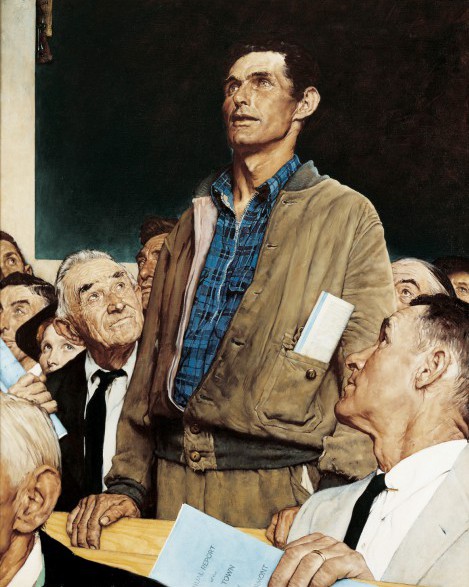
“Freedom of Speech” by Norman Rockwell

This happy Friday story is from The Daily Signal.

Excerpt:

In a unanimous decision, the Supreme Court struck down a town’s sign ordinance as an unconstitutional, content-based regulation of speech. This ruling for free speech means the government can’t pick and choose what speech deserves more protection based on the content of the speech.

Like most other towns in America, Gilbert, Ariz., regulates when, where and how signs may be displayed around town. Temporary non-commercial signs are classified by their content, and each category has its own set of regulations.

Real estate signs, for example, may be up to 80 square feet, and political signs may be up to 32 square feet; political signs may be displayed for four and a half months before an election, including in the public right of way; and homeowners’ association event signs may be displayed for 30 days.

The Good News Community Church, which holds services at different facilities such as local schools because it doesn’t have a permanent church, uses signs to invite people to services. Because the signs include directional information (i.e., an arrow pointing to the location of the service), they may not be bigger than 6 square feet and can go up only 12 hours before their Sunday services start, meaning the signs are posted late on Saturday night when they are hard to see in the dark.

The church challenged the town’s sign code in 2007 as an impermissible content-based restriction on speech in violation of the First Amendment. The district court in Arizona upheld the sign code, and the 9th Circuit Court of Appeals agreed, finding that there was no evidence that the town adopted its sign code for a discriminatory purpose.

Today, the Supreme Court ruled in favor of the Good News Community Church, concluding that these sign restrictions are content-based regulation because they define the categories of temporary, political and ideological signs on the basis of their messages and subject each category to different restrictions. As Justice Clarence Thomas points out,

If a sign informs its reader of the time and place a book club will discuss John Locke’s ‘Two Treatises of Government,’ that sign will be treated differently from a sign expressing the view that one should vote for one of Locke’s followers in an upcoming election, and both signs will be treated differently from a sign expressing an ideological view rooted in Locke’s theory of government.

The court found that these restrictions are subject to, and do not survive, strict scrutiny because the town did not demonstrate that the differentiation furthers a compelling governmental interest and is narrowly drawn. Assuming the town has a compelling interest in preserving its aesthetic appeal and traffic safety, the code’s distinctions are highly underinclusive.

Thus, the town cannot claim that placing strict limits on temporary directional signs is necessary to beautify the town when other types of signs create the same problem, and it did not show that temporary directions signs pose a greater threat to public safety than ideological or political signs.

Here’s the first amendment to the Constitution, which allows freedom of speech and free exercise of religion:

Congress shall make no law respecting an establishment of religion, or prohibiting the free exercise thereof; or abridging the freedom of speech, or of the press; or the right of the people peaceably to assemble, and to petition the Government for a redress of grievances.

Thank God that I live in a country where those words still have meaning, although you would never know it if you walked onto a university campus. Seems like free speech doesn’t apply there, because people on the secular left are so easily offended by different opinions than their own.

Religion and politics: Wayne Grudem’s 2012 Pulpit Freedom Sunday sermon

My church probably isn’t doing anything for Pulpit Freedom Sunday, because they are a gospel every week church. It’s really not clear to me whether my minister is even pro-life or pro-marriage, because he never talks about anything practical. However, I was able to dig up this 2012 sermon from Dr. Wayne Grudem, an amazing pastor who does have a position on many issues relevant to the Christian worldview.

The topic is “Moral and spiritual issues in the 2012 election”.

Here it is: (68 minutes, Dr. Grudem starts 4 minues in)

Details:

This message was delivered by Dr. Wayne Grudem at Calvary Chapel Chino Hills on Pulpit Freedom Sunday. Dr. Grudem addresses directly and poignantly the spiritual and moral issues we face in the upcoming 2012 Election. He urges believers to vote according to a Biblical world view. Dr. Grudem has an excellent understanding of not only the Bible and Theology, but also how the United States political system really works. He is author of the bestselling, “Systematic Theology” (used in numerous seminaries), “Politics According to the Bible,” and he is also the General Editor of the bestselling “ESV Study Bible.” Please dedicate an hour and listen to him; more importantly, please heed his wisdom and vote responsibly.

The sermon notes are free to download. (PDF) I recommend printing them to follow along with the sermon.

Here’s one of slides, just to show you what Wayne Grudem can do:

Pulpit Freedom Sunday: can your pastor do this?

Can your pastor do that? Mine can’t.

I think a lot of people like to think of Christianity as something that is about your personal well-being, or maybe your personal morality. If you attend a pretty typical gospel-every-week church, then you may never learn how the Christian worldview applies to the political issues of the day. It’s “too divisive”.

If you’re looking for the best book on the Bible and policy, it’s Wayne Grudem’s “Politics According to the Bible”. I really really endorse that book.

Supreme Court rules in favor of religious liberty and against labor unions

Life News first, on the Hobby Lobby religious liberty vs abortion subsidies case.

Excerpt:

The Supreme Court ruled today that the Christian-run Hobby Lobby doesn’t have to obey the HHS mandate that is a part of Obamacare that requires businesses to pay for abortion causing drugs in their employee health care plans.

The Obama administration was attempting to make Hobby Lobby and thousands of pro-life businesses and organizations comply with the HHS mandate that compels religious companies to pay for birth control and abortion-causing drugs for their employees. However, the U.S. Supreme Court today issued a favorable ruling in Sebelius v. Hobby Lobby Stores, Inc., a landmark case addressing the Constitutionally guaranteed rights of business owners to operate their family companies without violating their deeply held religious convictions.

Writing for the 5-4 majority, Justice Samuel Alito handed down the decision for the high court, saying, “The Supreme Court holds government can’t require closely held corporations with religious owners to provide contraception coverage.”

The court ruled that the contraception mandate violated the Religious Freedom and Restoration Act, a 1993 law and it held that the mandate “substantially burdens the exercise of religion” and that HHS didn’t use the “least restrictive means” to promote this government interest, tests required by RFRA.

“HHS’s contraception mandate substantially burdens the exercise of religion,” the decision reads, adding that the “decision concerns only the contraceptive mandate and should not be understood to mean that all insurance mandates.” The opinion said the “plain terms of Religious Freedom Restoration Act” are “perfectly clear.”

“If the owners comply with the HHS mandate, they believe they will be facilitating abortions, and if they do not comply, they will pay a very heavy price — as much as $1.3 million per day, or about $475 million per year, in the case of one of the companies,” the opinion reads. “If these consequences do not amount to a substantial burden, it is hard to see what would.”

[…]The Hobby Lobby decision only applies to companies, including Conestoga Wood Specialties, which had a companion case pending before the Supreme Court. Non-profit groups like Priests for Life and Little Sisters are still waiting for a ruling about their right to opt out of the mandate.

[…]Americans “don’t give up their rights to religious freedom just because they open a family-run business,” Lori Windham, senior counsel for the Becket Fund for Religious Liberty, which represented Hobby Lobby. This is a landmark decision for religious freedom. The Supreme Court recognized that Americans do not lose their religious freedom when they run a family business.”

Barbara Green, co-founder of Hobby Lobby, also responded: “Our family is overjoyed by the Supreme Court’s decision. Today the nation’s highest court has re-affirmed the vital importance of religious liberty as one of our country’s founding principles. The Court’s decision is a victory, not just for our family business, but for all who seek to live out their faith. We are grateful to God and to those who have supported us on this difficult journey.”

You can read the reactions from people on the left on Twitter, in which they threaten to burn Hobby Lobby stores to the ground. Note that Hobby Lobby is only objecting to covering 4 out of 20 prescribed contraceptives required by Obamacare, just the ones that can cause abortions. They don’t want to pay money to other people to make it cheaper for them to kill unborn children. Makes sense, right? Not to the left.

And now the second decision, which was reported on in the Wall Street Journal.

Excerpt:

Home-based care workers in Illinois aren’t full-fledged public employees so they can’t be forced to pay dues to a union they don’t want to join, a divided Supreme Court said. But the limited ruling stopped short of barring organized labor from collecting fees from government workers who object to union representation.

The court, in a 5-4 opinion by Justice Samuel Alito, said the aides weren’t full public employees even though they are paid by the state with Medicaid funds. Because of that status, the workers—often family members of the disabled—couldn’t be required to pay what are known as agency fees to a public-sector union that provides them representation.

Justice Alito said requiring mandatory union fees violated the First Amendment rights of aides who didn’t want to join or support the union. Monday’s ruling split along ideological lines, with conservative justices in the majority and liberal justices in the dissent.

The high court avoided the broadest possible ruling in the case, declining a request by the challengers to limit the ability of public-sector unions to collect fees from all workers who decline to join labor unions. Labor lawyers said that while unions dodged that bullet in Monday’s ruling, they may not be able to in the future. The ruling “sets the table for more challenges to agency fees down the road. And this fact will not make unions sleep any easier,” said Michael Lotito, a labor lawyer at Littler Mendelson P.C.

[…]The National Right To Work Legal Defense Foundation, an antiunion group in Springfield, Va., sued on behalf of eight Medicaid-paid aides, some of whom are covered by the SEIU agreement, saying the Illinois arrangement had forced parents and other relatives taking care of disabled people into union associations they didn’t want. The foundation said Monday’s ruling would free “thousands of home-care providers from unwanted union control.”

And lastly, somehow I missed a third good Supreme Court decision, which unanimously sided with the the pro-life Susan B. Anthony list. That decision came out in mid-June.