Violence and unrest in Honduras & China – we need to continue to stand up for human rights and democracy around the world!
I regret the military takeover in Honduras, but it’s clear President Zelaya was in violation of his country’s constitution.
The Hill writes:
McCain’s statement runs in direct conflict with the Obama administration’s position on the coup. Last week, the president said that the coup was “not legal” and that Zelaya is still the president of the Latin American nation.
Members of Congress have generally been mum on the situation, but some tensions are beginning to show, especially amongst Republicans. Rep. Connie Mack (R-Fla.) said that Zelaya “trampled on the Honduran constitution” and called the Honduran president’s effort to extend his term a “blatant power grab.”
Zelaya proposed a constitutional referendum that would allow him to seek reelection, superceding term limits layed out in the country’s constitution. Members of the Honduran military arrested him and forced him into exile on June 29.
Secretary of State Hillary Clinton met with the ousted president today.
The Honduran Constitution specifies that Presidents are only allowed to serve one-term. The current President Zeyala decided that things would be better if he were allowed to serve indefinitely. He tried to arrange a referendum to redo the Constitution so that he could serve a second term.
The Supreme Court declared that the Constitution does not allow the president to call a referendum, only the Congress can do that. So, they ordered the army to prevent the dictator from carrying out his plan to seize power anyway.
But Obama loves communist dictators. He would not side with the Iranian people against their Islamo-fascist dictator, and he will not side with the Honduran people against their communist dictator. It makes you wonder what Obama has against Constitutions, liberty, free market capitalism and limits on power, doesn’t it?
The latest
Obama’s UN representative introduced a resolution in the United Nations, along with other Marxist dictatorships in Venezuela and Bolivia, to support the Marxist dictator of Honduras.
The U.S. co-sponsored a successful U.N. resolution supporting Honduras’s ousted leader Tuesday as Republicans began to speak out against the Obama administration’s condemnation of the overthrow.
Manuel Zelaya, who was arrested and forced into exile Sunday, addressed the U.N. General Assembly after the unanimous vote on the resolution sponsored in part by Bolivia, Mexico, Venezuela and the United States.
“The resolution that the United Nations has just adopted unanimously … expresses the indignation of the people of Honduras and the people worldwide,” said Zelaya, who began his speech by thanking Venezuela and Ecuador.
Obama even wants to speak with the exiled dictator:
…”I believe, if he — if he does come either today or tomorrow, that he will likely meet with officials from the State Department, some of whom, as I said, have been in contact,” White House press secretary Robert Gibbs said in Tuesday’s briefing, repeating this when pressed by a reporter about whether Zelaya would meet with Obama.
Venezuelan President Hugo Chavez has urged Zelaya to try to speak with Obama while in D.C., saying the American president’s support would “deliver a major blow” to Honduras’s interim government.
But the Republicans in Congress are siding with the Honduran people, and against socialist dictators:
“Manuel Zelaya trampled the Honduran Constitution by pushing for his illegal referendum to allow him to rule indefinitely, and by firing the top military official, General Romeo Vasquez Velasquez, when he refused to comply with Zelaya’s unconstitutional orders,” Rep. Connie Mack (R-Fla.) said in a statement to The Hill on Tuesday.
“There is little doubt that Zelaya, in his blatant power grab, has moved Honduras down a dangerous path toward less freedom, less security, and less prosperity. He consistently ignored the checks and balances which are essential to a democratic government.”
The referendum had been judged illegal by Honduras’s highest court and was opposed widely through political and military circles, including within Zelaya’s own party.
Hondurans are understandably afraid that, backed by Chávez agents and money, it could lead to similar antidemocratic subversion there. In Tegucigalpa yesterday, thousands demonstrated against Mr. Zelaya, and new deputy foreign minister Marta Lorena Casco told the crowd that “Chávez consumed Venezuela, then Bolivia, after that Ecuador and Nicaragua, but in Honduras that didn’t happen.”
It’s no accident that Mr. Chávez is now leading the charge to have Mr. Zelaya reinstated, and on Monday the Honduran traveled to a leftwing summit in Managua in one of Mr. Chávez’s planes. The U.N. and Organization of American States are also threatening the tiny nation with ostracism and other punishment if it doesn’t readmit him.
…As for the Obama Administration, it seems eager to “meddle” in Honduras in a way Mr. Obama claimed was counterproductive in Iran. Yet the stolen election in Iran was a far clearer subversion of democracy than the coup in Honduras. As a candidate, Mr. Obama often scored George W. Bush’s foreign policy by saying democracy requires more than an election — a free press, for example, civil society and the rule of law rather than rule by the mob. It’s a point worth recalling before Mr. Obama hands a political victory to the forces of chavismo in Latin America.
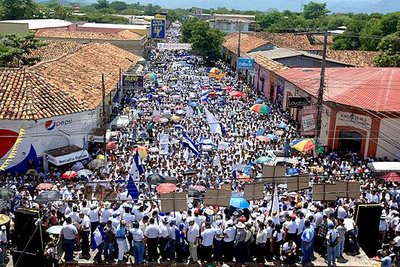
Meanwhile, the Honduran people marched in the streets against Obama and his communist dictator buddies, reports Gateway Pundit.
Hondurans protest against the unilateral meddling in their national affairs by Cowboy Socialist Barack Obama
Imagine what conservative Christian Republicans like Ronald Reagan and George W. Bush would have done in a similar situation. They would have defended the rights and liberties of the people from the arbitrary power of socialist dictators. But they understood the value of liberty, democracy and human rights. They were prepared to take stands against the tyrannies of communism and fascism. They did not want to be loved by evil tyrants.
“All of the legal defense funds out there, they’re looking for people with Court of Appeals experience. Because it is — Court of Appeals is where policy is made. And I know, and I know, that this is on tape, and I should never say that. Because we don’t ‘make law,’ I know. [Laughter from audience] Okay, I know. I know. I’m not promoting it, and I’m not advocating it. I’m, you know. [More laughter] Having said that, the Court of Appeals is where, before the Supreme Court makes the final decision, the law is percolating. Its interpretation, its application.
Verum Serum’s May 5th post has some quotes from a speech she gave at UC Berkeley, at a conference sponsored by the Berkeley La Raza Law Journal.
Here’s one of the quotes from Verum Serum:
Whether born from experience or inherent physiological or cultural differences, a possibility I abhor less or discount less than my colleague Judge Cedarbaum, our gender and national origins may and will make a difference in our judging. Justice O’Connor has often been cited as saying that a wise old man and wise old woman will reach the same conclusion in deciding cases…I am also not so sure that I agree with the statement. First, as Professor [Martha] Minnow has noted, there can never be a universal definition of wise. Second, I would hope that a wise Latina woman with the richness of her experience would more often than not reach a better conclusion than a white male who hasn’t lived that life. (emphasis added)
Nice Deb comments: “Imagine the hue and cry if a white male had said that about a Hispanic female.”
And one more from Verum Serum:
I willingly accept that we who judge must not deny the differences resulting from experience and heritage but attempt, as the Supreme Court suggests, continuously to judge when those opinions, sympathies, and prejudices are appropriate.
There is always a danger embedded in relative morality, but since judging is a series of choices that we must make, that I am forced to make, I hope I can make them by informing myself on the questions I must not avoid asking and continuously pondering. We…must continue individually and in voices united in organizations that have supported this conference, to think about these questions and to figure out how we go about creating the opportunity for there to be more women and people of color on the bench so we can finally have statistically significant numbers to measure the differences we will and are making.
You need to click through and read the rest of the quotes. Heritage Foundation has more quotes from the same speech, and some other quotes from her published papers.
Here’s one of the additional quotes from her published work:
The constant development of unprecedented problems requires a legal system capable of fluidity and pliancy. Our society would be strait-jacketed were not the courts, with the able assistance of the lawyers, constantly overhauling the law and adapting it to the realities of ever-changing social, industrial and political conditions; although changes cannot be made lightly, yet law must be more or less impermanent, experimental and therefore not nicely calculable. Much of the uncertainty of law is not an unfortunate accident: it is of immense social value.
And what about her judicial temperament, which is of critical importance?
John Lott has this quote on his blog from the Almanac of the Federal Judiciary:
Sotomayor can be tough on lawyers, according to those interviewed. “She is a terror on the bench.” “She is very outspoken.” “She can be difficult.” “She is temperamental and excitable. She seems angry.” “She is overly aggressive–not very judicial. She does not have a very good temperament.” “She abuses lawyers.” “She really lacks judicial temperament. She behaves in an out of control manner. She makes inappropriate outbursts.” “She is nasty to lawyers. She doesn’t understand their role in the system–as adversaries who have to argue one side or the other. She will attack lawyers for making an argument she does not like.”
The most complete effort so far to evaluate federal appellate judges is this paper by Stephen Choi and Mitu Gulati. Choi and Gulati use data from Lexis to measure three aspects of the judge’s performance—productivity, opinion quality, and independence.
…To determine how Sotomayor would do in the ranking, I had some research assistants collect her data for the years 1999-2001. To address the “freshman effect” (the possibility that her statistics are worse for her earliest years because of inexperience), we also looked at her data from 2006.
…Productivity. Judges write opinions, which provide guidance to lawyers and the public. All else equal, a judge who writes more opinions is more productive, and provides a greater social benefit. Over the three year period from 1998 to 2000, the most productive judge published 269 opinions, the least productive judge published 38 opinions, and the mean was 98.1. For the comparable period from 1999-2001, Judge Sotomayor published 73 opinions. She would have ranked 68th out of 98.
Quality (1). Choi and Gulati measure quality by counting citations to a judge’s top twenty opinions… The range is 96 to 734, with a mean of 277.9. Judge Sotomayor’s statistic is 231, which would place her 59th.
Quality (2). Judge Sotomayor’s opinions from 1999-2001 were cited 289 times in law reviews and other legal periodicals through May 31, 2004… Sotomayor would have ranked 65th.
Quality (3). Choi and Gulati also check what they call “invocations”—the frequency with which opinions written by other judges refer to the judge in question by name… Invocations range from 0 to 175 (excluding two outliers, the highest is 23), with a mean of 32. Judge Sotomayor was invoked 0 times (tied for last).
Independence. Judges should decide cases in a non-partisan way… A score of 0 means that a judge is just as likely to disagree as agree with a co-partisan (or opposite-partisan). Negative scores mean that a judge is more likely to agree with co-partisans. Judge Sotomayor’s score is -0.153 …which would have placed her 55th.
Judge Sotomayor is a liberal judicial activist of the first order who thinks her own personal political agenda is more important that the law as written. She thinks that judges should dictate policy, and that one’s sex, race, and ethnicity ought to affect the decisions one renders from the bench.
She reads racial preferences and quotas into the Constitution, even to the point of dishonoring those who preserve our public safety. On September 11, America saw firsthand the vital role of America’s firefighters in protecting our citizens. They put their lives on the line for her and the other citizens of New York and the nation. But Judge Sotomayor would sacrifice their claims to fair treatment in employment promotions to racial preferences and quotas. The Supreme Court is now reviewing that decision.
She has an extremely high rate of her decisions being reversed, indicating that she is far more of a liberal activist than even the current liberal activist Supreme Court.
Isn’t there are word to describe a person that discriminates against people based on their race?

 WINTERY KNIGHT