
Tag Archives: Stephen Harper

Could Obama have done better? He could learn from Canada’s success

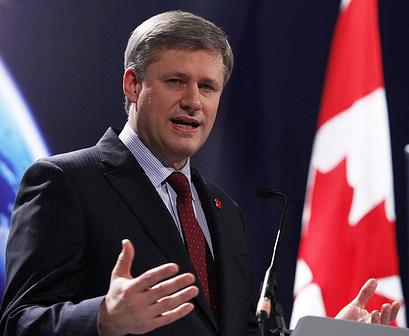
Prime Minister Stephen Harper

Here’s an editorial from Investors Business Daily.

Excerpt:

Away from the low growth and high regulation of an America under Washington’s thumb, our northern neighbor is economically strong. As 2011 ends, Canada has announced yet another tax cut — and will soar even more.

The Obama administration and its economic czars have flailed about for years, baffled about how to get the U.S. economy growing.

In reality, the president need look no further than our neighbor, Canada, whose solid growth is the product of tax cuts, fiscal discipline, free trade, and energy development. That’s made Canada a roaring puma nation, while its supposedly more powerful southern neighbor stands on the outside looking in.

On Thursday, Canadian Prime Minister Stephen Harper announced that he will slash corporate taxes again on Jan. 1 in the final stage of his Economic Action Plan, dropping the federal business tax burden to just 15%.

Along with fresh tax cuts in provinces such as Alberta, total taxes for businesses in Canada will drop to 25%, one of the lowest in the G7, and below the Organization of Economic Cooperation and Development average.

“Creating jobs and growth is our top priority,” said Minister Jim Flaherty. “Through our government low-tax plan … we are continuing to send the message that Canada is open for business and the best place to invest.”

It’s not just that Canada’s conservative government favors makers over takers. Harper’s also wildly popular for shrinking government. “The Harper government has pursued a strategic objective to disembed the federal state from the lives of citizens,” wrote University of Calgary Professor Barry Cooper, in the Calgary Herald.

Harper also has made signing free trade treaties his priority. Canada now has 11 free trade pacts in force, and 14 under active negotiation — including pacts with the European Union and India, among others.

“We believe in free trade in Canada, we’re a free-trading nation. That’s the source of our strength, our quality of life, our economic strength,” Flaherty said last month.

Lastly, Canada has pursued its competitive advantage — oil. And it did so not through top-down “industrial policy,” but by getting government out of the way.

Harper has enacted market-friendly regulations to accomplish big things like the Keystone Pipeline — and urged President Obama to move forward on it or else Canada would sell its oil to China.

These policies have been well-known since the Reagan era. But in a country that’s been institutionally socialist since the 1950s, Harper’s moves represent a dramatic affirmation for free market economics.

For Canada, they’ve had big benefits.

Canada’s incomes are rising, its unemployment is two percentage points below the U.S. rate, its currency is strengthening and it boasts Triple-A or equivalent sovereign ratings across the board from the five top international ratings agencies, lowering its cost of credit.

Is it too much to ask Washington to start paying attention to the Canadian success story?

These sound principles work every time they are tried, and they have led to a transformation in Canada.

Although this article doesn’t mention it, Stephen Harper is also the most solid statesman on foreign policy issues as well.

And here’s a view from up north from Canadian journalist Brian Lilley.

Excerpt:

Prime Minister Stephen Harper has put out his own list of accomplishments for the year that just ended but here are a few of the key conservative minded actions that spring to mind for me.

  • Ending political welfare. The per-vote subsidy that made political parties lazy and unresponsive to the voters of this country and insulated them from angering their core supporters will be gone by 2015-2016. Legislation ending the subsidy has already passed but the parties are slowly being weaned off the money and will get smaller amounts each year until the subsidy is gone.
  • They saw the light of common sense and released the names of those on their wanted list of suspected foreign war criminals. These were people that officials admitted should not be in the country, had been ordered out but that were still in Canada. At first officials would only admit there was a list of suspected war criminals but not say who they were. After much pressure, common sense won the day.
  • Ending the insane rules that would see farmers from certain provinces jailed for daring to sell their wheat to the customer of their choice. The Canadian Wheat Board still exists for those that want to use its centralized system. For those that want freedom, they now have that choice.
  • While much attention has been paid to Bill C-10, the omnibus crime bill, the government has passed C-2 (the mega-trials bill), this bill will make it easier to conduct the mega-trials now associated with organized crime without infringing on the right to a fair trial.
  • While the bill to end the gun registry has not been passed yet, it has been introduced and will pass early this year.
  • Immigration. On this file the Conservatives continue to push for ever higher numbers of newcomers while keeping those skeptical of high immigration onside by cracking down on fraud, cleaning up the system and putting Canada first.

Another thought for those, often myself included, that like to say this government is not conservative enough.

Lilley also notes that electing Harper presented a national day care program (which punishes families with stay-at-home), increasing unemployment benefits (which encourages people not to work), etc.


Canada’s economic boom: low tariffs, low corporate tax and more oil drilling

Prime Minister Stephen Harper

From Canoe.

Excerpt:

Finance Minister Jim Flaherty announced Sunday the government will scrap 70 tariff items to save Canadian businesses about $32 million a year.

“This builds on our government’s commitment in Budget 2010 to make Canada a tariff-free zone for industrial manufacturers,” Flaherty said in a statement. “By lowering costs for these businesses, we are enhancing their ability to compete in domestic and foreign markets and helping them invest and create jobs here at home.”

Various sectors — including food processing, apparel, electrical equipment and furniture — will benefit from the move.

The Conservatives had previously eliminated the duty on imported machinery and equipment in an attempt to make Canada a tariff-free zone for industrial manufacturers by 2015.

The Tories say that since 2009 they have eliminated more than 1,800 tariff items and have provided more than $435 million in annual tariff relief to Canadian businesses.

According to the leftist CTV news, Canada also has lower corporate taxes.

Excerpt:

The study released Wednesday by KPMG International found Canada’s corporate tax rate has dropped by more than 16 per cent over the last 11 years.

Canadian companies are actually paying less than their American counterparts.

On average, Canadian companies pay 28 per cent of their income in federal and provincial tax, well below the 40 per cent paid by American companies.

But Canada’s corporate tax rate is higher than Europe’s 20 per cent and the OECD average of 26 per cent.

Canadian corporate taxes fell three per cent in 2011, from 31 per cent in 2010.

“Canada’s corporate tax rate falls around the middle of the pack among the OECD countries,” said Elio Luongo, KPMG’s Canadian Managing Partner for Tax.

“But Canada’s general corporate tax rate is anticipated to continue to fall in 2012, when the federal tax rate will be 15 per cent, versus 16.5 per cent in 2011.”

I’ve written before about how Democrats oppose the job creation that would occur if the United States developed energy in Alaska, the Gulf of Mexico and the Ohio shale. Additionally, Obama has also opposed building the Keystone XL pipeline, which would have created 20,000 jobs paid for by a Canadian company. But Canada has no problems with developing their own energy resources, because their government operates independently of the environmentalist left.

Excerpt:

As world leaders gather in South Africa to discuss climate change this week and next, Canada’s environment minister says he plans to defend Alberta’s oilsands and is willing to argue they are an “ethical” and reliable energy source.

Heading into the 17th Conference of the Parties meeting, Environment Minister Peter Kent says he will not sign on to any deals that mandate some countries reduce greenhouse gas emissions while others don’t — as his government argues was the case under the Kyoto Protocol. He is also unequivocal in his defence of northern Alberta’s bitumen production, a position he expects will be supported by Alberta Environment Minister Diana McQueen when she joins him at the end of the week.

“We still need to — and the industry needs to and our provincial partners need to — be aggressive in ensuring international friends and neighbours and customers recognize Alberta’s heavy oil is no different from heavy oil produced in any number of other countries which don’t receive nearly the negative attention or criticism,” he says. “It is a legitimate resource.”

Kent has made headlines in the last year by arguing that Alberta’s oil is “ethical.”

“We talk about this on quite a regular basis,” Kent says. “I think it’s important we correct where we find … misunderstanding, misinformation or deliberate ignorance to demonize, to criticize and to attempt … to create a boycott.”

In January, on his second day as environment minister, Kent referred to Alberta’s oilsands product as “ethical oil” during an interview with a newspaper reporter.

Reports immediately linked Kent’s comments to the title of conservative activist Ezra Levant’s recent book, Ethical Oil: The Case for Canada’s Oil Sands.

The book essentially compares Canada’s human rights record to those of other oil-producing countries, and argues Canada’s “ethical oil” is preferable to “conflict oil” produced in countries with poor human rights records, such as Sudan, Venezuela, Saudi Arabia or Iran. The argument removes environmental issues, such as greenhouse gas emissions, from the equation, though Levant notes Alberta’s data on environmental issues is more transparent than information shared by other countries.

So in total I’ve presented three reasons why the Canadian economy is booming, while the American economy is stuck in neutral. Obama opposes free trade, lower corporate taxes and domestic energy production. When you elect a socialist lawyer, you get a Greece/Spain economy. When you elect a capitalist economist, you get Canada’s booming economy, and consequently, a lower unemployment rate. Recall that our recession began exactly when we elected Nancy Pelosi to the House leadership and Harry Reid to the Senate leadership in 2007. Democrats wreck economies. There is no reason why America cannot be more prosperous than Canada, but we have to not elect an abject buffoons as our leaders.

Stephen Harper says Islamicism is the biggest threat to Canada

From CBC. (H/T Blazing Cat Fur)

Excerpt:

In an exclusive interview with CBC News, Prime Minister Stephen Harper says the biggest security threat to Canada a decade after 9/11 is Islamic terrorism.

In a wide-ranging interview with CBC chief correspondent Peter Mansbridge that will air in its entirety on The National Thursday night, Harper says Canada is safer than it was on Sept. 11, 2001, when al-Qaeda attacked the U.S., but that “the major threat is still Islamicism.”

“There are other threats out there, but that is the one that I can tell you occupies the security apparatus most regularly in terms of actual terrorist threats,” Harper said.

Harper cautioned that terrorist threats can “come out of the blue” from a different source, such as the recent Norway attacks, where a lone gunman who hated Muslims killed 77 people.

But Harper said terrorism by Islamic radicals is still the top threat, though a “diffuse” one.

“When people think of Islamic terrorism, they think of Afghanistan, or maybe they think of some place in the Middle East, but the truth is that threat exists all over the world,” he said, citing domestic terrorism in Nigeria.

The prime minister said home-grown Islamic radicals in Canada are “also something that we keep an eye on.”

Harper said his government will bring back anti-terrorism clauses that were brought in in 2001 but were sunset in 2007 amid heated political debate.

Can you imagine Janet Napolitano taking the threat of Islamic terrorism as seriously? She thinks that screening Muslim males under 35 who enter the United States is “not good logic“. But groping babies and grannies is good logic.

Here’s more:

Janet Napolitano, 51, is President Obama’s new Homeland Security Secretary. She spoke with SPIEGEL about immigration, the continued threat of terrorism and the changing tone in Washington.

SPIEGEL: Madame Secretary, in your first testimony to the US Congress as Homeland Security Secretary you never mentioned the word “terrorism.” Does Islamist terrorism suddenly no longer pose a threat to your country?

Napolitano: Of course it does. I presume there is always a threat from terrorism. In my speech, although I did not use the word “terrorism,” I referred to “man-caused” disasters. That is perhaps only a nuance, but it demonstrates that we want to move away from the politics of fear toward a policy of being prepared for all risks that can occur.

Making judgments is wrong for people on the secular left – everyone has to be equal, and no one is ever right or wrong. This moral equivalence is going to get a lot of people killed, as in the Major Nidal Hasan incident. Political correctness kills, but you won’t get that from Stephen Harper.

“You’re not using good logic there. You’ve got to use actual intelligence that you received. And, so, you might — all you’ve given me is a kind of status. You have not given me a technique for tactic or behavior. Something that would suggest somebody is not Muslim, but Islamic, that has actually moved into the category of violent extremists,” Homeland Security Secretary Janet Napolitano said at a forum on U.S. security and preventing terrorist attacks.

“We have ways to make some of those cuts. And they involve the intel that comes in, the analysis that goes on. For example, we often times, for travelers entering the United States, we won’t not do what is called a secondary inspection just because they are a 35-year- old male who appears to be Muslim, whatever that means. But we know from intelligence that if they have a certain travel pattern over a certain period of time, that should cause us to ask some more significant questions than if we don’t.”