Tag Archives: Spending

Would the Buffett Rule “stabilize our debt and deficits”?

The Buffett Tax (click for larger image)

The Wall Street Journal assesses Obama’s claims about the Buffett Tax.

Excerpt:

Forget Warren Buffett, or whatever other political prop the White House wants to use for its tax agenda. This week the Administration officially endorsed what in essence is the Obama Rule: Taxes must be high simply to spread the wealth, never mind the impact on the economy or government revenue. It’s all about “fairness,” baby.

This was long apparent to those fated to closely watch the 2008 campaign, but some voters might have missed the point amid the gauzy rhetoric about hope and change. Now we know without any doubt. White House aides made it official Tuesday in their on-the-record briefing on the new federal minimum tax that travels under the political alias known as the “Buffett rule.”

The policy goal is to impose an effective minimum tax of 30% on the income of anyone who makes more than $1 million a year. When President Obama first proposed this new minimum tax he declared that the rule “could raise enough money” so that we “stabilize our debt and deficits for the next decade.”

Then he added: “This is not politics; this is math.” Well, remedial math maybe.

The Obama Treasury’s own numbers confirm that the tax would raise at most $5 billion a year—or less than 0.5% of the $1.2 trillion fiscal 2012 budget deficit and over the next decade a mere 0.1% of the $45.43 trillion the federal government will spend. When asked about those revenue projections, White House aide Jason Furman backpedaled from Mr. Obama’s rationale by explaining that the tax was never intended “to bring the deficit down and the debt under control.”

So if it doesn’t do what Obama says it’s supposed to do, what would really do?

The Buffett rule is really nothing more than a sneaky way for Mr. Obama to justify doubling the capital gains and dividend tax rate to 30% from 15% today. That’s the real spread-the-wealth target. The problem is that this is a tax on capital that is needed for firms to grow and hire more workers. Mr. Obama says he wants an investment-led recovery, not one led by consumption, but how will investment be spurred by doubling the tax on it?

The only investment and hiring the Buffett rule is likely to spur will be outside the United States—in China, Germany, India, and other competitors with much more investment-friendly tax regimes. The Buffett rule would give the U.S. the fourth highest capital gains rate among OECD nations, according to a new study by Ernst & Young, to go along with what is now the highest corporate tax rate (a little under 40% for the combined federal and average state rate). That’s what happens when politicians pursue fairness over growth.

When you make it less attractive for people with capital to invest their capital here at home then they will take their capital and invest it abroad. What Obama’s proposal accomplishes is to outsource jobs – the exact thing that he is always complaining about. It’s higher taxes and more regulation, especially EPA regulation, that causes capital (and consequently jobs) to move overseas. If you want capital to come into America, you lower the tax rates.

In other news, the Obama administration is suing a company owned by Warren Buffett for unpaid taxes.
Obama to hand out millions of taxpayer dollars in green energy firm bailouts

From The Hill.

Excerpt:

The Energy Department said Thursday it expects to begin tentatively approving new taxpayer-backed loans for renewable energy projects in the coming months.

The announcement comes about seven months after Solyndra, the California solar firm that received a $535 million loan guarantee from the administration in 2009, went bankrupt, setting off a firestorm in Washington.

[…][Frantz] defended the loan program from GOP critics, who have alleged that the administration is wasting taxpayer money by supporting risky renewable energy projects.

“By any measure, the Energy Department’s loan programs have helped the United States keep pace in the fierce global race for clean energy technologies,” Frantz wrote.

This direction is consistent with Obama’s own words:

Despite some green energy failures, such as the bankrupt Solyndra solar panel company and weak-selling Chevy Volt, President Barack Obama said that he wanted to “double down” on green energy spending, and would do what he could even without Congress to subsidize these companies.

Obama’s assertions, at the University of Miami on Thursday, come after numerous reports of green energy firms that received large sums of federal loans and grants but which have either declared bankruptcy or hit financial problems. In his remarks, Obama sought to draw a contrast between subsidies to green energy firms and $4 billion in tax breaks for oil and gas companies.

“A century of subsidies to the oil companies is long enough,” Obama said. “It’s time to end taxpayer giveaways to an industry that’s never been more profitable, and double-down on a clean energy industry that’s never been more promising.”

He wants to “double down” on handing out subsidies and bailouts to certain companies. What is the goal of this government spending? Is it a good deal for taxpayers? Who benefits?

What does giving money to green energy firms really accomplish?

Let’s see an example. BrightSource, a company owned by the Kennedys, got 1.4 billion of taxpayer dollars:

President John F. Kennedy’s nephew, Robert Kennedy, Jr., netted a $1.4 billion bailout for his company, BrightSource, through a loan guarantee issued by a former employee-turned Department of Energy official.

[…]The details of how BrightSource managed to land its ten-figure taxpayer bailout have yet to emerge fully. However, one clue might be found in the person of Sanjay Wagle.

Wagle was one of the principals in Kennedy’s firm who raised money for Barack Obama’s 2008 presidential campaign. When Obama won the White House, Wagle was installed at the Department of Energy (DOE), advising on energy grants.

From an objective vantage point, investing taxpayer monies in BrightSource was a risky proposition at the time. In 2010, BrightSource, whose largest shareholder is Kennedy’s VantagePoint Partners, was up to its eyes in $1.8 billion of debt obligations and had lost $71.6 million on its paltry $13.5 million of revenue.

[…]BrightSource touted the Ivanpah project as a green jobs creator. Yet as its own website reveals, the thermal solar plant will only create 1,400 jobs at its peak construction and 650 jobs annually thereafter. Even using the peak estimate of 1,400 jobs, that works out to a cost to taxpayers of $1 million per job created.

Here’s another example of giving money to green energy firms: Solyndra, which got $535 million taxpayer dollars.

Excerpt:

George Kaiser, the billionaire investor and fundraiser for President Barack Obama, discussed Solyndra LLC with administration officials, renewing debate about political influence in U.S. support for the company.

A March 5, 2010, communication from Kaiser to representatives of his family foundation, the biggest private investor in Solyndra, and its venture-capital arm said the solar-panel maker came up in a meeting with “administration folks” a few weeks earlier.

“Every one of them responded simultaneously about their thorough knowledge of the Solyndra story, suggesting it was one of their prime poster children,” Kaiser, whose family foundation invested in Solyndra, wrote in the e-mail released today by Republican lawmakers.

Kaiser’s role has been among the subjects of a congressional inquiry into Solyndra since theCalifornia company that received a $535 million U.S. loan guarantee filed for bankruptcy in September.

The e-mail and others released today contradict White House statements that “no political influence was brought to bear” and Kaiser “never discussed Solyndra during any of his 17 visits to the White House,” Representatives Fred Upton of Michigan and Cliff Stearns of Florida, who are leading a House Energy and Commerce Committee probe, said in a letter to White House Counsel Kathryn Ruemmler.

This is an election year, and Obama’s fundraisers would need to be paid off with taxpayer money first, if they are going to be able to turn around and donate some of it back to his election campaign.

To me, Obama’s only plan for a recovery is to keep spending and spending and spending. And what is he spending? He is spending away the future  prosperity of the next generation of Americans in order to buy votes from the current generation of Americans. What other President would be so incompetent as to blow through trillions and trillions of dollars in “stimulus” spending and get a lower number of working Americans on the other side? We elected a wastrel and he is doing what wastrels do – wasting money. It’s not even his own money – it’s your children’s money. And the worse part is that he gets annoyed when people don’t worship him for his failure – as if we should praise his high-minded rhetoric even when he fails to produce results.

Number of Americans not in labor force hits record high of 87,897,000

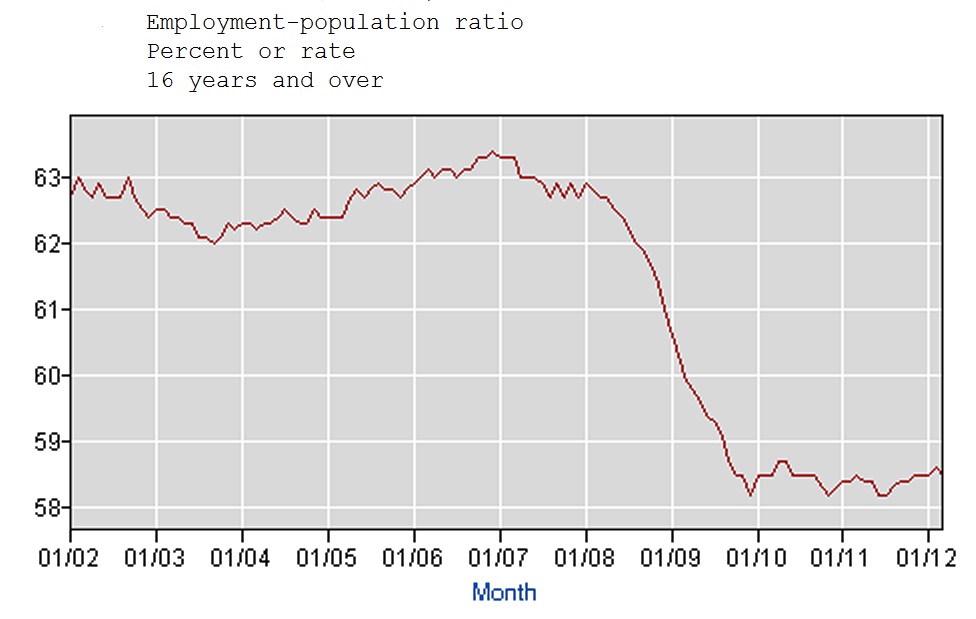
Employment to population ratio down 4.5% since Democrats took the House and Senate in January 2007
Employment to population ratio down 4.5% since Democrats took control of the House and Senate in January 2007

The Obama administration has pursued an economic policy of raising taxes on job creators, imposing regulatory burdens on businesses and shoveling mountains of taxpayer money into the hands of green energy firms which are often linked to Democrat fundraisers. Does it work to create jobs? Let’s see.

A record number of Americans are unemployed

From Breitbart.

Excerpt:

Amid disappointing unemployment numbers that fell 80,000 jobs short of projections, another number is raising eyebrows: the number of Americans not in the labor force has hit a record high 87,897,000.

This figure explains why overall unemployment dropped from 8.3% to 8.2%, as the Department of Labor’s unemployment figure does not include people who have given up hope and are not actively seeking employment.

When the number of individuals who have stopped looking for a job and/or who are working part-time but desire full-time employment is included–a figure known as the “underemployment rate”–real unemployment stands at 19.1%.

If you want to know if the President is doing a good job of creating jobs, just count the number of people who are unemployed. If the number of people who are unemployed is at a RECORD HIGH, then you need to elect a new President. Preferably someone who understands basic economics.

The real unemployment rate is 14.5%

From the American Enterprise Institute.

Excerpt:

Recall that back in 2009, White House economists Jared Bernstein and Christina Romer used their old-fashioned Keynesian model to predict how the $800 billion stimulus would affect employment. According to their model—as displayed in the above chart, updated—unemployment should be around 5.8% today.

But the true measure of U.S. unemployment is far worse:

1. If the size of the U.S. labor force as a share of the total population was the same as it was when Barack Obama took office—65.7% then vs. 63.8% today down from last month—the U-3 unemployment rate would be 10.9%.

2. But what if you take into the account the aging of the Baby Boomers, which means the labor force participation (LFP) rate should be trending lower. Indeed, it has been doing just that since 2000. Before the Great Recession, the Congressional Budget Office predicted what the LFP would be in 2012, assuming such demographic changes. Using that number, the real unemployment rate would be 10.5%.

3. Of course, the LFP rate usually falls during recessions. Yet even if you discount for that and the aging issue, the real unemployment rate would be 9.4%.

4. Then there’s the broader, U-6 measure of unemployment which includes the discouraged plus part-timers who wish they had full time work. That unemployment rate, perhaps the truest measure of the labor market’s health, is still a sky-high 14.5%.

5. The employment-population ratio dipped to 58.5% vs. 61% in December 2008. An historically low level of the U.S. population is actually working.

People keep talking about intelligent Barack Obama is. But shouldn’t we judge a person’s intelligence based on what they can produce? If you measure Obama’s intelligence based on his results – adding trillions and trillions of dollars to the debt while lowering the number of people who have jobs to a record low – then a fair-minded observer would say that Barack Obama is a person of low intelligence. He simply is out of his league. He would be out of his league if he tried to run a lemonade stand. If no one – Republican or Democrat – would hire this man to work in a private business that they owned, why would we ever elect him to be President?