Stuart Schneiderman linked to this article on his blog “Had Enough Therapy?” and I found it worth the read. The article starts by noting that France and Greece both voted against austerity, which means they want someone else to keep paying for their benefits, and they aren’t willing to grow up and recognize that no one wants to. But there’s an additional problem – the problem of bank runs. People who have money on deposit in banks in countries that have a lot of debt are movie it out, which may cause some really bad problems going forward.
Here’s an excerpt on the problem of bank runs:
Bank runs, even virtual ones, are the method by which public fear can blow up the eurozone. A bank run, as hundreds of thousands of depositors decide to pull their money out of a bank or a banking system at the same time, is the financial equivalent of a dam break. Banks, even very well run ones, never have all the money that their customers have deposited in their vaults. They lend that money out to other people, and because they charge borrowers a higher rate on their loans than they pay savers on their deposits, they make money.
[…]When borrowers can’t repay their loans, the bank sooner or later has to “write down” the value of those loans. In bad economic times, when borrowers are going bankrupt and the collateral on their loans loses value, banks can make huge losses. This is how Ireland lost its shirt; the banking system collapsed as the Irish real estate bubble burst, making building contractors and home owners bankrupt all over Ireland, and making the real estate that served as collateral for their loans almost worthless at the same time. The government — to prevent a panic and bank runs — guaranteed the deposits held by Irish banks, and ended up assuming such a massive debt that the Republic of Ireland needed a bailout from Europe.
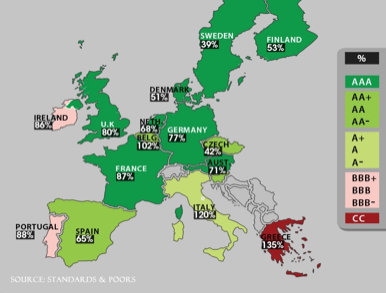
Since then, European bailouts have been the safety net for all the countries in the eurozone. When investors worry that countries like Spain, Portugal and Italy will have a Greek style financial meltdown and the interest rates on their bonds rise to reflect that risk, the ECB steps in to buy their bonds and the panic goes away — for a while. More, when individual banks are having trouble, the ECB has made huge amounts of money at extremely low interest rates available to them. Spanish banks, for example, can borrow cheap money from the ECB in order to buy Spanish government bonds at high interest rates. They pay one percent interest to the ECB and collect four percent interest from the Spanish government, and use the profit of three percent to offset their losses on their loans to private companies and consumers who are going belly up in Spain’s savage recession.
The success of this little merry-go-round is why Europe calmed down last December. The ECB in effect prints money which it gives to busted banks. The busted banks lend the money to insolvent governments at artificially low rates (but at rates that still allow the banks to make a profit). It was a neat little trick that kept the crisis quiet without forcing the Germans to admit openly that the ECB was in effect using German resources to bail out the rest of the zone.
Bank runs, even virtual bank runs, would blow this fragile arrangements to bits. As the prospect of Greece leaving the euro becomes more likely, savers in Portugal, Spain and Italy have to start wondering if their countries, too, will have to jump ship. Sophisticated investors have been moving their money out of those countries for some time; things may soon reach a pass in which ordinary, unsophisticated investors start to do the same thing. Again, why have your money in some gut-shot Spanish bank when you can transfer it to a German, Austrian or Dutch bank with a mouse click? And if you are worried about the whole eurozone, or that devious financial trolls will find a way to convert all deposits held by Spanish citizens in European banks to pesos when and if the change comes, put the money in Switzerland, the UK or even the US.
If a few thousands or a few tens of thousands do this in Portugal, Italy and Spain, no problem. But if hundreds of thousands or millions of people shift their money out of their home banking systems, then you have a new and very grave bank crisis that blows the December fix out of the water. Either the ECB would start creating trillions of euros to bail out the Club Med banks (and Club Med under some circumstances could stretch as far north as France), or banking systems start exploding like firecrackers across the southern tier. At the same time you would have a new panic on the bond markets; nobody is going to want to own Spanish or Italian debt under those circumstances.
This is something that we all need to be monitoring closely because the profligacy of socialist Europe is going to affect us all. What we have been doing here at home for the last four years, a flight from capitalism into Peter Pan economics, has not exactly prepared us for the coming storm.
Be effective and influential:

 WINTERY KNIGHT