Tag Archives: Solar Power

Solar power firm goes bankrupt after receiving millions of taxpayer dollars

From the Boston Herald, a look at what happens when the government redistributes wealth based on political correctness.

Excerpt:

Evergreen Solar Inc., the Massachusetts clean-energy company that received millions in state subsidies from the Patrick administration for an ill-fated Bay State factory, has filed for bankruptcy, listing $485.6 million in debt.

Evergreen, which closed its taxpayer-supported Devens factory in March and cut 800 jobs, has been trying to rework its debt for months. The cash-strapped company announced today has sought a reorganization in U.S. Bankruptcy Court in Delaware and reached a deal with certain note holders to restructure its debt and auction off assets.

The Massachusetts Republican Party called the Patrick administration’s $58 million financial aid package, which supported Evergreen’s $450 million factory, a “waste” of money.

“The bankruptcy of Evergreen Solar is another sad event for the Massachusetts company and highlights the folly of the Patrick-Murray Administration which has put government subsidies into their pet projects instead of offering broad based relief to all Bay State employers,” said Jennifer Nassour, head of the state GOP.

Here’s a previous story about another solar-power boondoggle, from the Daily Caller.

Excerpt:

Solyndra, Inc. was supposed to have showcased the effectiveness of the Obama administration’s stimulus and green jobs initiatives, but instead it has become the center of congressional attention for waste, fraud and abuse of such programs.

According to a Feb. 17 letter signed by Energy and Commerce Committee Chairman Fred Upton, Michigan Republican, and Oversight Subcommittee Chairman Cliff Stearns, Florida Republican, to Energy Secretary Steven Chu, the Fremont, Calif.-based solar panel manufacturer should never have received a $535 million loan guarantee from the stimulus.*

The company became the first recipient of an Energy Department loan guarantee under the stimulus in March 2009, which was intended to “finance construction of the first phase of the company’s new manufacturing facility” for photovoltaic solar panels.

The Energy Department estimated in a March 20, 2009 press release that the loan guarantee would create 3,000 construction jobs and a further 1,000 jobs after the plant opened.

And President Barack Obama and Vice President Joseph Biden each personally showcased Solyndra as an example of how stimulus dollars were at work creating jobs, during appearances at the company over the course of the following year.

Biden personally announced the closure of Solyndra’s $535 million loan guarantee in a Sept. 9, 2009 speech, delivered via closed-circuit television, on the occasion of the groundbreaking of the plant.

The vice president justified the federal government’s investment in Solyndra in front of employees and other dignitaries, including Secretary Chu and former Calif. Gov. Arnold Schwartzenegger, saying the jobs the company intended to create would “serve as a foundation for a stronger American economy.”

“These jobs are the jobs that are going to define the 21st century that will allow America to compete and to lead like we did in the 20th century,” Biden said.

According to Biden’s speech, the $535 million loan guarantee was a smaller part of the $30 billion of stimulus money the administration planned to spend as part of its Green Jobs Initiative.

Obama made similar claims in a May 26, 2010 speech at the plant, but the 1,000 jobs he and Biden touted in their respective speeches failed to materialize.

Instead, Solyndra announced on Nov. 3 it planned to postpone expanding the plant, which put the taxpayers on the hook to the tune of $390.5 million taxpayers**, or 73 percent of the total loan guarantee, according to the Wall Street Journal.

It also announced that it no longer planned to hire the 1,000 workers that Obama and Biden had touted in their speeches and that it planned to close one of its older factories and planned to lay-off 135 temporary or contract workers and 40 full-time employees.

A closer look at the company shows it has never turned a profit since it was founded in 2005, according to its Securities and Exchange Commission (SEC) filings.

And Solyndra’s auditor declared that “the company has suffered recurring losses, negative cash flows since inception and has a net stockholders’ deficit that, among other factors, [that] raise substantial doubt about its ability to continue as a growing concern” in a March 2010 amendment to its SEC registration statement.

“While we understand the purpose of the Loan Guarantee Program is to help private companies engaging in clean energy products to obtain financing by providing loan guarantees, subsequent events raise questions about Solyndra was the right candidate to receive a loan guarantee in excess of half a billion dollars,” Upton and Stearns wrote.

A June 2010 Wall Street Journal report indicating that Solyndra’s majority owner, Oklahoma billionaire George Kaiser, was a major fundraiser for the 2008 Obama-Biden campaign has stimulus opponents such as Citizens Against Government Waste crying foul.

Even the radically left-wing Huffington Post is getting the picture, in this article entitled “The Party’s Over for Big Wind“.

Excerpt:

Here’s the reality: the backlash against industrial wind is real, it’s global, and it’s growing. The U.S. has about 170 anti-wind groups. AWEA doesn’t want you to know that a number of towns in New York state have prohibited the construction of industrial wind turbines. In April, the town of Falmouth, Massachusetts enacted a year-long moratorium on construction of new wind turbines. And earlier this month, a pair of environmental groups in Massachusetts called for a ban on new turbines in the state until more work is done on the health effects of wind turbine noise.

The wind lobby is desperate to downplay the problem of infrasound from wind turbines. But this month, in a peer-reviewed article in the Bulletin of Science, Technology & Society, Carl V. Phillips, a Harvard-trained PhD, concludes that there is “overwhelming evidence that wind turbines cause serious health problems in nearby residents, usually stress-disorder type diseases, at a nontrivial rate.”

The subsidies for wind energy are in peril. A recent report from the Energy Information Administration shows that in 2010, the wind energy sector got more federal subsidies than any other energy sector other than biofuels. The report found that wind energy got a total of $4.986 billion in subsidies, or nearly twice as much as was given to the oil and gas sector, which got $2.82 billion. The majority of the wind energy money came from the federal stimulus package passed in 2009. But much of that stimulus money has been spent.

Last December, AWEA cheered after Congress approved a tax bill that included a one-year extension of the investment tax credit for renewable energy. But another high-profile renewable energy subsidy, the tax credit for the corn ethanol scam, is due to expire at the end of this year. And given that Republicans in Washington are eager to cut all types of federal spending, the investment tax credit is likely to, once again, be in legislators’ cross hairs.

Bode was right a year ago when she said the wind industry is in distress. Her industry’s still in peril today because it cannot survive without mandates and taxpayer subsidies. And unless or until it can, she cannot expect any sympathy from cash-strapped voters.

Why are we wasting money on unproven technologies? Do we have money to waste on old-time religion?

Green energy firm run by Obama fundraiser gets $535M loan guarantee

Obama Unemployment Stimulus Graph

From the Daily Caller. (H/T Doug Ross)

Excerpt:

Solyndra, Inc. was supposed to have showcased the effectiveness of the Obama administration’s stimulus and green jobs initiatives, but instead it has become the center of congressional attention for waste, fraud and abuse of such programs.

According to a Feb. 17 letter signed by Energy and Commerce Committee Chairman Fred Upton, Michigan Republican, and Oversight Subcommittee Chairman Cliff Stearns, Florida Republican, to Energy Secretary Steven Chu, the Fremont, Calif.-based solar panel manufacturer should never have received a $535 million loan guarantee from the stimulus.*

The company became the first recipient of an Energy Department loan guarantee under the stimulus in March 2009, which was intended to “finance construction of the first phase of the company’s new manufacturing facility” for photovoltaic solar panels.

The Energy Department estimated in a March 20, 2009 press release that the loan guarantee would create 3,000 construction jobs and a further 1,000 jobs after the plant opened.

And President Barack Obama and Vice President Joseph Biden each personally showcased Solyndra as an example of how stimulus dollars were at work creating jobs, during appearances at the company over the course of the following year.

Biden personally announced the closure of Solyndra’s $535 million loan guarantee in a Sept. 9, 2009 speech, delivered via closed-circuit television, on the occasion of the groundbreaking of the plant.

The vice president justified the federal government’s investment in Solyndra in front of employees and other dignitaries, including Secretary Chu and former Calif. Gov. Arnold Schwartzenegger, saying the jobs the company intended to create would “serve as a foundation for a stronger American economy.”

“These jobs are the jobs that are going to define the 21st century that will allow America to compete and to lead like we did in the 20th century,” Biden said.

According to Biden’s speech, the $535 million loan guarantee was a smaller part of the $30 billion of stimulus money the administration planned to spend as part of its Green Jobs Initiative.

Obama made similar claims in a May 26, 2010 speech at the plant, but the 1,000 jobs he and Biden touted in their respective speeches failed to materialize.

Instead, Solyndra announced on Nov. 3 it planned to postpone expanding the plant, which put the taxpayers on the hook to the tune of $390.5 million taxpayers**, or 73 percent of the total loan guarantee, according to the Wall Street Journal.

It also announced that it no longer planned to hire the 1,000 workers that Obama and Biden had touted in their speeches and that it planned to close one of its older factories and planned to lay-off 135 temporary or contract workers and 40 full-time employees.

A closer look at the company shows it has never turned a profit since it was founded in 2005, according to its Securities and Exchange Commission (SEC) filings.

And Solyndra’s auditor declared that “the company has suffered recurring losses, negative cash flows since inception and has a net stockholders’ deficit that, among other factors, [that] raise substantial doubt about its ability to continue as a growing concern” in a March 2010 amendment to its SEC registration statement.

“While we understand the purpose of the Loan Guarantee Program is to help private companies engaging in clean energy products to obtain financing by providing loan guarantees, subsequent events raise questions about Solyndra was the right candidate to receive a loan guarantee in excess of half a billion dollars,” Upton and Stearns wrote.

A June 2010 Wall Street Journal report indicating that Solyndra’s majority owner, Oklahoma billionaire George Kaiser, was a major fundraiser for the 2008 Obama-Biden campaign has stimulus opponents such as Citizens Against Government Waste crying foul.

What did we get for spending nearly a trillion dollars on stimulus? We got 9% unemployment. But Obama’s political cronies got a big raise.

Economics in One Lesson

Perhaps it is time to review Henry Hazlitt’s Economics in One Lesson, chapter 4, entitled “Public Works Mean Taxes”.

Excerpt:

Therefore, for every public job created by the bridge project a private job has been destroyed somewhere else. We can see the men employed on the bridge. We can watch them at work. The employment argument of the government spenders becomes vivid, and probably for most people convincing. But there are other things that we do not see, because, alas, they have never been permitted to come into existence. They are the jobs destroyed by the $10 million taken from the taxpayers. All that has happened, at best, is that there has been a diversion of jobs because of the project. More bridge builders; fewer automobile workers, television technicians, clothing workers, farmers.

And consider Chapter 5 as well, entitled “Taxes Discourage Production”.

In our modern world there is never the same percentage of income tax levied on everybody. The great burden of income taxes is imposed on a minor percentage of the nation’s income; and these income taxes have to be supplemented by taxes of other kinds. These taxes inevitably affect the actions and incentives of those from whom they are taken. When a corporation loses a hundred cents of every dollar it loses, and is permitted to keep only fifty-two cents of every dollar it gains, and when it cannot adequately offset its years of losses against its years of gains, its policies are affected. It does not expand its operations, or it expands only those attended with a minimum of risk. People who recognize this situation are deterred from starting new enterprises. Thus old employers do not give more employment, or not as much more as they might have; and others decide not to become employers at all. Improved machinery and better-equipped factories come into existence much more slowly than they otherwise would. The result in the long run is that consumers are prevented from getting better and cheaper products to the extent that they otherwise would, and that real wages are held down, compared with what they might have been.

There is a similar effect when personal incomes are taxed 50, 60 or 70 percent. People begin to ask themselves why they should work six, eight or nine months of the entire year for the government, and only six, four or three months for themselves and their families. If they lose the whole dollar when they lose, but can keep only a fraction of it when they win, they decide that it is foolish to take risks with their capital. In addition, the capital available for risk-taking itself shrinks enormously. It is being taxed away before it can be accumulated. In brief, capital to provide new private jobs is first prevented from coming into existence, and the part that does come into existence is then discouraged from starting new enterprises. The government spenders create the very problem of unemployment that they profess to solve.

George W. Bush cut taxes in his first term and created 1 million NEW JOBS. Obama transfered BILLIONS from the private sector to the public sector, where government waste is rampant. Government spending is a job killer. Obama might be a nice man, but he is just wrong on economics and business. What we should have done is elected someone who doesn’t repeat the mistakes made in other countries, like in Japan where massive government spending failed to stimulate the economy. And we shouldn’t enact single-payer health care, because it’s not working in Canada. The wait times to see doctors in Canada are increasing. We should only imitate the successes of other countries, like the free trade agreements in Chile or the flat tax in Lithuania or the private retirement accounts in Chile or the low tax rates of Hong Kong. We have to decide, as a nation, whether we want jobs and prosperity, or rhetoric and feelings.

New report compares cost of coal power to renewable wind and solar power

Map of Australia
Map of Australia

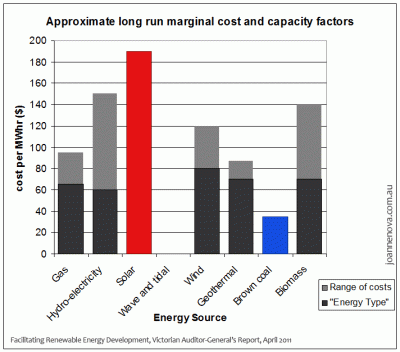
From the Victorian Auditor-General’s Report, April 2011. (H/T Joanne Nova)

Here’s the chart:

Cost of renewable wind and solar energy

Click here for a bigger version.

Compared to coal, wind power is incredibly expensive, and solar power is even worse.

What happened when the Canadians embraced wind and solar power?

What happened to consumer energy prices in Ontario when the Liberal government embraced unproven wind and solar power?

The Globe and Mail explains:

If you haven’t opened your September hydro bill yet, you’re in for a shock. Rates have risen 18 per cent this year to date, and that’s just the start. By this time next year – election time – Ontario power consumers will be forking over about twice as much (in nominal terms) as they did when Dalton McGuinty took office in 2003.

[…]Power expert Tom Adams may know more about this subject than any other living being. And he’s steamed. Ontario’s rates, he says, have already surpassed the U.S. average and are headed for European levels – “just because of public policy.”

The policy is to go all out on renewables – wind and solar– whether or not it makes sense. The province is paying sky-high rates for power it doesn’t need so we can have wind turbines marching on and on to the horizon, just like Denmark does. “Power demand has been dropping since 2005,” says Mr. Adams. In fact, we have so much excess supply that, from time to time, it threatens to crash the system. Because of this, we’re even paying the neighbours to take the power off our hands.

“Ontario will need new power supplies in the future,” Mr. Adams says. “But why not buy it when we need it?” Instead of waiting, the power authority is signing long-term contracts at the rate of about $1-billion a week, while paying enormous premiums to attract wind and solar producers. In other words, it’s making 20-year commitments to pay stunningly high prices for power we don’t need.

On top of that, the province is building new transmission lines to nowhere while neglecting to ensure that Toronto’s hospitals and banks can keep the lights on. In July, Toronto experienced what Mr. Adams calls “Ontario’s first green blackout.” That blackout occurred because the city’s downtown core is badly underpowered. It has the weakest power system of any financial centre in the developed world.

Why haven’t we done anything about it? Because the green lobby has been campaigning for conservation, instead. And so, when the government started picking sites for transmission upgrades, it decided to build a power line up the shore of Lake Nipigon to connect remote wind turbines to Thunder Bay.

Ever since the days of Adam Beck, the father of public power in Ontario, the province’s energy policy has been linked to economic policy. The motto was reliable power at cost. Now energy policy has been entirely decoupled from economic policy and attached to the runaway train of environmental policy. Everyone in the power system knows it. But they’re so terrified to raise their hands, most of the public is still in the dark.

The National Post wrote about how the Ontario government wastes taxpayer money to subsidize big corporations who experiment with unproven, expensive energy programs, like solar power.

Excerpt:

The Swedish retail giant IKEA announced yesterday it will invest $4.6-million to install 3,790 solar panels on three Toronto area stores, giving IKEA the electric-power-producing capacity of 960,000 kilowatt hours (kWh) per year. According to IKEA, that’s enough electricity to power 100 homes. Amazing development. Even more amazing is the economics of this project. Under the Ontario government’s feed-in-tariff solar power scheme, IKEA will receive 71.3¢ for each kilowatt of power produced, which works out to about $6,800 a year for each of the 100 hypothetical homes. Since the average Toronto home currently pays about $1,200 for the same quantity of electricity, that implies that IKEA is being overpaid by $5,400 per home equivalent.

Welcome to the wonderful world of green economics and the magical business of carbon emission reduction. Each year, IKEA will receive $684,408 under Premier Dalton McGuinty’s green energy monster — for power that today retails for about $115,000. At that rate, IKEA will recoup $4.6-million in less than seven years — not bad for an investment that can be amortized over 20.

No wonder solar power is such a hot industry. No wonder, too, that the province of Ontario is in a headlong rush into a likely economic crisis brought on by skyrocketing electricity prices. To make up the money paid to IKEA to promote itself as a carbon-free zone, Ontario consumers and industries are on their way to experiencing the highest electricity rates in North America, if not most of the world.
The government’s regulator, the Ontario Energy Board, has prepared secret forecasts of how much Ontario consumers are going to have to pay for electricity over the next five years. The government won’t allow the report to be released. The next best estimate comes from Aegent Energy Advisors Inc., in a study it did for the Canadian Manufactures and Exporters group. Residential rates are expected to jump by 60% between 2010 and 2015. Industrial customers will be looking at a 55% increase.

Going back to 2003, based on numbers dug up by consultant Tom Adams, the price of residential electricity in Ontario hovered around 8.5¢ a kWh in 2003 — the first year of the McGuinty Liberal regime. By 2015, Aegent Energy estimates the price will be up to 21¢, an increase of 135%. Doubling the price of electricity in a decade is no way to spur growth and investment. In this age of global economic competition IKEA may end up with fewer sales of its Billy bookshelves in Toronto because its customers will be bogged down with soaring power bills and a sliding economy.

How about wind power in a coastal province like New Brunswick? Is that any better? The National post explains the costs and drawbacks of wind power.

Excerpt:

A $200-million wind farm in northern New Brunswick is frozen solid, cutting off a potential supply of renewable energy for NB Power.

The 25-kilometre stretch of wind turbines, located 70 kilometres northwest of Bathurst, N.B. has been completely shutdown for several weeks due to heavy ice covering the blades.

[…]Wintery conditions also temporarily shutdown the site last winter, just months after its completion. Some or all of the turbines were offline for several days, with “particularly severe icing” blamed.

The accumulated ice alters the aerodynamics of the blades, rendering them ineffective as airfoils. The added weight further immobilizes the structures.

[…]Melissa Morton, a spokeswoman for the utility, says the contract isn’t based on power delivered during a specific period, but rather on an annual basis.

“Our hopes is that it will balance out over the 12-month period and, historically, that has been the case.”

Despite running into problems in consecutive winters, Ms. Morton says NB Power doesn’t have concerns about the reliability of the supply from the Caribou Mountain site.

It’s a waste of taxpayer money.