
Tag Archives: Socialized Medicine

New study finds that many young people won’t purchase Obamacare plans

Dr. David Hogberg of the National Center for Public Policy Research explains how Obamacare affects young people.

Here’s the executive summary:

If the ObamaCare health insurance exchanges are to function properly, it is crucial that a substantial number of people ages 18-34 join them. This age group that is young and relatively healthy must purchase health insurance on the exchanges in order to “cross-subsidize” people who are older and sicker. Without the young and healthy, the exchanges will enter a “death spiral” where only the older and sicker participate and price of insurance premiums will increase precipitously.

This study finds that in 2014 many single people aged 18-34 who do not have children will have a substantial financial incentive to forego insurance on the exchanges and instead pay the individual mandate penalty of $95 or one percent of income. About 3.7 million of those ages 18-34 will be at least $500 better off if they forgo insurance and pay the penalty. More than 3 million will be $1,000 better off if they go the same route. This raises the likelihood that an insufficient number of young and healthy people will participate in the exchanges, thereby leading to a death spiral. 

The design of the plan is to tax younger, healthier people – especially men – in order to obtain the money to pay for heavy users of health care.

To compel the young and healthy to purchase insurance, the architects of ObamaCare included an individual mandate that requires individuals to either buy insurance or pay a penalty. The penalty, which increases over time, is whichever is greater: $95 or one percent of income in 2014, $325 or two percent of income in 2015, and $695 or 2.5 percent of income in 2016 and thereafter.

[…]The gender breakdown of these individuals presents another problem. Women have higher rates of health utilization than men, including more visits to primary-care physicians and greater use of diagnostic tests and emergency care. However, as Table 3 shows, roughly two-thirds of the individuals for whom insurance will cost at least $1,000 more than the fine are men.

Hard to see why any young man would have voted Democrat, and yet many did. Did they know that they were voting for a tax on themselves at a time when many of them are poorly educated by government-run schools, and can’t even find jobs? How can you pay a fine for not having health care when you don’t have a proper education or a proper job?

The net effect of the “community rating” and “guaranteed issue” provisions of Obamacare will be to raise health insurance premiums and force private companies to stop offering plans:

If the exchanges do not attract a sufficient number of people in the 18-34 age demographic, they will eventually enter an insurance “death spiral.” This occurs when the young and healthy drop out of the “insurance pool.” This leads to “adverse selection” in which insurance is only attractive to those who are generally older and sicker. If the insurance pool is comprised largely of people who are older and sicker, then insurance prices will rise to cover their costs. That rate increase causes even more young and healthy people drop their insurance, leaving the pools even older and sicker than before, and so on. Eventually, all but a few insurers will be forced to discontinue their business on the exchanges because they can no longer make a profit. Fewer insurers means less competition, resulting in even higher insurance premiums.

Community rating and guaranteed issue are catalysts for a death spiral. In its strictest form, community rating means that insurers must charge everyone the same premium, regardless of factors such as health status and age. Guaranteed issue means that an insurer must sell a policy to a consumer anytime.

Under ObamaCare, the exchanges use a modified version of both of these regulations. Its form of community rating doesn’t allow insurers to vary rates based on health status. It does allow, however, for modification of premiums if one smokes and to compensate for age (although in a more restricted manner than the market currently does). Regarding guaranteed issue, insurers must sell policies to all comers but (with a few exceptions) only during the annual open enrollment period from October to December.

Both of these rules give young and healthy people big incentives to forgo insurance coverage altogether. Community rating means young people have a reduced incentive to buy insurance since they will pay a premium that is above the market rate. Many who are currently purchasing insurance in the individual market, for example, will see a substantial premium increase if they switch to the exchange.

In a market without guaranteed issue, consumers run the risk of insurers not selling them policies when they get seriously ill. But that risk is largely gone under the exchanges. For instance, a young person who gets a serious illness in June only has to wait until October to sign up for insurance and then wait until January 1 of the next year to receive coverage. Combined, community rating and guaranteed issue give the young and healthy big incentives to forgo insurance until they are sick.

“Community rating” and “guaranteed issue” have actually already been tried at the state level. What happened then?

This:

The late Conrad Meier, then a senior fellow in health care policy for the Heartland Institute, examined what happened when these two regulations were instituted on the state level in his 2005 monograph “Destroying Insurance Markets.” In the early 1990s eight states — Kentucky, Maine, Massachusetts, New Hampshire, New Jersey, New York, Vermont and Washington — imposed community rating and guaranteed issue on their individual insurance markets. The result, according to Meier, was the above-described death spiral.

For example, in 1992 the New Jersey legislature adopted community rating and guaranteed issue rules for its individual insurance market with the passage of the “Individual Health Coverage Program.” The monthly premium for family coverage from Aetna rose from $769 in 1994 to $6,005 in 2005, a whopping increase of 683 percent! Other insurers saw similar increases.

Before the reforms began, there were about 28 insurers covering the New Jersey individual market. By 2007 there were only seven. According to the Census Bureau, the number of people in New Jersey’s individual market fell from about 998,000 in 1994 to 630,000 in 2005, a decline of 37 percent.

It’s pretty clear that Obamacare was designed to replicate this same effect that’s been observed in states at a national level, paving the way for single payer health care. What will Americans think when their healthcare is controlled by the kind of people who run USPS, Amtrak, the Bureau of Motor Vehicles and the IRS? 
Harry Reid: Obamacare is “absolutely” a step towards single payer health care system

Here’s a Forbes magazine article by health care policy expert Avik Roy.

Excerpt: (links removed)

When I speak to conservatives about health care policy, I’m often asked the question: “Do you think that Obamacare is secretly a step toward single-payer health care?” I always explain that, while progressives may want single-payer, I don’t think that Obamacare is deliberately designed to bring about that outcome. Well, yesterday on PBS’ Nevada Week In Review, Senate Majority Leader Harry Reid (D., Nev.) was asked whether his goal was to move Obamacare to a single-payer system. His answer? “Yes, yes. Absolutely, yes.”

In one sense, this isn’t shocking. Reid and many other Democrats, including President Obama, have often stated that their ideal health-care system is one in which the government abolishes the private insurance market. Video of the PBS discussion isn’t yet online, but here’s how Karoun Demirjian of the Las Vegas Sun described it:

Reid said he thinks the country has to “work our way past” insurance-based health care during a Friday night appearance on Vegas PBS’ program “Nevada Week in Review.”

“What we’ve done with Obamacare is have a step in the right direction, but we’re far from having something that’s going to work forever,” Reid said.

When then asked by panelist Steve Sebelius whether he meant ultimately the country would have to have a health care system that abandoned insurance as the means of accessing it, Reid said: “Yes, yes. Absolutely, yes.”

Reid noted that he and other progressives fought hard for a “public option” in the exchanges as a Trojan horse for single-payer, but Democrats didn’t have 60 votes in the Senate to achieve it:

The idea of introducing a single-payer national health care system to the United States, or even just a public option, sent lawmakers into a tizzy back in 2009, when Reid was negotiating the health care bill.

“We had a real good run at the public option … don’t think we didn’t have a tremendous number of people who wanted a single-payer system,” Reid said on the PBS program, recalling how then-Sen. Joe Lieberman’s opposition to the idea of a public option made them abandon the notion and start from scratch.

Eventually, Reid decided the public option was unworkable.

“We had to get a majority of votes,” Reid said. “In fact, we had to get a little extra in the Senate, we have to get 60.”

Do you like the service you get at the Department of Motor Vehicles or the Post Office? How would you like to get your health care the same way? That’s what the Democrats are trying to do. We could have gone in another direction and legislated consumer-focused health care, providing an experience similar to Amazon.com – but we didn’t. We can’t keep electing communists and then acting surprised when they push us towards communism.

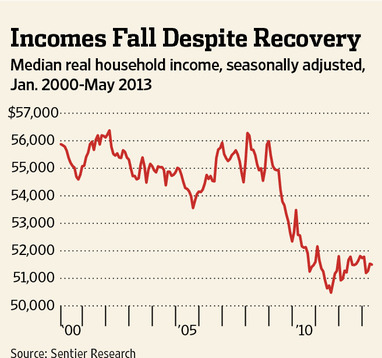
Annual median household income down $4,500 since Democrats won Congress in 2006

Median Household Income Under Obama

The Wall Street Journal reports.

Excerpt:

The recovery that began four years ago has been one of the weakest on record, averaging a little more than 2%. And it has not gained speed. Growth in the fourth quarter of 2012 was 0.4%. It rose to a still anemic 1.8% in the first quarter but most economists are predicting even slower growth in the second quarter.

We hope the predictions of a faster growth in the second half will be right, but the Obama Treasury and Federal Reserve have been predicting for four years that takeoff was just around the corner. Stocks are doing great, and housing prices are rising, but job growth remains lackluster. What has never arrived is the 3%-4% growth spurt during typical expansions.

[…]What about the middle class that is the focus of Mr. Obama’s rhetoric? Each month the consultants at Sentier Research crunch the numbers from the Census Bureau’s Current Population Survey and estimate the trend in median annual household income adjusted for inflation. In its May 2013 report, Sentier put the figure at $51,500, essentially unchanged from $51,671 a year earlier.

And that’s the good news. The bad news is that median real household income is $2,718, or 5%, lower than the $54,218 median in June 2009 when the recession officially ended. Median incomes typically fall during recessions. But the striking fact of the Obama economy is that median real household income has fallen even during the recovery.

While the declines have stabilized over the last two years, incomes are still far below the previous peak located by Sentier of $56,280 in January 2008. No wonder Mr. Obama is now turning once again to his familiar political narrative assailing inequality and blaming everyone else for it. He wants to change the subject from the results on his watch.

The core problem has been Mr. Obama’s focus on spreading the wealth rather than creating it. ObamaCare will soon hook more Americans on government subsidies, but its mandates and taxes have hurt job creation, especially at small businesses. Mr. Obama’s record tax increases have grabbed a bigger chunk of affluent incomes, but they created uncertainty for business throughout 2012 and have dampened growth so far this year.

The food stamp and disability rolls have exploded, which reduces inequality but also reduces the incentive to work and rise on the economic ladder. This has contributed to a plunge in the share of Americans who are working—the labor participation rate—to 63.5% in June from 65.7% in June 2009. And don’t forget the Fed’s extraordinary monetary policy, which has done well by the rich who have assets but left the thrifty middle class and retirees earning pennies on their savings.

Mr. Obama would have done far better by the poor, the middle class and the wealthy if he had focused on growing the economy first. The difference between the Obama 2% recovery and the Reagan-Clinton 3%-4% growth rates is rising incomes for nearly everybody.

And remember, thanks to Obamacare, medical insurance premiums have soared over $3,000. We are getting poorer because of Obama’s big government policies.

Whose fault is it?

In the 2006 mid-term elections, the Democrats took over the House and Senate. That was the beginning of the Nancy Pelosi and Harry Reid spending spree. Millions of dollars have been wasted on ineffective government programs, handouts and bailouts. We’ve had trillion dollar deficits for the last four years under Obama, and over 8 trillion added to the national debt since Pelosi/Reid 2007. All that deficit spend does have an effect on economic growth – businesses know that they are going to have to pay it off at some point, either through higher taxes or inflation or both.