Tag Archives: Socialism

New study: government run child-care increases negative outcomes for kids

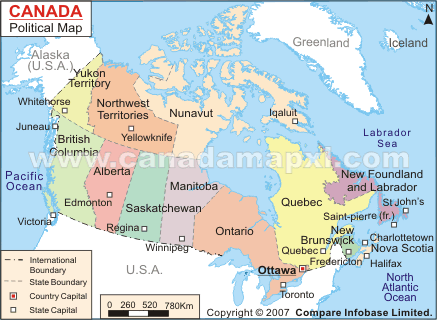
Canada Political Map

I’ve complained before about Quebec, the most liberal and secular province in Canada. Well, one of the things that makes them so crappy is their policy of encouraging women to abandon their young children to strangers in government-run daycare. The government takes a whole lot of taxpayer money, often from traditional single-earner homes, and uses it to subsidize government-run child care. Well, now we have a brand new fresh study to show how wrong this policy has been.

Canada’s radically leftist CTV News reports on the study.

Excerpt:

In a paper released Monday, a group of university researchers say that children exposed to the province’s child-care system were more likely to have higher crime rates, worse health and lower levels of life satisfaction as they have aged than their counterparts in other provinces who didn’t have access to the same type of system.

[…]In their paper made public Monday through the National Bureau of Economic Research, Kevin Milligan from the University of British Columbia, Michael Baker from the University of Toronto, and Jonathan Gruber from MIT in Cambridge, Mass., update work from 2008 to see if children in the Quebec care system kicked their troubling behaviours over time.

To do that, they analyzed four different data sets from Statistics Canada that touched on child outcomes, health and crime rates and scores from standardized tests that are connected to the national Council of Ministers of Education.

What the trio found instead was “striking evidence” that exposure to the program was associated with higher crime rates, with the effects most acutely seen in boys. Boys were more likely to have higher levels of hyperactivity and aggression, the researchers wrote, while girls showed declines in prosocial behaviour, which captures many altruistic activities like donating and volunteering. All of those behaviours fall under the heading of “non-cognitive” abilities, such as impulsiveness and emotional stability.

Exposure to the program was also associated with “worsened health and life satisfaction,” the study says.

There was no such lasting effects on math, science and reading abilities, the researchers write.

By the way, in case you are wondering – yes, that is the same Jonathan Gruber of MIT who was the architect of Obamacare. Surprising that he would be co-author on a study that dings big government.

Are these results unique to Canada? Let’s take a look at a recent study from the UK.

From the UK Telegraph.

Excerpt:

Academics at Oxford University discovered that exposure to some forms of early education contributed to bad behaviour and could be linked to emotional problems.

[…]In the Oxford study, researchers recruited 991 families with children aged three months. Mothers had an average age of 30.

Researchers assessed children at the age of four through questionnaires about their behaviour and emotions completed by teachers and parents. They also observed care provided by mothers and observed non-parental care for at least 90 minutes for those children placed in formal childcare settings.

The report, published in the journal Child: Care, Health and Development, said that “children who spent more time in group care, mainly nursery care, were more likely to have behavioural problems, particularly hyperactivity”.

The study, led by Prof Alan Stein, of Oxford’s Department of Child and Adolescent Psychiatry, found that “spending more time in day care centres, over the total period was a predictor of total problem scores”.

“Children who spent more time in day care centres were more likely to be hyperactive,” it said. “Children receiving more care by childminders were more likely to have peer problems.”

The authors added: “The findings in relation to childminding suggest that it might be out of home care rather than group care that raises the risk of behavioural difficulties.”

Well, that’s only Canada and the UK. Maybe things are better in Sweden?

Here’s a second article from the National Post (one of Canada’s national newspapers) about Sweden’s government-run universal day care system.

Excerpt:

True, parental leave in Sweden is a generous 16 months. There are no babies in daycare. But when parental leave ends, practically the reverse is true: A full 92% of all children aged 18 months to five years are in daycare. Parents pay only a symbolic amount for this; tax subsidies for daycare are $20,000 per child, annually. Swedish taxes are among the highest in the world, and the tax system was designed to make both parents seek employment in the work force.

[…]Then there are the questions about the social toll Sweden’s childcare system is taking. Sweden has offered a comprehensive daycare system since 1975; since the early ‘90s, negative outcomes for children and adolescents are on the rise in areas of health and behaviour. While direct causation has been difficult to prove, many Swedish health-care professionals point to the lack of parent involvement beyond the first 16 months as a primary contributing factor. Psychosomatic disorders and mild psychological problems are escalating among Swedish youth at a faster rate than in any of 11 comparable European countries. Such disorders have tripled among girls over the last 25 years. Education outcomes in Swedish schools have fallen from the top position 30 years ago, to merely average amongst OECD nations today. Behaviour problems in Swedish classrooms are among the worst in Europe.

Now this idea of government taking children away from families is very popular on the left, because they want children to be “equal”, and that means getting them away from their parents so that the government can raise them “equally”. You can even see Hillary Clinton pushing for it when she talks about “universal pre-K”. Well, maybe it’s time that someone showed her the studies. Not that she strikes me as someone who cares a lot about children, given her support for born-alive abortions and organ harvesting.

Does Bernie Sanders know a lot about business, finance and economics?

Democrats took control of government spending in 2007

This article from Investors Business Daily takes a look at his record and experience in the areas that are relevant to economic growth.

It says:

Democratic presidential hopeful Bernie Sanders said Monday his parents would never have thought their son would end up in the Senate and running for president.

[…]He explained his family couldn’t imagine his “success,” because “my brother and I and Mom and Dad grew up in a three-and-a-half-room rent-controlled apartment in Brooklyn, and we never had a whole lot of money.”

It wasn’t as bad as he says. His family managed to send him to the University of Chicago. Despite a prestigious degree, however, Sanders failed to earn a living, even as an adult. It took him 40 years to collect his first steady paycheck — and it was a government check.

“I never had any money my entire life,” Sanders told Vermont public TV in 1985, after settling into his first real job as mayor of Burlington.

Sanders spent most of his life as an angry radical and agitator who never accomplished much of anything. And yet now he thinks he deserves the power to run your life and your finances — “We will raise taxes;” he confirmed Monday, “yes, we will.”

One of his first jobs was registering people for food stamps, and it was all downhill from there.

Sanders took his first bride to live in a maple sugar shack with a dirt floor, and she soon left him. Penniless, he went on unemployment. Then he had a child out of wedlock. Desperate, he tried carpentry but could barely sink a nail. “He was a shi**y carpenter,” a friend told Politico Magazine. “His carpentry was not going to support him, and didn’t.”

Then he tried his hand freelancing for leftist rags, writing about “masturbation and rape” and other crudities for $50 a story. He drove around in a rusted-out, Bondo-covered VW bug with no working windshield wipers. Friends said he was “always poor” and his “electricity was turned off a lot.” They described him as a slob who kept a messy apartment — and this is what his friends had to say about him.

The only thing he was good at was talking … non-stop … about socialism and how the rich were ripping everybody off. “The whole quality of life in America is based on greed,” the bitter layabout said. “I believe in the redistribution of wealth in this nation.”

So he tried politics, starting his own socialist party. Four times he ran for Vermont public office, and four times he lost — badly. He never attracted more than single-digit support — even in the People’s Republic of Vermont. In his 1971 bid for U.S. Senate, the local press said the 30-year-old “Sanders describes himself as a carpenter who has worked with ‘disturbed children.’ ” In other words, a real winner.

This is the man that so many Democrats want to put in charge of our economic policy. He’s never run a damned thing in his entire life, but his words sound nice if you have no understanding of how the world works. Besides, doesn’t a person’s good intentions automatically mean that he will achieve good results? He doesn’t have to know anything if his heart is in the right place, does he?

Here’s an article from the Washington Free Beacon that talks about a non-partisan study from the Tax Foundation think tank, which analyzes Sanders’ plans for the US economy.

Excerpt:

Bernie Sanders proposed tax plan would raise taxes by $13.6 trillion over the next decade and reduce the economy’s size by 9.5 percent, according to an analysis by the Tax Foundation.

[…]After accounting for reductions in economic growth, Sanders’ plan would lead to 12.84 percent lower after-tax incomes for all taxpayers, 6 million fewer full-time jobs, and an 18.6 percent smaller capital stock.

That’s who just won the Democrat primary in the Live-Free-Or-Die state of New Hampshire on Tuesday night. They used to want freedom in New Hampshire, now they just want free stuff. Free stuff that their neighbor has to pay for. Or maybe their neighbor’s children.

The problem with all these new taxes ($13.6 trillion) is that you can’t get that money from ONLY “the wealthy”. Although ignorant college kids may think that you can get $13.6 in tax revenue from the rich, the truth is that the so-called 1% don’t make that much money.

Let’s say that $13.6 trillion is $1.36 trillion per year.

John Stossel explains why you can’t make $1.36 trillion per year from taxing the rich:

Progressives say, if you’re so worried about the deficit, raise taxes! There are lots of rich people around, squandering money. On my show, David Callahan of the group Demos put it this way: “Wealthy Americans who have done so well in the past decade should help get us out.”

But it’s a fantasy to imagine that raising taxes on the rich will solve our deficit problem. If the IRS grabbed 100 percent of income over $1 million, the take would be just $616 billion.

[…]My $616 billion assumption above is absurd. Rich people wouldn’t work if government takes all their earnings.

Progressives claim an increase in tax rates won’t stop producers from producing. But they presumably understand that people don’t work for free. When the top marginal rate was 90 percent, actor Ronald Reagan worked just half the year. As soon as he made enough money such that every additional dollar was taxed at 90 percent, he stopped working and went off to ride horses. Reagan later said that woke him up to the damage that high taxes impose.

Maryland created a special “tax on the rich” that legislators said would bring in $106 million. Instead, the state lost $257 million. Some of Maryland’s rich just left the state. When New York state hiked its income tax on millionaires, billionaire Tom Golisano moved to Florida, which has no personal income tax. “[M]y personal income tax last year would’ve been $13,800 a day,” he told us. “Would you like to write a check for $13,800 a day to a state government, as opposed to moving to another state?”

That $13.6 trillion in taxes cannot come from the rich – they will stop producing, or more likely move their production to another country with more reasonable taxes. (Canada’s corporate tax rate is 15% – less than half our 36% corporate tax rate). The tax money Bernie wants is going to have to come out of the pockets of middle-class families, small businesses and other job creators.

Now think, Democrats: how well can your employer afford to employ you if they have to pay much higher taxes? They can’t, and you won’t have a job. Everything doesn’t stay the same when you make these changes to go in a socialist direction. People react to the changes. We have to think beyond stage one. What comes next, for ALL the people who are impacted by the change?

New study: Bernie Sanders’ budget would raise taxes $13.6 trillion over a decade

Democrats took control of government spending in 2007

It’s very strange to me that young people seem to like Bernie Sanders’ rhetoric so much. Have they really considered what his budget would require?

Here’s an article from the Washington Free Beacon that talks about a non-partisan study from the Tax Foundation think tank.

Excerpt:

(I., Vt.) proposed tax plan would raise taxes by $13.6 trillion over the next decade and reduce the economy’s size by 9.5 percent, according to an analysis by the Tax Foundation.

While on the campaign trail, the senator has proposed $18 trillion in spending over the next decade. His plan includes $15 trillion for a government-run single-payer health care plan and trillions more for Social Security, roads and bridges, higher education, paid family and medical leave, and private pension funds, to name just a few.

Sanders’ proposed tax plan will increase marginal tax rates and the cost of capital, a move that will significantly reduce GDP, lower wages, and eliminate jobs.

According to the Tax Foundation, Sanders aims most of his tax provisions at high-income households, creating four new income tax brackets with rates of 37 percent, 43 percent, 48 percent, and 52 percent. Additionally, Sanders would tax capital gains and dividends for households with income over $250,000 and create a 2.2 percent income-based health care premium.

However, as Sanders has admitted, his plan also includes tax increases on the middle class. “We will raise taxes. Yes, we will,” Sanders said at the CNN town hall last weekend.

“A majority of the revenue raised by Sanders plan would come from a new 6.2 percent employer-side payroll tax, a new 2.2 percent broad-based income tax and the elimination of tax expenditures relating to healthcare,” the analysis explains.

According to a recent report from the Congressional Budget Office, even without Sanders’ tax plan the nation’s economy is projected to expand at a rate much lower than in recent decades. Sanders’ plan would lower the growth rate further, as its proposed marginal tax rate increases on labor and capital would reduce GDP by 9.5 percent in the long term.

“At the center of my campaign is how we’re going to raise wages,” Sanders said at the first Democratic debate. “Yes, of course, raise the minimum wage, but we have to do so much more, including finding ways so that companies share profits with the workers who helped to make them. And then we have to figure out how we’re going to make the tax system a fairer one.”

“And in my view what we need to do is create millions of jobs by rebuilding our crumbling infrastructure; raise the minimum wage to $15 an hour; pay equity for women workers; and our disastrous trade policies, which have cost us millions of jobs; and make every public college and university in this country tuition-free,” he said.

After accounting for reductions in economic growth, Sanders’ plan would lead to 12.84 percent lower after-tax incomes for all taxpayers, 6 million fewer full-time jobs, and an 18.6 percent smaller capital stock.

Let’s take a look at a few of these from the perspective of a non-clown.

Minimum wage

You know, you don’t have to be an economics genius to understand that this man is a fool – the equivalent of a clown trying to take control of a nuclear power plant. Just look at his position on minimum wage. Every economist understands that raising the minimum wage causes businesses to lay off workers. Why? Because they have to pay for the higher minimum wage somehow. Either they lay off workers and scale back their business, or they charge consumers more. When you charge consumers more, they buy less of what you’re selling. So, usually it means laying off workers.

This Daily Signal article explains what happened when liberal cities raised their minimum wage rates.

Payroll tax

Raising the rate o the employer payroll tax means that employers will basically have to pay more for the same labor. They X labor out of their employees now, and paying Y wages. After Sanders, they will be getting X labor still, but paying a higher Y in wages. What will they do? They will simply let go of their least productive employees and scale back their business, maybe expanding abroad and sending jobs to a country where they are taxed less.

This article from the Fraser Institute explains what happens when companies have to pay more to employ workers.

Tariffs

Bernie Sanders thinks that consumers should pay more for consumer goods. That’s what happens when you slap tariffs on goods manufactured in other countries. Consumers and businesses end up paying more for the same product, leaving less money for other things that you need for your family.

Here’s a post that explains why free trade is best for consumers.

Single payer health care

Single payer health care is supported by economic illiterates in the Democrat and Republican parties – both Sanders and Trump support it. What single payer does is allow government workers to take a cut of every transaction between you and your doctor, effectively imposing a tax on medical treatment without adding any value. It would be as if every transaction between you and Amazon.com were to be funneled through the government to see if you were allowed to buy what you wanted, and for how much. Obviously, we would have to hire government workers to make decisions about your Amazon purchases, to make you wait in line behind others who wanted the same items, and to process payments to Amazon.

Just read this Boston Globe article about the costs of Vermont’s (failed) proposal to have single-payer health care.

Public Works

Henry Hazlitt’s book “Economics in One Lesson” explains the problem with taxing the private sector to build public works.

Henry Hazlitt’s Economics in One Lesson, chapter 4, entitled “Public Works Mean Taxes”.

Excerpt:

Therefore, for every public job created by the bridge project a private job has been destroyed somewhere else. We can see the men employed on the bridge. We can watch them at work. The employment argument of the government spenders becomes vivid, and probably for most people convincing. But there are other things that we do not see, because, alas, they have never been permitted to come into existence. They are the jobs destroyed by the $10 million taken from the taxpayers. All that has happened, at best, is that there has been a diversion of jobs because of the project. More bridge builders; fewer automobile workers, television technicians, clothing workers, farmers.

And consider Chapter 5 as well, entitled “Taxes Discourage Production”.

In our modern world there is never the same percentage of income tax levied on everybody. The great burden of income taxes is imposed on a minor percentage of the nation’s income; and these income taxes have to be supplemented by taxes of other kinds. These taxes inevitably affect the actions and incentives of those from whom they are taken. When a corporation loses a hundred cents of every dollar it loses, and is permitted to keep only fifty-two cents of every dollar it gains, and when it cannot adequately offset its years of losses against its years of gains, its policies are affected. It does not expand its operations, or it expands only those attended with a minimum of risk. People who recognize this situation are deterred from starting new enterprises. Thus old employers do not give more employment, or not as much more as they might have; and others decide not to become employers at all. Improved machinery and better-equipped factories come into existence much more slowly than they otherwise would. The result in the long run is that consumers are prevented from getting better and cheaper products to the extent that they otherwise would, and that real wages are held down, compared with what they might have been.

There is a similar effect when personal incomes are taxed 50, 60 or 70 percent. People begin to ask themselves why they should work six, eight or nine months of the entire year for the government, and only six, four or three months for themselves and their families. If they lose the whole dollar when they lose, but can keep only a fraction of it when they win, they decide that it is foolish to take risks with their capital. In addition, the capital available for risk-taking itself shrinks enormously. It is being taxed away before it can be accumulated. In brief, capital to provide new private jobs is first prevented from coming into existence, and the part that does come into existence is then discouraged from starting new enterprises. The government spenders create the very problem of unemployment that they profess to solve.

Why anyone would consider a man who has never held a private sector job for any length of time is beyond me. That article explains that Sanders has only ever collected unemployment or worked in government jobs. My cashier at Chick-Fil-A understands more about economics than this fool.