
Tag Archives: Smoot-Hawley

Jay Richards: eight common myths about wealth, poverty and the free market

Have you read Jay Richards’ book “Money, Greed and God?” Because if you haven’t, he’s written a series of articles that summarize the main points of the book.

The index post is here.

Here are the posts in the series:

  • Part 1: The Eight Most Common Myths about Wealth, Poverty, and Free Enterprise
  • Part 2: Can’t We Build A Just Society?
  • Part 3: The Piety Myth
  • Part 4: The Myth of the Zero Sum Game
  • Part 5: Is Wealth Created or Transferred?
  • Part 6: Is Free Enterprise Based on Greed?
  • Part 7: Hasn’t Christianity Always Opposed Free Enterprise?
  • Part 8: Does Free Enterprise Lead to An Ugly Consumerist Culture?
  • Part 9: Will We Use Up All Our Resources?
  • Part 10: Are Markets An Example of Providence?

Parts 4 and 5 are my favorites. It’s so hard to choose one to excerpt, but I must. I will choose… Part 4.

Here’s the problem:

Myth #3: The Zero Sum Game Myth – believing that trade requires a winner and a loser. 

One reason people believe this myth is because they misunderstand how economic value is determined. Economic thinkers with views as diverse as Adam Smith and Karl Marx believed economic value was determined by the labor theory of value. This theory stipulates that the cost to produce an object determines its economic value.

According to this theory, if you build a house that costs you $500,000 to build, that house is worth $500,000. But what if no one can or wants to buy the house? Then what is it worth?

Medieval church scholars put forth a very different theory, one derived from human nature: economic value is in the eye of the beholder. The economic value of an object is determined by how much someone is willing to give up to get that object. This is the subjective theory of value.

And here’s an example of how to avoid the problem:

How you determine economic value affects whether you view free enterprise as a zero-sum game, or a win-win game in which both participants benefit.

Let’s return to the example of the $500,000 house. As the developer of the house, you hire workers to build the house. You then sell it for more than $500,000. According to the labor theory of value, you have taken more than the good is actually worth. You’ve exploited the buyer and your workers by taking this surplus value. You win, they lose.

Yet this situation looks different according to the subjective theory of value. Here, everybody wins. You market and sell the house for more than it cost to produce, but not more than customers will freely pay. The buyer is not forced to pay a cost he doesn’t agree to. You are rewarded for your entrepreneurial effort. Your workers benefit, because you paid them the wages they agreed to when you hired them.

This illustration brings up a couple important points about free enterprise that are often overlooked:

1. Free exchange is a win-win game.

In win-win games, some players may end up better off than others, but everyone ends up better off than they were at the beginning. As the developer, you might make more than your workers. Yet the workers determined they would be better off by freely exchanging their labor for wages, than if they didn’t have the job at all.

A free market doesn’t guarantee that everyone wins in every competition. Rather, it allows many more win-win encounters than any other alternative.

2. The game is win-win because of rules set-up beforehand. 

A free market is not a free-for-all in which everybody can do what they want. Any exchange must be free on both sides. Rule of law, contracts, and property rights are needed to ensure exchanges are conducted rightly. As the developer of the house, you’d be held accountable if you broke your contract and failed to pay workers what you promised.

An exchange that is free on both sides, in which no one is forced or tricked into participating, is a win-win game.

On this view, what you really need to fear as a consumer is government intervention that restricts your choices in the marketplace.

Free trade in the real world

This is not a theoretical problem, either. Millions of people in the Ukraine are protesting against Vladimir Putin and his restrictive Russian policies in order to get more economic freedom by signing a free trade deal with the European Union.

Rick Pearcey posted about it on the Pearcey Report:

France24.com reports:

Hundreds of thousands of protesters swarmed Ukraine’s capital Kiev on Sunday, where the country’s opposition leaders urged them to continue heaping pressure on President Viktor Yanukovich to sack his government and abandon plans for closer ties with Russia.

Many of the demonstrators who gathered at the city’s central Independence Square are furious with the government over its decision to back out of a historic agreement with the European Union in favour of a possible trade deal with Russia, Ukraine’s Soviet-era ruler.

The protest . . . is just the latest sign of mounting tensions in Ukraine over the past two weeks, raising fears over the country’s political and economic stability.

That’s a real crisis: freedom-loving people fighting for their right to be prosperous by adopting the economic policies that produce wealth.

If you care about poverty, it’s often tempting to think that it can only be solved one way – by transferring wealth from the rich to the poor. But that is a very mistaken view, as any economist will tell you. The right way to create prosperity is by creating laws and policies that unleash individual creativity. Letting individuals create innovative products and services, letting them keep what they earn, making sure that the law doesn’t punish entrepreneurs – that incentivizes wealth creation. Fixing poverty does not mean transferring wealth, it means giving people more freedom to create wealth on their own. Free trade between nations is an important way that we encourage people to create better products and services that what they have available in their own countries.

Economists agree on the benefits of free trade

Who could possibly disagree with free trade? Well, many people on the left do. They favor imposing restrictions on free trade. For example, people on the left favor making those who import goods pay tariffs, which makes it harder to trade with other nations. People on the left want to pass rent control laws to block landlords and tenants from trading more freely. People on the left want to pass minimum wage laws that block employers and workers from trading wages for labor more freely. But economists generally don’t agree with any of restrictions on free trade. In fact, even across the ideological spectrum, the majority of economists view free trade as a wealth creating policy, and restrictions on free trade as a wealth destroying policy.

Harvard economist Greg Mankiw explains what most professional economists agree on.

Excerpt:

Here is the list, together with the percentage of economists who agree:

  1. A ceiling on rents reduces the quantity and quality of housing available. (93%)
  2. Tariffs and import quotas usually reduce general economic welfare. (93%)
  3. Flexible and floating exchange rates offer an effective international monetary arrangement. (90%)
  4. Fiscal policy (e.g., tax cut and/or government expenditure increase) has a significant stimulative impact on a less than fully employed economy. (90%)
  5. The United States should not restrict employers from outsourcing work to foreign countries. (90%)
  6. The United States should eliminate agricultural subsidies. (85%)
  7. Local and state governments should eliminate subsidies to professional sports franchises. (85%)
  8. If the federal budget is to be balanced, it should be done over the business cycle rather than yearly. (85%)
  9. The gap between Social Security funds and expenditures will become unsustainably large within the next fifty years if current policies remain unchanged. (85%)
  10. Cash payments increase the welfare of recipients to a greater degree than do transfers-in-kind of equal cash value. (84%)
  11. A large federal budget deficit has an adverse effect on the economy. (83%)
  12. A minimum wage increases unemployment among young and unskilled workers. (79%)
  13. The government should restructure the welfare system along the lines of a “negative income tax.” (79%)
  14. Effluent taxes and marketable pollution permits represent a better approach to pollution control than imposition of pollution ceilings. (78%)

Now when you are talking to a Democrat, you are talking to someone who disagrees with most or all of those common sense economic policies. For example, Obama’s backers in the labor movement inevitably endorse higher import tariffs, which discourage free trade between countries. No economist supports these tariffs on imports, because history has shown (e.g. – Smoot-Hawley Act) that tariffs destroy economic growth and reduce wealth creation. And that’s what I mean when I talk about economic illiteracy – I mean ignoring what we know from economics and our own experience with bad policies when we make policy.

Democrat economic policies don’t work because they are making policies that are based on economic myths. We know that these myths are myths because of economics is a mathematical science, and because we have tried good and bad policies in different times and places. We have calculations and we have experience to know what works and what doesn’t work. If you want to help the poor, you have to respect what economists know about how wealth is created. The solution is not to “spread the wealth around”, it’s to encourage people to create more wealth by inventing things that people freely choose to buy.
Jay Richards: eight common myths about wealth, poverty and free enterprise

Have you read Jay Richards’ book “Money, Greed and God?” Because if you haven’t, he’s written a series of articles that summarize the main points of the book.

The index post is here.

Here are the posts in the series:

  • Part 1: The Eight Most Common Myths about Wealth, Poverty, and Free Enterprise
  • Part 2: Can’t We Build A Just Society?
  • Part 3: The Piety Myth
  • Part 4: The Myth of the Zero Sum Game
  • Part 5: Is Wealth Created or Transferred?
  • Part 6: Is Free Enterprise Based on Greed?
  • Part 7: Hasn’t Christianity Always Opposed Free Enterprise?
  • Part 8: Does Free Enterprise Lead to An Ugly Consumerist Culture?
  • Part 9: Will We Use Up All Our Resources?
  • Part 10: Are Markets An Example of Providence?

Parts 4 and 5 are my favorites. It’s so hard to choose one to excerpt, but I must. I will choose… Part 4.

Here’s the problem:

Myth #3: The Zero Sum Game Myth – believing that trade requires a winner and a loser. 

One reason people believe this myth is because they misunderstand how economic value is determined. Economic thinkers with views as diverse as Adam Smith and Karl Marx believed economic value was determined by the labor theory of value. This theory stipulates that the cost to produce an object determines its economic value.

According to this theory, if you build a house that costs you $500,000 to build, that house is worth $500,000. But what if no one can or wants to buy the house? Then what is it worth?

Medieval church scholars put forth a very different theory, one derived from human nature: economic value is in the eye of the beholder. The economic value of an object is determined by how much someone is willing to give up to get that object. This is the subjective theory of value.

And here’s an example of how to avoid the problem:

How you determine economic value affects whether you view free enterprise as a zero-sum game, or a win-win game in which both participants benefit.

Let’s return to the example of the $500,000 house. As the developer of the house, you hire workers to build the house. You then sell it for more than $500,000. According to the labor theory of value, you have taken more than the good is actually worth. You’ve exploited the buyer and your workers by taking this surplus value. You win, they lose.

Yet this situation looks different according to the subjective theory of value. Here, everybody wins. You market and sell the house for more than it cost to produce, but not more than customers will freely pay. The buyer is not forced to pay a cost he doesn’t agree to. You are rewarded for your entrepreneurial effort. Your workers benefit, because you paid them the wages they agreed to when you hired them.

This illustration brings up a couple important points about free enterprise that are often overlooked:

1. Free exchange is a win-win game.

In win-win games, some players may end up better off than others, but everyone ends up better off than they were at the beginning. As the developer, you might make more than your workers. Yet the workers determined they would be better off by freely exchanging their labor for wages, than if they didn’t have the job at all.

A free market doesn’t guarantee that everyone wins in every competition. Rather, it allows many more win-win encounters than any other alternative.

2. The game is win-win because of rules set-up beforehand. 

A free market is not a free-for-all in which everybody can do what they want. Any exchange must be free on both sides. Rule of law, contracts, and property rights are needed to ensure exchanges are conducted rightly. As the developer of the house, you’d be held accountable if you broke your contract and failed to pay workers what you promised.

An exchange that is free on both sides, in which no one is forced or tricked into participating, is a win-win game.

On this view, what you really need to fear as a consumer is government intervention that restricts your choices in the marketplace.

Free trade in the real world

This is not a theoretical problem, either. Millions of people in the Ukraine are protesting against Vladimir Putin and his restrictive Russian policies in order to get more economic freedom by signing a free trade deal with the European Union.

Rick Pearcey posted about it on the Pearcey Report:

France24.com reports:

Hundreds of thousands of protesters swarmed Ukraine’s capital Kiev on Sunday, where the country’s opposition leaders urged them to continue heaping pressure on President Viktor Yanukovich to sack his government and abandon plans for closer ties with Russia.

Many of the demonstrators who gathered at the city’s central Independence Square are furious with the government over its decision to back out of a historic agreement with the European Union in favour of a possible trade deal with Russia, Ukraine’s Soviet-era ruler.

The protest . . . is just the latest sign of mounting tensions in Ukraine over the past two weeks, raising fears over the country’s political and economic stability.

That’s a real crisis: freedom-loving people fighting for their right to be prosperous by adopting the economic policies that produce wealth.

If you care about poverty, it’s often tempting to think that it can only be solved one way – by transferring wealth from the rich to the poor. But that is a very mistaken view, as any economist will tell you. The right way to create prosperity is by creating laws and policies that unleash individual creativity. Letting individuals create innovative products and services, letting them keep what they earn, making sure that the law doesn’t punish entrepreneurs – that incentivizes wealth creation. Fixing poverty does not mean transferring wealth, it means giving people more freedom to create wealth on their own. Free trade between nations is an important way that we encourage people to create better products and services that what they have available in their own countries.

Economists agree on the benefits of free trade

Who could possibly disagree with free trade? Well, many people on the left do. They favor imposing restrictions on free trade. For example, people on the left favor making those who import goods pay tariffs, which makes it harder to trade with other nations. People on the left want to pass rent control laws to block landlords and tenants from trading more freely. People on the left want to pass minimum wage laws that block employers and workers from trading wages for labor more freely. But economists generally don’t agree with any of restrictions on free trade. In fact, even across the ideological spectrum, the majority of economists view free trade as a wealth creating policy, and restrictions on free trade as a wealth destroying policy.

Harvard economist Greg Mankiw explains what most professional economists agree on.

Excerpt:

Here is the list, together with the percentage of economists who agree:

  1. A ceiling on rents reduces the quantity and quality of housing available. (93%)
  2. Tariffs and import quotas usually reduce general economic welfare. (93%)
  3. Flexible and floating exchange rates offer an effective international monetary arrangement. (90%)
  4. Fiscal policy (e.g., tax cut and/or government expenditure increase) has a significant stimulative impact on a less than fully employed economy. (90%)
  5. The United States should not restrict employers from outsourcing work to foreign countries. (90%)
  6. The United States should eliminate agricultural subsidies. (85%)
  7. Local and state governments should eliminate subsidies to professional sports franchises. (85%)
  8. If the federal budget is to be balanced, it should be done over the business cycle rather than yearly. (85%)
  9. The gap between Social Security funds and expenditures will become unsustainably large within the next fifty years if current policies remain unchanged. (85%)
  10. Cash payments increase the welfare of recipients to a greater degree than do transfers-in-kind of equal cash value. (84%)
  11. A large federal budget deficit has an adverse effect on the economy. (83%)
  12. A minimum wage increases unemployment among young and unskilled workers. (79%)
  13. The government should restructure the welfare system along the lines of a “negative income tax.” (79%)
  14. Effluent taxes and marketable pollution permits represent a better approach to pollution control than imposition of pollution ceilings. (78%)

Now when you are talking to a Democrat, you are talking to someone who disagrees with most or all of those common sense economic policies. For example, Obama’s backers in the labor movement inevitably endorse higher import tariffs, which discourage free trade between countries. No economist supports these tariffs on imports, because history has shown (e.g. – Smoot-Hawley Act) that tariffs destroy economic growth and reduce wealth creation. And that’s what I mean when I talk about economic illiteracy – I mean ignoring what we know from economics and our own experience with bad policies when we make policy.

Democrat economic policies don’t work because they are making policies that are based on economic myths. We know that these myths are myths because of economics is a mathematical science, and because we have tried good and bad policies in different times and places. We have calculations and we have experience to know what works and what doesn’t work. If you want to help the poor, you have to respect what economists know about how wealth is created. The solution is not to “spread the wealth around”, it’s to encourage people to create more wealth by inventing things that people freely choose to buy.

Indian auto sales surge 71.9% while free trade vaults Chile into the first world

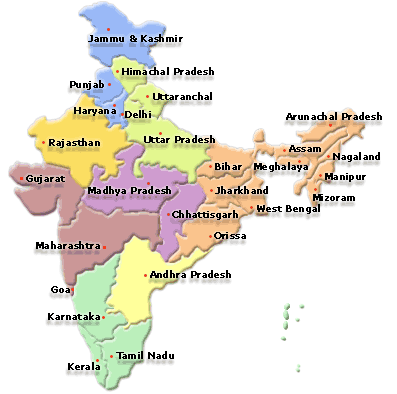
Map of India
Map of India

Before, I wrote about India’s election results and the decision of the ruling Congress Party to drastically cut income taxes. And I also wrote about China’s decision to cut taxes on purchases of new automobiles. So did those tax cuts work out for India and China?

Story from the Associated Press

Excerpt:

China extended its lead over the U.S. as the world’s biggest auto market in November, with production and sales both surpassing 1 million vehicles, and India saw sales jump 71.9-percent.

[…]China’s auto market is sizzling, thanks largely to tax cuts and subsidies aimed at supporting the industry and encouraging use of more fuel-efficient vehicles. The boom has clinched China’s status as the world’s biggest vehicle market due to languishing sales in the U.S.

[…]The surge is also a sign of how the Indian consumer — encouraged by government tax cuts, a big disbursement of back pay for government employees and falling interest rates — is fueling economic growth in Asia’s third-largest economy.

As everyone knows, the Democrats chose to bail out auto companies with taxpayer money and reward people with taxpayer money for destroying fully functional vehicles. And we all know how well that has worked out.

Chile poised to jump from the third world to the first world

Check out this editorial from Investors Business Daily. (podcast here)

Excerpt:

Chile is expected to win entry to OECD’s club of developed countries by Dec. 15 — a great affirmation for a once-poor nation that pulled itself up by trusting markets. One thing that stands out here is free trade.

[…]It’s not like Chile was born lucky. Only 30 years ago, it was an impoverished country with per capita GDP of $1,300. Its distant geography, irresponsible neighbors and tiny population were significant obstacles to investment and growth. And its economy, dominated by labor unions, wasn’t just closed, but sealed tight.

In the Cato Institute’s 1975 Economic Freedom of the World Report it ranked a wretched 71 out of 72 countries evaluated.

Today it’s a different country altogether. Embracing markets has made it one of the most open economies in the world, ranking third on Cato’s index, just behind Hong Kong and Singapore. Per capita GDP has soared to $15,000.

Besides its embrace of free trade, other reforms — including pension privatization, tax cuts, respect for property rights and cutting of red tape helped the country grow not only richer but more democratic, says Cato Institute trade expert Daniel Griswold.

But the main thing, Griswold says, is that the country didn’t shift course. “Chile’s economy is set apart from its neighbors, because they have pursued market policies consistently over a long period,” he said. “Free trade has been a central part of Chile’s success.”

Democrats oppose free trade, and their hostility to free trade angers many other countries in the world.

What does it take for a country to succeed?

I gave my Dad my copy of “Money, Greed and God” by Jay Richards, and although he thought that it started out slow, he’s warmed up to it. He calls me on the phone at least twice a day, and last night he alerted me to this web site, where you can track each countries average citizen’s life span and per-capita GDP over time. My Dad was pretty liberal on economics before, so naturally I’ve been working on him with lots of introductory books on economics. He’s read about a dozen now, and Thomas Sowell is his favorite.

Anyway, my Dad says that this is what a country needs to succeed:

  • free trade with other nations
  • the rule of law
  • low judicial activism
  • low tax rates
  • private property protections
  • currency not threatened by inflation
  • low government spending
  • minimal regulation of commerce

And at that web site, you can track the success of countries like Singapore and Hong Kong, which embrace conservative small government free market fiscal policies, and compare them with countries like Zimbabwe and North Korea, which embrace big government protectionist fiscal policies. Countries fail because they adopt the wrong policies. They succeed when they adopt the right policies. It doesn’t matter how poor they start, if they have the right policies, they grow rich over time.

Why are the Democrats so incompetent on economic policy?

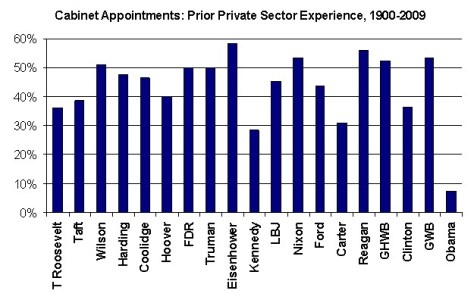
Well, it’s because there is almost no one in the Obama socialist regime who has ever run a business or worked in a business. Check out this graphic. (H/T Flopping Aces)

You can read more about the Obama administration’s ignorance of business and economics here in Forbes magazine.

This Reuters article discusses the price of economic ignorance: (H/T Gateway Pundit)

Excerpt:

Hunger is spreading while the number of homeless families is increasing as a result of the recession and other factors, according to a report on Tuesday.

The U.S. Conference of Mayors said cities reported a 26 percent jump in demand for hunger assistance over the past year, the largest average increase since 1991.

Middle-class families as well as the uninsured, elderly, working poor and homeless increasingly looked for help with hunger, which was mainly fueled by unemployment, high housing costs and low wages.

Democrats really don’t know what they are doing. It’s like putting pre-schoolers in charge of Amazon.com. It doesn’t work. Their ivory tower, silver-spoon worldview cannot comprehend real-world, grown-up complexities. So long as the Democrats continue to attack the businesses that employ citizens while redistributing wealth from people who produce to people who vote Democrat, our economic troubles will continue.

Related Cato Institute podcasts