
Tag Archives: Single-Payer

How well is government-run health care working out in socialist Venezuela?

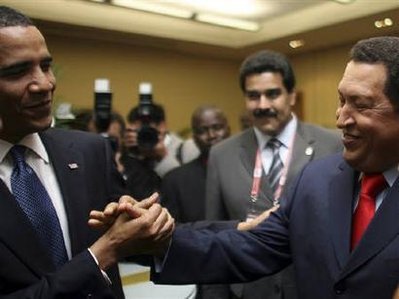
Are Barack Obama and Hugo Chavez very different?

Here is an article about government-run health care from the radically leftist New York Times, of all places.

Excerpt:

Doctors not allied with the government say many patients began dying from easily treatable illnesses when Venezuela’s downward economic slide accelerated after Chavez’s death from cancer in March. Doctors say it’s impossible to know how many have died, and the government doesn’t keep such numbers, just as it hasn’t published health statistics since 2010.

Almost everything needed to mend and heal is in critically short supply: needles, syringes and paraffin used in biopsies to diagnose cancer; drugs to treat it; operating room equipment; X-ray film and imaging paper; blood and the reagents needed so it can be used for transfusions.

Last month, the government suspended organ donations and transplants. At least 70 percent of radiotherapy machines, precisely what Gonzalez will need once her tumor is removed, are now inoperable in a country with 19,000 cancer patients — meaning fewer than 5,000 can be treated, said Dr. Douglas Natera, president of the Venezuelan Medical Federation.

[…]The country’s 1999 constitution guarantees free universal health care to Venezuelans, who sit on the world’s largest proven oil reserves. Maduro’s government insists it’s complying. Yet of the country’s 100 fully functioning public hospitals, nine in 10 have just 7 percent of the supplies they need, Natera said.

[…]Venezuela’s 400 private hospitals and clinics are overburdened and strapped for supplies, 95 percent of which must be imported, said Dr. Carlos Rosales, president of the association that represents them.

The private system has just 8,000 of the country’s more than 50,000 hospital beds but treats 53 percent of the country’s patients, including the 10 million public employees with health insurance. Rosales said insurers, many state-owned, are four to six months behind in payments and it is nearly impossible to meet payrolls and pay suppliers.

Worse, government price caps set in July for common procedures are impossible to meet, Rosales said. For example, dialysis treatment was set at 200 bolivars ($30 at the official exchange rate and less than $4 on the black market) for a procedure that costs 5,000 bolivars to administer.

[…]At Maracay’s 433-bed Central Hospital, mattresses are missing, broken windows go unrepaired and the cafeteria has been closed for a year. Paint peels off walls and rusty pipes lie exposed. In the halls, patients on intravenous drips lie recovering on gurneys.

[…]Broken anesthesia machines and battered stainless-steel instrument tables, some held together with tape, filled one of five idled operating rooms. Foul odors and water from leaky pipes continue to seep into the rooms, doctors said.

In August, cancer patients protested at the eight-month mark since the hospital’s two radiotherapy machines broke down. The machines remain out of order.

Half the public health system’s doctors quit under Chavez, and half of those moved abroad, Natera said.

Now, support staff is leaving, too, victim of a wage crunch as wages across the economy fail to keep up with inflation.

At the Caracas blood bank, Lopez said 62 nurses have quit so far this year along with half the lab staff. It now can take donations only on weekday mornings.

And here is a comment about a Chavez supporter who has been waiting for years for care: “Gonzalez says she adored Chavez for his anti-poverty programs, always voted for him and constantly applied for government benefits, though she never received any.” Yes. That’s what causes problems like this. Low-information voters voting for a charismatic strong man who tells them what they want to hear, and seizes wealth from the most-educated, productive citizens in order to hand it out to his supporters. But eventually, you run out of other people’s money to spend, and that’s where Venezuela is now. But they keep on digging their hole.

If you’re a big-government sort of person, then you would love the Venezuelan health care system. Price controls make sure that doctors and hospitals don’t make any money by providing care. Everyone is equal and you have to wait your turn in line whether you pay taxes or not. The only problem is that it’s capitalism – not communism – which cares about the needs of consumers. In a capitalist system, consumers buy what they like, and businesses compete with each other to lower prices and raise quality. Not so in a communist system, which forces the most talented people in the country to stop producing, or just leave the country completely.

Related posts

Doctor shortage: how Obamacare makes it harder to find a doctor

Remember how Obama promised that if you liked your doctor, then you could keep your doctor? It turns out that there is more to making policies than just saying what you’d like to do in a scripted campaign speech. The truth is that some health care policies will make you lose your doctor, regardless of what the President reads off of a teleprompter. Is Obamacare one of these policies? Let’s see.

Avik Roy writes about it in Forbes magazine.

Excerpt:

On Saturday, the Wall Street Journal reported that, due to Obamacare’s cuts to Medicare Advantage, among other factors, UnitedHealth expects its network of physicians “to be 85 percent to 90 percent of its current size by the end of 2014.” The result? Some retirees enrolled in Medicare Advantage will need to find new doctors. And it’s a trend that could accelerate in future years.

[…]Over the next ten years, Obamacare was designed to spend around $1.9 trillion on expanding health coverage to the uninsured. The law pays for this new spending with $1.2 trillion in new taxes, and $716 billion in cuts to Medicare, relative to prior law.

[…]The private insurers who supply Medicare Advantage plans, like UnitedHealth and Humana, have been responding to the cuts by squeezing out inefficiencies in the way they deliver care. One obvious way to do that is to pay doctors and hospitals less—or kick out the providers who refuse to accept lower reimbursement rates. And that’s what United has done, according to the WSJ report from Melinda Beck.

“Doctors in at least 10 states have received termination letters, some citing ‘significant changes and pressures in the health-care environment,’” writes Beck.

Another one of my favorite health care policy experts is the ex-Canadian Sally C. Pipes, who knows all about the horrors of single-payer health care. It killed her mother! Here’s what she had to say about the doctors shortage in a Forbes magazine article from earlier this year.

The first problem is that we have an aging doctor population and since we do such a poor job of educating our children (public school indoctrination centers) we aren’t making any new ones:

Right now, the United States is short some 20,000 doctors, according to the Association of American Medical Colleges. The shortage could quintuple over the next decade, thanks to the aging of the American population — and the aging and consequent retirement of many physicians. Nearly half of the 800,000-plus doctors in the United States are over the age of 50.

The second problem is that adding more regulations and burdensome paperwork makes a lot of people not want to be doctors any more:

Obamacare is further thinning the doctor corps. A Physicians Foundation survey of 13,000 doctors found that 60 percent of doctors would retire today if they could, up from 45 percent before the law passed.

The third problem is that the government isn’t reimbursing doctors as much as private insurance companies do, and it makes them refuse to take government-funded patients:

They’ve long limited the number of Medicaid patients they’ll treat, thanks to the program’s low reimbursement rates. According to a study published in Health Affairs, only 69 percent of doctors accepted new Medicaid patients in 2011. In Florida, just 59 percent do so. And a survey by the Texas Medical Association of doctors in the Lone Star State found that 68 percent either limit or refuse to take new Medicaid patients.

Medicaid pays about 60 percent as much as private insurance. For many doctors, the costs of treating someone on Medicaid are higher than what the government will pay them.

These underpayments have grown worse over time, as cash-strapped states have tried to rein in spending on Medicaid. Ohio hasn’t increased payments to doctors in three years; Kentucky hasn’t raised them in two decades. Colorado, Nebraska, South Carolina, Arizona, Oregon, and Arizona all cut payments in 2011.

By throwing nine million more people into the program without fixing this fatal flaw, Obamacare will make it even harder for Medicaid patients to find doctors.

It’s not just Medicaid that’s the problem, either. It’s the government-controlled exchanges.

Healthcare providers are signaling that they may turn away patients who purchase insurance through the exchanges, too.

In California, for example, folks covered by Blue Shield’s exchange plan will have access to about a third of its physician network. The UCLA Medical Center and its doctors are available to customers of just one plan for sale through the state exchange, Covered California. And the prestigious Cedars-Sinai Medical Center is not taking anyone with exchange insurance.

Now I know what you’re thinking – why not just force doctors to work for lower wages, like a good socialist country might? Well, that actually makes the shortage worse, because people don’t like to learn hard things and then work hard for little pay. And doctors work VERY hard – it’s not an easy profession to get into. That will just make all the doctors leave the country for other countries where they can be paid fairly for the work they do.

And in fact that is exactly what happened in a 100% socialized health care system in Venezuela, according to this report from the left-leaning Associated Press.

Excerpt:

Half the public health system’s doctors quit under Chavez, and half of those moved abroad, Natera said.

Now, support staff is leaving, too, victim of a wage crunch as wages across the economy fail to keep up with inflation.

At the Caracas blood bank, Lopez said 62 nurses have quit so far this year along with half the lab staff. It now can take donations only on weekday mornings.

I recommend reading that entire article for a glimpse of where the Democrats are trying to take us. There is not a dime’s worth of difference on policy between the Democrat party and the socialist party of Venezuela, except that the socialists have been in control in Venezuela for longer, and so they are further along the road to serfdom.

In other news, the Washington D.C. insurance commissioner was fired after raising concerns about the “fix” proposed by Obama in his speech last week. That’s also something that you might expect to see in a country like Venezuela. That’s what happens in authoritarian socialist countries. Whistleblowers and critics just disappear.

In North Dakota, 35,000 lose their health care plan, but only 30 sign up for Obamacare

I know that Obama talked a lot about wanting to help people without insurance find insurance, but so far all he done is make a lot of people lost their insurance (and more to come in 2014!).

Here’s a story from ABC News.

Excerpt:

More than 35,000 customers in North Dakota face discontinued health coverage because their plans are being scrapped due to new requirements under the Affordable Care Act.

The three major health insurers in North Dakota were asked to report to state regulators their enrollment figures and cancellations resulting from the health reform act, commonly known as Obamacare.

The state’s largest health insurer, Blue Cross Blue Shield of North Dakota, covers about 31,600 members – 17,000 in small groups and 14,600 individuals – whose insurance plans are being discontinued.

That combined figure represents 8 percent of the North Dakota Blues’ 400,000 membership total.

[…]The total number of North Dakota residents who must switch coverage is 35,585, according to the tally by the state Insurance Department.

“You have almost 36,000 North Dakotans who either are or will be losing their health insurance policies, and this is after they and all Americans have been told they will be able to keep their health insurance,” Insurance Commissioner Adam Hamm said Friday.

The premiums are all going up because Obamacare mandates new coverages, which people did not have on their old plans. They didn’t have those coverages because they didn’t need them. For example, people who weren’t addicted to drugs didn’t request treatments for drug addiction. But now we all have to pay for it, whether we use it or not. That makes prices go up!

More:

Under the new requirements, deductibles for individuals or small groups are generally capped at $2,000, with an exception allowing caps of up to $5,000 for individuals and $3,000 for small groups.

Total out-of-pocket expenses now cannot exceed $6,350 for an individual or $12,700 for a family.

Nationally, estimates of the percentage of policies that will be discontinued under the new coverage requirements have ranged from 40 percent to 67 percent, Krystopolski said.

In most cases, plans failed to meet the new requirements because they did not cover maternity care or because the deductibles were too high, she said.

So how many of those 35,585 people that the Democrats kicked out of their insurance plans have found new ones on the Obamacare exchanges?

Almost none:

Besides collecting information on cancellations, Hamm’s office asked the three major health insurers to report the number of enrollments under the new health insurance marketplace provided by the Affordable Care Act.

As of Friday, the three insurers have logged 30 enrollments covering 37 people, a number Hamm called “concerning.”

Remember that these figures only represent the effects of the individual mandate. Things are going to get a lot worse when the employer mandate takes effect in 2014. For those of us with health care through our employers, our day is coming.