
Tag Archives: Sean McDowell

Review of the book “Is God Just a Human Invention?”

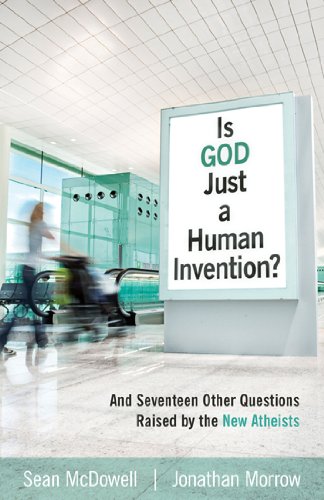
Is God Just A Human Invention?

The thorough, chapter-by-chapter review of the book is here at Apologetics 315.

Excerpt:

One of the brashest challenges that religious truth has experienced over the past several decades is the remarkable rise of the pugnacious New Atheists. Sean McDowell and Jonathan Marrow, new generation Christian apologists, have undertaken the task of contesting this anti-theistic upsurge. And in Is God Just a Human Invention? And Seventeen Other Questions Raised by the New Atheists the authors have pulled together a wide range of research that powerfully critiques the arguments from the combative non-theists.

[…]The authors deal with the scientific and philosophical challenges to Christian theism in a reasoned and respectful manner.

[…]Is God Just a Human Invention? is loaded with exceptional quotes from Christian and non-Christian thinkers. Additionally, the book furnishes very short essays at the back of each chapter from various erudite Christian scholars that augment the thesis of what was advanced by the authors.

This volume combines simplicity and applicability without forfeiting precision. The authors lead the reader into the full girth of the many contemporary discussions concerning the defense of Christianity. They offer several of the leading arguments for Christian theism while toppling some of the most belligerent of the objections promoted by the New Atheists. They have written, with abundant care, to attain a thoroughness that is not often established in popular books. The wisdom and excellence with which each chapter is written makes this a crucial volume for the budding apologist’s library.

Here are the 18 topics, and after each topic a Christian scholar discusses the relevance of each topic.

  1. Is Faith Irrational? (Commentary by: Gregory Koukl)
  2. Are Science and Christianity at Odds? (Commentary by: John Warwick Montgomery)
  3. Are Miracles Possible? (Commentary by: Gary R. Habermas)
  4. Is Darwinian Evolution the Only Game in Town? (Commentary by: William A. Dembski)
  5. How Did the Universe Begin? (Commentary by: R. Douglas Geivett)
  6. How Did Life Begin? (Commentary by: Fazale R. Rana)
  7. Why Is the Universe Just Right for Life? (Commentary by: Jay W. Richards)
  8. Has Science Shown There Is No Soul? (Commentary by: Dale Fincher and Jonalyn Fincher)
  9. Is God Just a Human Invention? (Commentary by: Garry DeWeese)
  10. Is Religion Dangerous? (Commentary by: Douglas Groothuis)
  11. Does God Intend for Us to Keep Slaves? (Commentary by: Paul Copan)
  12. Is Hell a Divine Torture Chamber? (Commentary by: Frank Turek)
  13. Is God a Genocidal Bully? (Commentary by: Clay Jones)
  14. Is Christianity the Cause of Dangerous Sexual Repression? (Commentary by: Kerby Anderson)
  15. Can People Be Good Without God? (Commentary by: Mark D. Linville)
  16. Is Evil Only a Problem for Christians? (Commentary by: Randy Alcorn)
  17. What Good Is Christianity? (Commentary by: Glenn S. Sunshine)
  18. Why Jesus Instead of the Flying Spaghetti Monster? (Commentary by: Darrell L. Bock)

If you’re looking for a good book on Christian apologetics for beginners, this is a great choice.

By the way, my Dad is currently reading my copy of this book! So it’s fine for normal people.

I have some book reviews that people have sent me in my inbox, so maybe I should be reading them and posting them too! I get a bit behind on e-mail, though.

Can atheists be moral? Sean McDowell and James Corbett debate

Brian Auten posted the audio a few milliseconds after the debate concluded!

Here is the MP3 file.

Sean’s case is similar to the one I make, but he only has 3 minimal requirements for morality.

First, he explains the difference between objective and subjective truth claims, and points out that statements of a moral nature are meaningless unless morality is objective. Then he states 3 things that are needed in order to ground objective morality.

  1. an objective moral standard
  2. free will
  3. objective moral value of humans

The question of the foundations of morality is without a doubt the easiest issue for beginning apologists to discuss with their neighbor. If you’re new, then you need to at least listen to his opening speech. He’s an excellent speaker, and his rebuttals are very, very smooth. The citations of atheist philosophers like Walter Sinnott-Armstrong, e.g. – to show that “religious” wars had nothing to do with religion, really hurt his opponent. He seems to cite prominent atheists like Thomas Nagel, Richard Taylor, Michael Shermer, etc., constantly in order to get support for his assertions. That took preparation. I can’t believe that McDowell is this calm in a debate situation.

When I listen to Frank Turek, he seems to struggle in his rebuttals. McDowell sounds like he foreknew exactly what his opponent would say and pre-wrote responses. He even had powerpoint slides made in advance for his rebuttals! I am not making this up – Corbett even remarked on it.

For those of you who want to understand how these things work, listen to the debate. There is a period of cross-examination if you like that sort of thing. I do!

EXTRA:

Sean McDowell on whether Christians should embrace postmodernism

The article by Sean McDowell is here.

Excerpt:

In Postmodern Youth Ministry, for example, Tony Jones argues that postmodernity is the most important culture shift of the past 500 years, upending our theology, philosophy, epistemology (how we know things), and church practice. It is an “earthquake that has changed the landscape of academia and is currently rocking Western culture.” (p. 11). Thus, to be relevant in ministry today, according to Jones and other postmodernists, we must shed our modern tendencies and embrace the postmodern shift.

For the longest time I simply accepted that we inhabit a postmodern world and that we must completely transform our approach to ministry to be effective today. But that all changed when I had the opportunity of hearing philosopher William Lane Craig speak at an apologetics conference not too long ago.

[…]In the introduction to Reasonable Faith, Craig provocatively claims, “Indeed, I think that getting people to believe that we live in a postmodern culture is one of the craftiest deceptions that Satan has yet devised” (p. 18). Accordingly, we ought to stop emphasizing argumentation and apologetics and just share our narrative. Craig develops this idea further:

And so Satan deceives us into voluntarily laying aside our best weapons of logic and evidence, thereby ensuring unawares modernism’s triumph over us. If we adopt this suicidal course of action, the consequences for the church in the next generation will be catastrophic. Christianity will be reduced to but another voice in a cacophony of competing voices, each sharing its own narrative and none commending itself as the objective truth about reality, while scientific naturalism shapes our culture’s view of how the world really is (p. 18-19).

In a personal email, Craig relayed to me that he believes postmodernism is largely being propagated in our church by misguided youth pastors. While he meant the comment more to elicit a smile than to be taken as a stab in the back, I can’t help but wonder if he is right.

There was a podcast that Sean did a while back on the worldview of Christian youth, where he explains how they think that religious claims are all basically personal preferences, not real knowledge that can be reasoned about and supported by evidence. It really eats into their ability to act in Christian ways when they don’t think Christianity is true.

My personal experiences with “Christian” postmodernism

Growing up, I was often confronted with the idea that God was not somehow insulated from logic and evidence. The main people who asserted that idea were the church leaders and campus club leaders. They were very skeptical of controversial doctrines like Hell, exclusive salvation, inerrancy and authorial intent. They didn’t like the law of non-contradiction, and they didn’t like historical or scientific evidence. Some others didn’t even like the idea that the Bible could override their emotions and intuitions.

As I grew older, I began to uncover why the postmoderns in leadership believed that God is not bound by the laws of logic, and that evidence was not as authoritative as personal experiences and stories. It was because of their desire for popularity. They did not want to have to confront people with exclusive and judgmental Christian claims. They did not want to have defend orthodox Christianity as true, using logic and evidence. The leaders even attacked the people who tried to introduce thinking and reasoning about Christian claims.

Postmodern Christians want to be able say to offer Christianity as one choice in a buffet, with the goal of addressing people’s felt needs. They say things like, “Christianity is true for me, and Hinduism is true for you“, in order to be accepted. And they feel, emotionally and intuitively, that non-judmentalism and non-exclusivism are right. Postmodernism helps them to justify their focus on popularity and their refusal to learn apologetics. They don’t want to learn facts, because they don’t want to have to defend Christianity as being objectively true.

Postmodern Christians are opposed to the idea that Christianity is knowledge, because “knowing for certain” takes away their ability to have “wiggle-room” when they want to do what all the other people are doing. They want to be able to keep God at arms-length when he is morally demanding, while keeping him within arm’s reach for emotional support, when needed – maybe just in private. God “exists” for postmoderns when they need comfort, and he doesn’t “exist” when they want autonomy from the moral law.