Tag Archives: Same-Sex Marriage

Do Supreme Court justices understand the reasons for traditional marriage?

This article from the Public Discourse takes a look at the oral arguments from the same-sex marriage case in progress at the Supreme Court.

Here’s the list:

  • Error Number One: Massachusetts Marriage Rates Have Stayed the Same
  • Error Number Two: Because Some Men Leave Their Wives and Children, Marriage Does Not Help Keep Fathers Around
  • Error Number Three: The Purpose of States’ Recognizing and Regulating Marriage is to Bestow Dignity on Couples
  • Error Number Four: The Only Harm to Legalizing Same-Sex Marriage Is Making Marriage More Adult-Centered
  • Error Number Five: There Is a Parallel between Brown/Loving and Lawrence/Obergefell
  • Error Number Six: Age Restrictions on Marriage Are Equivalent to the Definitional Element of One Man and One Woman

One of Obama’s Supreme Court picks is showing herself a poor thinker:

Error Number Two: Because Some Men Leave Their Wives and Children, Marriage Does Not Help Keep Fathers Around

Justice Sotomayor also committed what is commonly referred to as an exception fallacy. This is where someone reaches an overall conclusion about a group on the basis of a few exceptional cases. Thus, when Mr. Bursch was making the argument that redefining marriage to include same-sex couples will disconnect marriage from the long-held norm that the institution binds children to their biological mother and father, Justice Sotomayor responded:

Marriage doesn’t do that on any level. How many married couples do fathers with the benefits or the requirements of marriage walk away from their children? So it’s not that the institution alone does it and that without it that father is going to stay in marriage. He made a choice . . . Some mothers do the same thing.

This is a classic example of the exception fallacy. Of course some men and women walk away from their marriage and their children. But that is the exception, not the rule, and it is certainly counter to the social norm of marriage that gently pushes parents to stay together and raise their children.

It is rather shocking that a justice of the United States Supreme Court would claim that “on any level” marriage does not have that effect and longstanding purpose. It is also disappointing that she would commit such a basic error of logic.

I often encounter the problem among people with no math background. You cite statistics about what outcomes are expected, and they reply with an exceptional outlier to refute the argument. I’m troubled that Supreme Court justices lack the ability to reason in this way, though.

Here’s another pretty obvious mistake:

Error Number Four: The Only Harm to Legalizing Same-Sex Marriage Is Making Marriage More Adult-Centered

Several justices struggled to see how redefining marriage in genderless terms would cause any harm or have any impact on the institution of marriage. As Mr. Bursch correctly but incompletely argued, legalizing same-sex marriage will alter the institution to be primarily concerned with fulfilling the desires of adults rather than the needs of children.

But that’s not all. As the 100 Scholars of Marriage made clear in their amicus brief, several other important and beneficial social norms will be eroded, if not erased, by same-sex marriage, including:

– Gender-diverse parenting: the norm that children both need and deserve to be raised by a man and a woman, not only because of what they learn from interacting with a parent of each sex, but because men and women parent and interact with their children differently, providing distinct but complementary benefits. By its very structure, same-sex marriage eliminates this norm and its attendant benefits to children.

– Biological bonding: the norm that marriage binds children to their biological mother and father in a family unit. Same-sex marriage and parenting, by definition, means that at best only one of a child’s biological parents will be in the home. While death, divorce, or parental delinquency create exceptions, elevating the exception to the norm undermines that norm and the benefits it produces.

– Postponing or channeling procreation: the norm that procreation should only responsibly occur within the stable bonds of marriage. Same-sex marriage is not, and biologically cannot be, about procreation. By redefining marriage in this way, the institution becomes less about being the socially recommended “place” and “time” where procreation is recommended.

– Placing social value on raising children: the norm that society values and needs children to be born and raised by their parents. Again, same-sex marriage is not primarily about procreation, and its acceptance attenuates this norm for the institution as a whole. Of course, same-sex couples can adopt or one member of the couple can reproduce with someone of the opposite sex, but these are secondary purposes and behaviors.

What impact will the weakening or elimination of these norms have on the institution of marriage, and thus the behavior of society? Put another way, as Justice Breyer asked, “what’s the empirical connection?”

Well, the last major alteration to the institution of marriage—no-fault divorce—did have unintended negative consequences, reducing marriage rates and increasing divorce rates more than expected, with children and women suffering the consequences. Additionally, the Netherlands, the country that has had same-sex marriage the longest, after controlling for other factors, has experienced a drop in opposite-sex marriage rates among young women after adopting same-sex marriage.

The truth is, no one knows for sure what the effect will be—but it clashes with history, common sense, and theory to assume it will be innocuous.

The norm of gender-diverse parenting is important, because fathers and mothers are both needed.

Look at this abstract from a very new study to see why:

The association between family structure instability and children’s life chances is well documented, with children reared in stable, two-parent families experiencing more favorable outcomes than children in other family arrangements. This study examines father household entrances and exits, distinguishing between the entrance of a biological father and a social father and testing for interactions between family structure instability and children’s age, gender, and genetic characteristics. Using data from the Fragile Families and Child Wellbeing Study and focusing on changes in family structure by age (years 0–9), the authors show that father exits are associated with increases in children’s antisocial behavior, a strong predictor of health and well-being in adulthood. The pattern for father entrances is more complicated, with entrances for the biological father being associated with lower antisocial behavior among boys and social father entrances being associated with higher antisocial behavior. Child’s age does not moderate the association; however, genetic information in the models sharpens the findings substantially.

Biological fathers need to present in the home.

It doesn’t look like we will get a good legal decision on this case. The leftist judges are just not thinking clearly.
Most Americans believe that religious businesses can refuse gay wedding-related services

This poll is from CBS News.

It says:

A majority of Americans (57 percent) continue to say it should be legal for same-sex couples to marry, although that’s down three points from a high reached in February. Most Democrats (66 percent ) and independents (61 percent ) think same-sex marriage should be legal, while most Republicans (61 percent ) do not.

Still, just over half of Americans (51 percent) think small business owners should be allowed to refuse wedding services to same-sex couples if it violates their religious beliefs; 42 percent think those businesses should be required to provide those services. There are sharp partisan differences on this issue.

I found the numbers in this poll troubling – it seems to me that the support for same-sex marriage over religious liberty is worse than I thought.

According to this Washington Examiner article, Bobby Jindal and Ted Cruz appear to be the toughest defenders of religious liberty, with Walker and Rubio in the second tier.

It says:

Evangelical Christian voters are facing an unusual problem: they may have too many choices when it comes to the 2016 presidential election. Several Republican candidates are vying for their support, viewing the voting bloc as a key stepping stone to the nomination.

More than ever before, evangelical sources say, candidates will need to focus on the issue of religious liberty to win this crucial vote, especially in states like Iowa. Many evangelicals felt Indiana Gov. Mike Pence failed to stand up for his state’s Religious Freedom and Restoration Act, which animated conservative Christians across the country.

Steve Deace, a leading talk radio personality in Iowa, believes the impact of Pence’s decision on voters in his state cannot be understated. “There’s a better chance Hillary Clinton will be the [GOP] nominee next year than Mike Pence,” Deace told the Washington Examiner. “Religious freedom is going to be the biggest issue. It has become a transcendent issue. It’s bigger than life, it’s bigger than marriage.”

[…]Bob Vander Plaats, the CEO of the social conservative group the Family Leader, is a kingmaker of sorts in Iowa who has gained influence in the state by leading the effort to remove three Iowa Supreme Court judges from office because of a decision in favor of gay marriage. In 2008, he endorsed former Arkansas Gov. Mike Huckabee. In 2012, he picked former Sen. Rick Santorum, R-Pa.

This time, Vander Plaats expects to endorse someone around the Thanksgiving holiday, and said Huckabee, Louisiana Gov. Bobby Jindal, and Texas Sen. Ted Cruz are the Republicans that have already impressed him.

[…]Deace said that after the candidate forum he moderated in Des Moines, Iowa, last month, he believes Cruz and Jindal to be the early favorites among evangelical voters. But many evangelical voters, he says, have interest in Florida Sen. Marco Rubio and Wisconsin Gov. Scott Walker, and have not yet made a decision. Unlike recent elections past, Deace says evangelical listeners who are loyal members of his audience want someone who has the organization and financing capable of winning the Republican nomination.

“They’re tired of the false choice of choosing between the guy who believes in something and the guy who raises a bunch of money,” Deace said. “They want the guy who believes in something to raise a bunch of money. … They’re not necessarily looking for the nice guy, or the guy who says ‘Jesus’ the most.”

Evangelicals have several good candidates this time in the primary. I am still favoring Jindal and Walker above all the others, and I’m happy to see that they are seen as solid on religious liberty.

Warning: if the Supreme Court legalizes same-sex marriage, you could lose your church

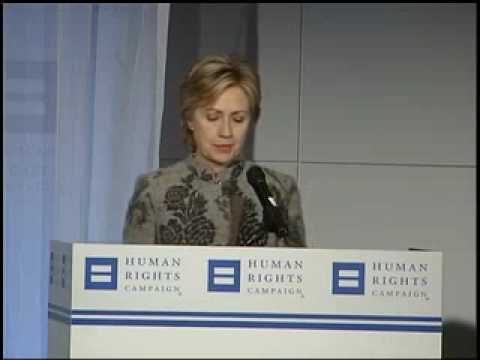
Hillary Clinton and the Human Rights Campaign

This is by John Zmirak, who is writing at The Stream. You should read the whole thing.

He writes:

If you aren’t following the arguments over same-sex marriage before the Supreme Court, you should be. Even if you don’t cater weddings or sell pizza in Indiana, your religious freedom is in danger. For detailed accounts of the debate and the questions asked by justices that might be readable tea leaves, see Ryan Anderson’s analysis and the capsule summary provided by Russell Moore and Andrew T. Walker.

The outcome of this week’s debate will determine whether orthodox American Christians will fall to the status of dhimmis, the third-class Christian citizens of sharia Muslim states. (Dhimmis have bare freedom of worship, but pay special, heavy taxes and are excluded from any positions of influence.) If the court imposes same-sex “marriage,” it will be exposing the churches attended by the majority of Americans to sustained legal attack. Does that sound like crazy alarmism? The Solicitor General of the United States agrees with me. Except that he is in favor of it.

Justice Samuel Alito asked Solicitor General Donald Verrilli whether acceptance of same-sex marriage would subject orthodox Christian churches to the treatment once accorded Bob Jones University, which lost its tax-exempt status because its ban on interracial dating contradicted federal policy. Verrilli seemed a little taken aback, then answered yes, “it’s certainly going to be an issue.”

In other words, if the Supreme Court votes against natural marriage, it will free up the feds to target organizations you might have heard of, such as the Catholic Church and the Southern Baptist Convention. (In theory, the feds might also take aim at every mosque in America, but something tells me that the mosques are likely to get a pass.) Remember that the Obama administration has already tried to force these same churches to provide abortifacients to their employees. Attacking their tax-exempt status over biblical sexual ethics is peanuts next to that.

In case you don’t follow tax policy as a hobby, see Joe Carter’s detailed account of the grave consequences this would have for churches. Put briefly, most would close. Unless, of course, they caved.

Imagine if your house of worship needed to turn a hefty profit, so it could pay the same taxes on its property and income as a casino or a strip joint — unlike Planned Parenthood, since that abortion business is a tax-exempt (and federally funded) “charity.” Imagine if none of the money you gave your church were deductible from your taxes, unlike the money you sent to Greenpeace. Many if not most religious schools and colleges would also shut their doors, unable to pay the same business taxes as for-profit diploma mills.

The First Amendment won’t prevent any of this. When the dictates of a religion conflict with what courts have ruled is a constitutional right, the church’s claims give way every time.

Practical point:

When presidential candidates come to our states to court us during the primaries — the only time faithful Christians exercise any real leverage in this country — the issue of same-sex marriage must now rival abortion in its importance. Any hopeful should be pressed repeatedly to give a straight, unambiguous answer to this question: “Do you support a constitutional amendment restoring natural marriage? If not, then what exactly will you do to protect my religious freedom? If nothing, why should I support you?” We should print that question on cards and distribute it in Iowa and New Hampshire, and candidates should hear nothing else from us till they answer. We need to know whether a year from now we will be living like Americans, or increasingly like Christians in China.

You don’t have to speculate about these things, you just have to look north to Canada, or east to Europe, where the secular leftists are much stronger. Same-sex marriage is a club that the secularist leftists can use to get publicly expressed religious convictions out of the public square, once and for all. All they have to do is leverage sentiments of tolerance that come from religion to pass the gay marriage law, and then use the gay marriage law to get rid of the moral convictions that make it harder for them to do what they want without feeling ashamed. And it’s working, because we have reduced Christianity to emotions, instead of grounding it on reason and evidence. It’s all about feeling good now, and feeling good is more important to most Christians than respecting God’s actual character.