
Tag Archives: Robert Gates

Government troops shooting protesters in Syria

Now that violence has broken out in Jordan and Syria, countries where we have much more vital strategic interests, will Obama open up a fourth and a fifth military front as well?

Excerpt:

Even as the Obama administration defends the NATO-led air war in Libya, the latest violent clashes in Syria and Jordan are raising new alarm among senior officials who view those countries, in the heartland of the Arab world, as far more vital to American interests.

Deepening chaos in Syria, in particular, could dash any remaining hopes for a Middle East peace agreement, several analysts said. It could also alter the American rivalry with Iran for influence in the region and pose challenges to the United States’ greatest ally in the region, Israel.

In interviews, administration officials said the uprising appeared to be widespread, involving different religious groups in southern and coastal regions of Syria, including Sunni Muslims usually loyal to President Bashar al-Assad. The new American ambassador in Damascus, Robert Ford, has been quietly reaching out to Mr. Assad to urge him to stop firing on his people.

As American officials confront the upheaval in Syria, a country with which the United States has icy relations, they say they are pulled between fears that its problems could destabilize neighbors like Lebanon and Israel, and the hope that it could weaken one of Iran’s key allies.

The Syrian unrest continued on Saturday, with government troops reported to have killed more protesters.With 61 people confirmed killed by security forces, the country’s status as an island of stability amid the Middle East storm seemed irretrievably lost.

For two years, the United States has tried to coax Damascus into negotiating a peace deal with Israel and to moving away from Iran — a fruitless effort that has left President Obama open to criticism on Capitol Hill that he is bolstering one of the most repressive regimes in the Arab world.

[…]Indeed, the crackdown calls into question the entire American engagement with Syria. Last June, the State Department organized a delegation from Microsoft, Dell and Cisco Systems to visit Mr. Assad with the message that he could attract more investment if he stopped censoring Facebook and Twitter. While the administration renewed economic sanctions against Syria, it approved export licenses for some civilian aircraft parts.

The Bush administration, by contrast, largely shunned Damascus, recalling its ambassador in February 2005 after the assassination of a former Lebanese prime minister, Rafik Hariri. Many Lebanese accuse Syria of involvement in the assassination, a charge it denies.

When Mr. Obama named Mr. Ford as his envoy last year, Republicans in the Senate held up the appointment for months, arguing that the United States should not reward Syria with closer ties. The administration said it would have more influence by restoring an ambassador.

Diplomacy only works when it is backed by the CREDIBLE threat of FORCE. For two years, Obama didn’t show that he was willing to use force, and it emboldened the Iran-backed Syrian government to behave violently. Look at how Obama fumbled the Iranian election, where civilians were being shot down in the streets. That’s what causes violence – appeasement of evil. If evil people thought that they were going to have to pay a price for being evil, then they wouldn’t be evil. Obama made friends with bad people – he emboldened them to do bad things.

What is the strategic advantage of war in Libya?

From ABC News.

Excerpt:

Secretary of Defense Robert Gates said that Libya did not pose a threat to the United States before the U.S. began its military campaign against the North African country.

On “This Week,” ABC News’ Senior White House Correspondent Jake Tapper asked Gates, “Do you think Libya posed an actual or imminent threat to the United States?”

“No, no,” Gates said in a joint appearance with Secretary of State Hillary Clinton. “It was not — it was not a vital national interest to the United States, but it was an interest and it was an interest for all of the reasons Secretary Clinton talked about.  The engagement of the Arabs, the engagement of the Europeans, the general humanitarian question that was at stake,” he said.

Why didn’t the Obama administration go to Congress before engaging in military action in oil-rich Libya?

During his campaign for the Presidency, in December, 2007, Barack Obama told The Boston Globe that “The President does not have power under the Constitution to unilaterally authorize a military attack in a situation that does not involve stopping an actual or imminent threat to the nation.”

Earlier in 2007, then-Senator Hillary Clinton said in a speech on the Senate floor that, “If the administration believes that any — any — use of force against Iran is necessary, the President must come to Congress to seek that authority.”

Bush debated the war in Iraq for 6 months and got permission from Congress before going in. Why couldn’t Obama do it? Why does Obama have to rush to war?
Is the Obama administration deliberately weakening our military?

Who needs air superiority? Not Obama

Consider this article from the Weekly Standard. (H/T ECM)

Excerpt:

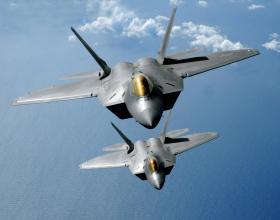
When Secretary of Defense Robert Gates went to Chicago last summer to make the case for killing the F-22 — the world’s premier air supremacy fighter and the only “fifth generation fighter” currently in production anywhere — he argued that the F-35 Joint Strike Fighter would be a more cost-effective alternative. Though the JSF “has had development problems to be sure,” Gates said, “It is a versatile aircraft, less than half the total cost of the F-22, and can be produced in quantity with all the advantages produced by economies of scale – some 500 will be bought over the next five years.”

[…]But the oddest thing about Gates’s speech last summer was his assertion that competitors to the United States, specifically China, would be unable to produce their own fifth-gen fighters any time soon. “Consider that by 2020, the United States is projected to have nearly 2,500 manned combat aircraft of all kinds,” Gates said, while “China, by contrast, is projected to have no fifth generation aircraft by 2020.”

[…]We know now that Gates’s estimate of U.S. procurement last summer was bogus. We will be nowhere near 2,500 fifth-gen aircraft (F-35s and F-22s) by 2020. And now Gates has conceded that China will, in fact, have produced a fifth-generation stealth fighter by 2020. How many will they have produced? How many will we have produced? We can only be sure of two things: Gates doesn’t know, and he killed the F-22 based on a faulty assumption that the number of Chinese stealth fighters in 2020 would be zero.

I am a HUGE fan of the F-22 and I hate the F-35.

China should not be underestimated

And what about this article from Investors Business Daily?

Excerpt:

From the Battle of Midway to President Reagan’s 600-ship fleet that helped win the Cold War, naval supremacy has been critical to the protection and survival of our nation.

Which is why we find the recent remarks of Defense Secretary Robert Gates to the Navy League at the Sea-Air-Space expo so disturbing. He seems to think naval supremacy is a luxury we can’t afford and that, like every other aspect of our military, an already shrunken U.S. Navy needs to downsize.

“As we learned last year, you don’t necessarily need a billion-dollar guided missile destroyer to chase down and deal with a bunch of teenage pirates wielding AK-47s and RPGs (rocket-propelled grenades),” Gates quipped.

We are not laughing.

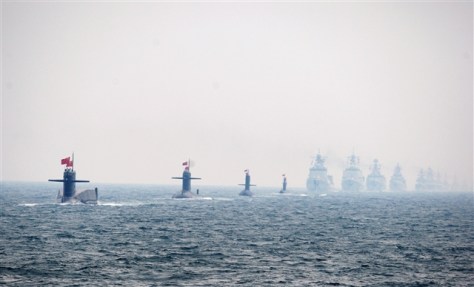
Pubescent pirates aren’t the only threat we face. Last month, a Chinese naval task force from the East Sea Fleet — including the imposing Sovremenny-class guided missile destroyers, frigates and submarines — passed through the Miyako Strait near Okinawa, a move that sent shock waves through Japan.

Sovermenny vessels are DDGs not DDs. That means that they have guided-missile capability via the SS-N-22 surface-to-surface platform. That missile has a range of 160 nautical miles, flies at Mach 3, and is fairly dangerous. Fire enough of them and one is bound to get through. What if these weapons were sold to our enemies and used to menace commercial and civilian shipping? It’s the next level of piracy.

We need more carrier battle groups, not less. Carrier battle groups are the most visible way of projecting American power abroad in theaters where we face dangerous repressive regimes like North Korea and Iran. It’s good that countries like India are stepping up by building two new conventionally-powered aircraft carriers and support vessels, but we have to pull our own weight, too.

Obama’s naive foreign policy increases likelihood of war in Middle East

The Wall Street Journal explains.

Excerpt:

Events are fast pushing Israel toward a pre-emptive military strike on Iran’s nuclear facilities, probably by next spring. That strike could well fail. Or it could succeed at the price of oil at $300 a barrel, a Middle East war, and American servicemen caught in between. So why is the Obama administration doing everything it can to speed the war process along?

The article lists various elements of Obama’s weak stance against Iran, then continues:

[…]All this only helps persuade Israel’s skittish leadership that when President Obama calls a nuclear-armed Iran “unacceptable,” he means it approximately in the same way a parent does when fecklessly reprimanding his misbehaving teenager. That impression is strengthened by Mr. Obama’s decision to drop Iran from the agenda when he chairs a meeting of the U.N. Security Council on Sept. 24; by Defense Secretary Robert Gates publicly opposing military strikes on Iran’s nuclear facilities; and by Russia’s announcement that it will not support any further sanctions on Iran.

In sum, the conclusion among Israelis is that the Obama administration won’t lift a finger to stop Iran, much less will the “international community.” So Israel has pursued a different strategy, in effect seeking to goad the U.S. into stopping, or at least delaying, an Israeli attack by imposing stiff sanctions and perhaps even launching military strikes of its own.

How do you think Iran would respond to such an air strike? Their entire land force would be left largely intact. Do you think they are just going to take that and do nothing to retaliate? This is a nightmare.