The video is here:
I highly recommend this debate.

The video is here:
I highly recommend this debate.
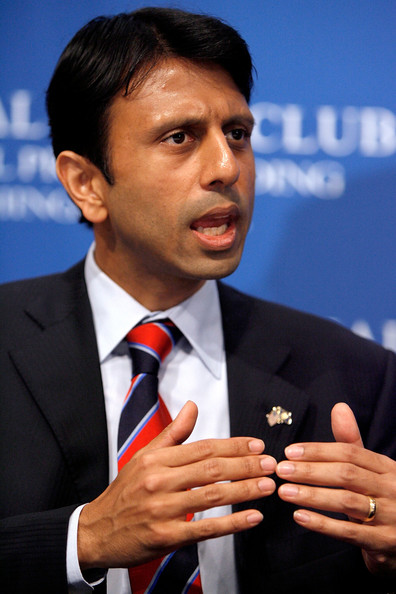
From the Philadelphia Inquirer.
Excerpt:
One gubernatorial election ended early this fall, when Louisiana Gov. Bobby Jindal won the state’s blanket primary Oct. 22. Under Louisiana’s system, all candidates of all parties are listed on the ballot, and if no one gets 50 percent, the top two finishers go to a runoff. Jindal blew past the threshold with 66 percent.
Jindal’s reelection was unusual in several respects. The only previous time the state has not had a runoff was his election in 2007. He is only the fourth Republican governor in the last 125 years in Louisiana, and one of those four switched over from the Democrats in office. Jindal’s best-known challenger this year was a schoolteacher, who raised less than 1 percent of the incumbent’s campaign treasury. The Democratic State Central Committee declined to endorse any candidate running on its party label.
But perhaps most unbelievable is that Jindal faced no serious competition after cutting state spending more than 25 percent. In January 2008, the state had a budget of $34.3 billion. This summer, Jindal signed into law a budget spending $25 billion. As governors from Harrisburg to Trenton to Columbus to Madison have learned, cutting a state’s budget is difficult enough; doing so without a significant backlash seems a politically impossible task.
A key part of Jindal’s story is recognizing that he took the helm of a state that had hit bottom: Decades of mismanagement and corruption had taken their toll even before Hurricane Katrina wreaked such devastation and exposed such colossal unresponsiveness in state government. The state, recognizing the bitter fruit of its traditions of colorful corruption, was ready to take a chance on a then-37-year-old Indian American congressman who speaks roughly 100 words per minute. The state was willing to try a new approach to governing; how much worse could it be?
Privatization played a big role in Jindal’s reinvention of state government, with private contractors taking over state-run operations for a lesser cost. The companies often hired the state workers who would often be the centerpiece of opponents’ criticism.
His administration privatized the state’s Office of Risk Management. Then the state’s Division of Administration privatized claims management and loss prevention in the self-insurance program, saving $20 million over five years. The Department of Health and Hospitals privatized six inpatient, residential-treatment programs around the state, saving $2.5 million. Separately, patients were moved from state-operated institutions that cost $600 or more per patient per day to community-based services and private group homes that average $191 per day, saving an additional $23.8 million.
Consolidation was another key element: The state’s Department of Revenue shrank from eight offices statewide to three. The Department of Children and Family Services consolidated its offices from 157 to 90, saving a total of $2.7 million.
But some of Jindal’s cuts are the old-fashioned kind. The state sold 1,300 vehicles from its fleet of automobiles. Louisiana’s Transportation Department shut down a ferry that was used by only 7,200 drivers per year, saving the state roughly three-quarters of a million dollars.
In fiscal 2011, Louisiana eliminated more than 3,500 full-time government positions. Add the 6,363 previous reductions during Jindal’s term, and that means a total of almost 9,900 full-time positions reduced since he took the oath, a savings of almost $600 million. Louisiana now has the lowest level of full-time state government employees in almost 20 years.
“You change people’s expectations and you make structural changes,” Jindal said, while racing around the state about three weeks before the election. “The most important is this cultural change, to say government is not the answer to everything. In a weird way, I want the office of governor to be less important than it is. What I mean by that is, there was an old joke that kids in Louisiana don’t grow up wanting to be president; they grow up wanting to be governor. You should want them to want to business leaders or doctors or teachers.”
Some cuts were more noticeable to the public, but Louisianans found shorter hours and workweeks at state facilities more palatable than complete shutdowns or higher taxes: Historic sites are now open five days a week instead of seven, pools at a half dozen state parks were closed on Mondays and Tuesdays this summer, and entrance stations at all state parks had shorter hours. Finally, 54,000 rank-and-file state workers are going without a raise for the second consecutive year.
Jindal’s first term was marked by several high-profile crises he successfully managed – Hurricane Gustav and the response to the BP oil spill, along with the Obama administration’s six-month moratorium on all drilling in the Gulf of Mexico – but the state’s economy has generally chugged along: Louisiana’s unemployment rate is 7.1 percent, two percentage points lower than the national average, and a comparably booming economy makes cuts in state spending much easier to take.
“If you have a good-paying job with benefits, you wouldn’t need the state to do so many things for you,” Jindal says. “You become less dependent, and that diminishes the role of the state and so you need fewer state employees, and it’s a virtuous cycle. You can lower taxes and lower government spending.”
Louisiana is a swing state. If Bobby Jindal can cut government spending in a swing state and get re-elected with 66% of the vote, then we do have hope that the American people will do the right thing. Maybe we just need to hit bottom with Obama so that we realize that competence does matter after all. We have a deep, deep bullpen for future elections. Governors like Scott Walker (Wisconsin), Rick Scott (Florida) and John Kasich (Ohio)would be excellent presidential candidates. And of course we have Marco Rubio and soon-to-be senators Josh Mandel and Ted Cruz waiting in the wings.
Newt Gingrich on health care
From the Wall Street Journal. (H/T Reason to Stand)
Excerpt:
White House hopeful Newt Gingrich called the House Republican plan for Medicare “right-wing social engineering,” injecting a discordant GOP voice into the party’s efforts to reshape both entitlements and the broader budget debate.
In the same interview on Sunday, Mr. Gingrich backed a requirement that all Americans buy health insurance, complicating a Republican line of attack on President Barack Obama’s health law.
The former House speaker’s decision to stick with his previous support for an individual mandate comes days after former Massachusetts Gov. Mitt Romney defended the health revamp he championed as governor, which includes a mandate.
The moves suggest the Republican primary contest, which will include both men, could feature a robust debate on health care, with GOP candidates challenging the Democratic law while defending their own variations.
Newt Gingrich opposes Paul Ryan’s reforms
Consider this article from National Review.
Excerpt:
Newt Gingrich’s appearance on “Meet the Press” today could leave some wondering which party’s nomination he is running for. The former speaker had some harsh words for Paul Ryan’s (and by extension, nearly every House Republican’s) plan to reform Medicare, calling it “radical.”
“I don’t think right-wing social engineering is any more desirable than left-wing social engineering,” he said when asked about Ryan’s plan to transition to a “premium support” model for Medicare. “I don’t think imposing radical change from the right or the left is a very good way for a free society to operate.”
As far as an alternative, Gingrich trotted out the same appeal employed by Obama/Reid/Pelosi — for a “national conversation” on how to “improve” Medicare, and promised to eliminate ‘waste, fraud and abuse,’ etc.
Newt Gingrich on Hillary Clinton
More from the leftist New York Times.
Excerpt:
For Ms. Clinton, standing side by side with her husband’s onetime nemesis gives her the chance to burnish her credentials among the moderates she has been courting during her time in the Senate.
But in comments this week, she portrayed the rapprochement as one born of shared policy interests, not calculated politics.
“I know it’s a bit of an odd-fellow, or odd-woman, mix,” she said. “But the speaker and I have been talking about health care and national security now for several years, and I find that he and I have a lot in common in the way we see the problem.”
For his part, Mr. Gingrich, who helped lead the impeachment fight against President Bill Clinton, called Mrs. Clinton “very practical” and “very smart and very hard working,” adding, “I have been very struck working with her.”
Newt Gingrich on global warming
Newt Gingrich on foreign policy
Newt Gingrich endorsed a pro-abortion, pro-same-marriage candidate
Remember when Newt Gingrich endorsed the RINO Dede Scozzafava in New York?
Excerpt:
In a major coup for her campaign, Republican Dede Scozzafava today will pick up the endorsement of Newt Gingrich, one of the nation’s leading conservative figures and the architect of the “Republican Revolution” in the mid-1990s.
“The special election for the 23rd Congressional District is an important test leading up to the mid-term 2010 elections,” Gingrich said in a statement to supporters. “Our best chance to put responsible and principled leaders in Washington starts here, with Dede Scozzafava.”
The endorsement is important for Scozzafava, a social moderate, as she attempts to hold onto a conservative base eroded by Doug Hoffman, the Conservative Party candidate in the thee-way 23rd District race.
[…]Hoffman has mounted a late surge in the special election with endorsements by prominent conservatives that include former Republican Sen. Fred Thompson; Campaign for Working Families founder Gary Bauer; and the conservative Club for Growth in Washington, D.C.
Scozzafava’s candidacy is also reported to have triggered a deep divide among House Republicans, with some of the most conservative members refusing to support her campaign.
But Gingrich, who served as Speaker of the House from 1995 to 1999, wants to unite the party. He sees Scozzafava and the Upstate special election – the only House race in the nation this fall — as the best hope for Republicans to start a comeback and regain control of Congress.
Gingrich is apparently willing to overlook Scozzafava’s support for same-sex marriage and abortion rights.
The conservative Club for Growth lists some of his fiscal blunders.
Excerpt:
The second large error in Gingrich’s entitlement record was equally troubling: the former Speaker played a high profile advocacy role on behalf of President George W. Bush’s Medicare prescription drug benefit bill in 2003. Gingrich penned several op-eds supporting the general thrust and specific provisions of the bill, urging House Republicans to pass what was billed at the time to be a $400 billion expansion of the federal government.
[…]In the 2009 special election for Congress in New York’s 23rd district, Gingrich was outspoken in his support of liberal Republican nominee Dede Scozzafava, up to the moment she finally quit the race after center-right voters rallied behind Conservative Party nominee Doug Hoffman. Long after most prominent conservatives had endorsed Hoffman, Gingrich held firm in his advocacy for a liberal candidate who supported Obama’s stimulus plan and the pro-union “card check” proposal, among other bad positions.
In 2010, Gingrich openly campaigned for embattled U.S. Senator Robert Bennett in Utah, whom Gingrich’s wrongly called “a true-blue conservative.” In 2008, Gingrich aggressively supported and campaigned for liberal Congressman Wayne Gilchrist (R-MD) when he faced a conservative challenge from now-Congressman Andy Harris. In 2006, same thing, when Gingrich backed liberal Congressman Joe Schwarz (R-MI) when he was challenged by conservative now-Congressman Tim Walberg.
Unfortunately, the problems in Speaker Gingrich’s record are frequent enough and serious enough to give pause. On two of the most important recent issues that confronted limited government conservatives (creating the new budget busting Medicare drug entitlement, and the Wall Street bailout), Gingrich was on the wrong side. His advocacy of an individual health care mandate is problematic. His penchant for tinkering with rewards for favored industries and outcomes shows a troubling willingness to use federal power to coerce taxpayers into his preferred direction. And his occasional hostility toward conservatives who do not share his desire to support liberal Republicans or to compromise on matters of principle is worrisome.
Maybe he is actually running to win the Democrat nomination this time.
 WINTERY KNIGHT