Tag Archives: Religious Liberty

Highlights from day one of the Masterpiece Cakeshop Supreme Court case

Kristen Waggoner of Alliance Defending Freedom argued Jack Phillips’ case before the Supreme Court. (Photo: Jeff Malet/The Heritage Foundation) Kristen Waggoner of Alliance Defending Freedom argued Jack Phillips’ case before the Supreme Court. (Photo: Jeff Malet/The Heritage Foundation)

I thought it might be worth reading about the first day of arguments in the Masterpiece Cakeshop case. Not only can we find out what is likely to happen, but we’ll also learn how the ADF lawyer Kristen Waggoner is making her defense.

The Daily Signal reports:

The Supreme Court heard oral arguments on Tuesday in a closely watched case dealing with free speech, religious liberty, and same-sex marriage.

Specifically, the justices considered whether the state of Colorado can force Jack Phillips, a Christian baker, to create a custom cake for a same-sex wedding against his deeply held religious beliefs.

Attorneys for Phillips clearly explained that he seeks to exercise his freedom only to speak messages that he agrees with, while still welcoming all customers into his store. The First Amendment’s free speech and religious liberty clauses protect his freedoms to do just that.

In a lengthy and charged oral argument, the nine justices wrestled with how Americans who hold different views on marriage in our post-Obergefell society can continue to live with each other in mutual respect.

Here is the key that might predict the outcome, from the Supreme Court’s swing vote:

In one of the most charged exchanges of the day, Justice Anthony M. Kennedy questioned Colorado Solicitor General Frederick Yarger about whether a member of the Colorado Civil Rights Commission who compared Phillips to a racist and a Nazi demonstrated anti-religious bias—and that, if he did so, whether the judgment against Masterpiece should stand.

More:

After disavowing the commissioner’s comments, Yarger argued that the ruling should still stand. But Kennedy returned to the issue again, telling Yarger that “tolerance is essential in a free society. And tolerance is most meaningful when it’s mutual. It seems to me that the state in its position here has been neither tolerant nor respectful of Mr. Phillips’ religious beliefs.”

Kennedy also pointed out there were other cake shops that would have accommodated Charlie Craig and David Mullins, the same-sex couple who requested a cake for their wedding.

In a similar line of questioning, Justice Samuel Alito pointed out that the state of Colorado had failed to demonstrate mutual tolerance when it only protected the freedom of cake artists who landed on one side of the gay marriage debate—namely, the state’s side.

When three religious customers went to cake artists to request cakes that were critical of same-sex marriage, those cake artists declined—yet Colorado did not apply its anti-discrimination statute to punish the artists. But when Phillips declined to create a cake to celebrate a same-sex marriage, Colorado imposed a three-pronged penalty that drove him out of the wedding cake business, causing him to lose 40 percent of his business.

[…]In the exchange with Alito, the Colorado solicitor general said that cake artists could not discriminate on the basis of identity, but could discriminate on the basis of messages. Gorsuch later responded, saying that’s exactly what Phillips has argued.

It was also made clear that Phillips was not discriminating against identity, but just refusing to agree with the state’s position on same-sex marriage.

During the oral arguments, the court appeared to recognize what is patently obvious from the facts. Phillips welcomes all people into his store, encourages them to buy off-the-shelf items, and will make custom-designed cakes for them provided they don’t ask for items that violate his beliefs.

He has served gays for the 24 years his store has been in operation and welcomes their business to this day. He does not discriminate against anybody because of their identity.

So comparisons to shopkeepers in the Jim Crow South who sought to keep the races “separate but equal” are a smear that divert attention from the real issue: Phillips simply disagrees with the state on the issue of marriage.

More:

Finally, the oral arguments revealed the scope of how far the state of Colorado is willing to go to impose its views of marriage on citizens. In one line of questioning from Roberts, Colorado admitted that it would force Catholic Legal Services to provide a same-sex couple with legal services related to their wedding even if it violates Catholic teachings on marriage.

And in questioning from Alito, the ACLU answered that the state could force a Christian college whose creed opposes same-sex marriage to perform a same-sex wedding in its chapel.

I was listening to the latest Ben Shapiro podcast, and in the last 10 minutes, he talked about the case. He pointed out that at the time when Phillips refused to participate in a same-sex marriage, same-sex marriage was not even legal in Colorado. Nevertheless, Colorado went after him. Hard. I think they secular left is going to lose this case – it’s just too much fascism. Too much intolerance.

You can read more about Kristen Waggoner here. She’s also arguing the Arlen’s Flowers v. the State of Washington case. A great lady. A real hero.

If you’re looking for a great book to read on what comes after same-sex marriage and how to discuss and debate it, read Ryan T. Anderon’s “Truth Overruled: The Future of Marriage and Religious Liberty“. It’s the best book for laymen on the subject. Really helps you to know how to talk about this issue. I had to do it a week ago with one of my atheist co-workers who asked ME out to lunch to talk more about his spiritual journey. If you don’t read, you can’t defend.
Documented cases of discrimination against religious people skyrocketing

Discrimination against religious people

Consider this story from the Daily Signal, and keep in mind that these are only the documented cases.

Excerpt:

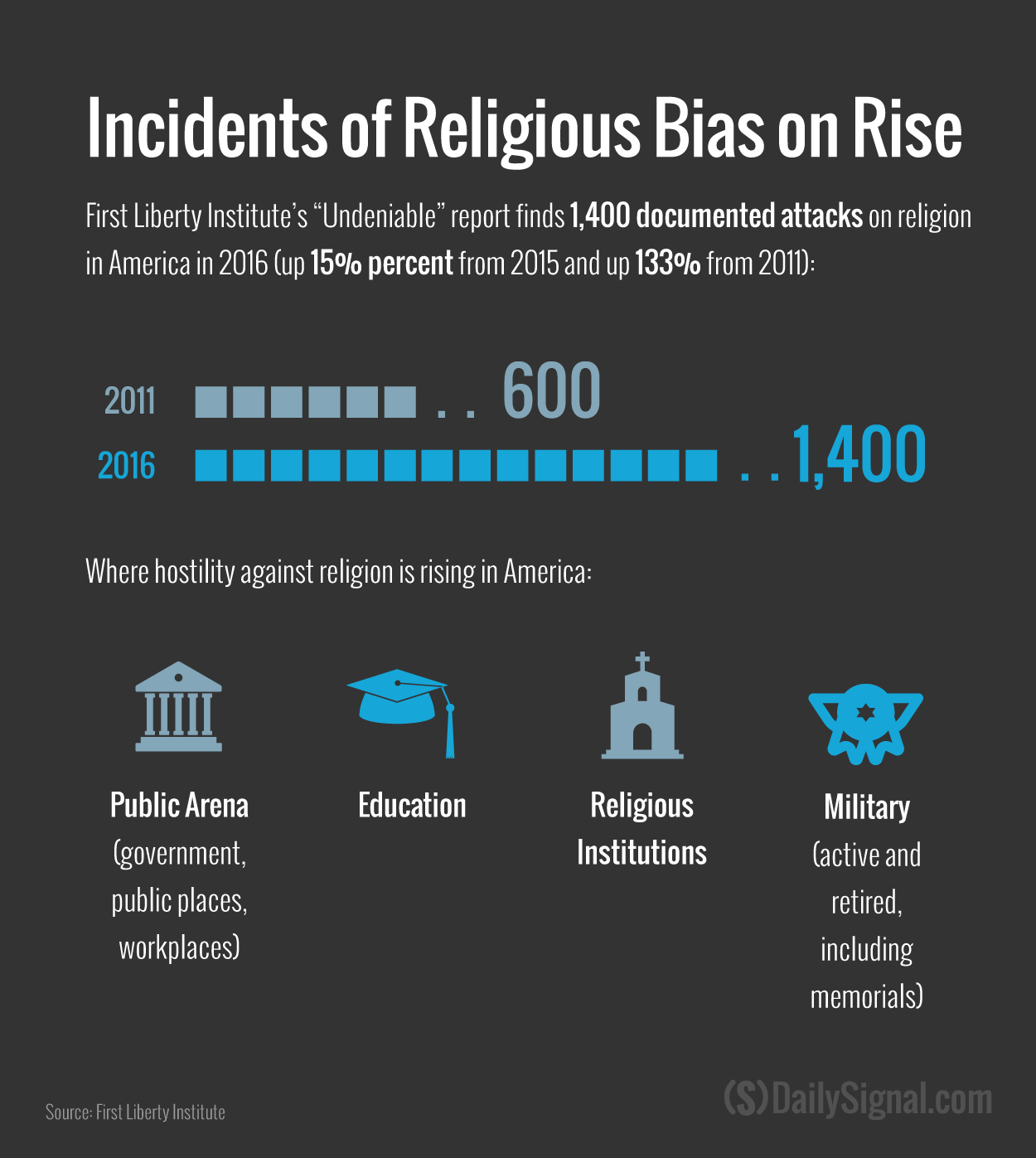
Freedom of religion isn’t as protected as some Americans may think. In fact, reported attacks on religion are increasing in the U.S. and, according to First Liberty Institute, the evidence is undeniable.

The 2017 edition of a First Liberty report called “Undeniable” shows threats to Americans’ First Amendment rights spanning the past five years.

The number of documented incidents of religious discrimination grew 15 percent in 2016 compared with 2015. The number of incidents increased by 133 percent, from 600 to more than 1,400, between 2011 and 2016.

“We’re in a battle right now for religious freedom in the future of our country,” First Liberty President Kelly Shackelford said in a Facebook Live video Sept. 12.

Justin Butterfield, editor-in-chief of the study, said in an interview with The Daily Signal that much of the data comes from court filings from across the country.

The research team also collects reports from news outlets and other organizations, including the Freedom From Religion Foundation, an atheist group.

Butterfield, who has a law degree from Harvard, said researchers specifically looked for instances where someone was illegally restricted from, or prosecuted for, practicing his or her faith.

Some people like to think that gay rights are a wonderful thing, but you can’t expect people who are involved in a sin to treat those who disagree with them with respect. Sin causes people to want to coerce and silence those who disagree.

Here is a story from Alliance Defending Freedom about a case in Washington state – a very, very godless state:

Alliance Defending Freedom attorneys filed a brief Monday with the Washington Supreme Court asking it to take up the case of Barronelle Stutzman, a floral artist whom the state and the American Civil Liberties Union sued for acting consistently with her faith.

ADF filed notices of appeal in April on behalf of Stutzman, owner of Arlene’s Flowers in Richland, after a lower state court ruled that she must pay penalties and attorneys’ fees for declining to use her artistic abilities to design custom floral arrangements for a long-time customer’s same-sex ceremony. Rather than participate in the ceremony, Stutzman referred the customer, whom she considers a friend and had served for nearly 10 years, to several other florists in the area who would provide high-quality arrangements and wedding support.

[…]“Government is supposed to protect freedom, not intimidate citizens into acting contrary to their faith and conscience,” added ADF Senior Legal Counsel Jeremy Tedesco. “The two lawsuits have the potential to financially devastate Barronelle’s business and personal assets – including taking this 70-year old grandmother’s retirement and personal savings – simply for acting in accordance with her faith. We hope the Washington Supreme Court will review this case not only because of the important legal and constitutional implications, but also because of the devastating impact the lower court’s ruling has on Barronelle.”

Barronelle just asked to not be forced to celebrate something that she didn’t believe in, and the attorney general of Washington thought that an appropriate response to her refusal to celebrate gay marriage was to take everything she owned, and block her from earning a living in the state of Washington.

It’s very important to people who are behaving immorally that they not be judged or shamed by religious people for their immoral choices. How far would social liberals go to stop religious people from judging them? Well, in America, they resort to lawsuits, censorship, coercion, vandalism and even violence. You’ll recall the attack by domestic terrorist Floyd Lee Corkins against the Family Research Council building. Corkins was, of course, a social progressive and in favor of legalizing gay marriage, and opposed to religious liberty.

Supreme Court: Christians taxpayers are allowed access to social programs

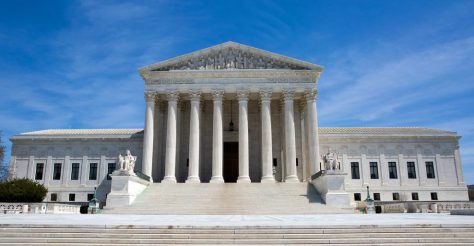
The Supreme Court of the United States

Here is the latest Supreme Court decision news, and I’ll explain shortly why this is good news for a much more important religious liberty case.

David French posted this analysis in National Review:

While there are many threats to religious liberty, few are more consequential over the long term than the state’s ever-expanding role in private life. If the government is able to vacuum up tax dollars, create programs large and small for public benefit, and then exclude religious individuals or institutions from those programs, it has functionally created two tiers of citizenship. Secular individuals and institutions enjoy full access to the government they fund, while religious individuals and institutions find themselves funding a government that overtly discriminates against them.

That’s the issue the Supreme Court addressed today in Trinity Lutheran Church v. Comer. By a 7–2 margin, the Court held that when a state creates a neutral program for public benefit — in this case, a program that uses scrap tires to provide rubberized safety flooring for playgrounds — it can’t exclude a church from that program, even if that means state benefits flow directly to a house of worship.

Social conservative Maggie Gallagher writes this in The Stream:

The good news is the Trinity Lutheran victory shows us the current Court is more supportive of religious liberty than many of us feared.

Justice Elana Kagan joined the majority opinion without any reserve. Justice Breyer wrote his own concurring opinion limiting his judgement to playground resurfacing programs and not all government benefits.

Only Justices Sonia Sotomayor and Ruth Bader Ginbsurg dissented. In Justice Sotomayor’s dissent, she warned of almost apocalyptic consequences:

This ruling, “weakens this country’s longstanding commitment to a separation of church and state beneficial to both,” she wrote, “If this separation means anything, it means that the government cannot, or at the very least need not, tax its citizens and turn that money over to houses of worship. The court today blinds itself to the outcome this history requires and leads us instead to a place where separation of church and state is a constitutional slogan, not a constitutional commitment.”

If so, it’s a good thing.

You’ll remember that Sotomayor was the wise Latina nominated by Barack Obama, who many Christians-in-name-only voted for. And of course separation of church and state is nowhere in the Constitution. What Sotomayor and her ilk on the secular left want is for Christian taxpayers to channel their earnings into the coffers of their secular leftist overlords, who apparently know much better how to spend it than the fools who earned it.

This is good news, but it’s also a hopeful sign that the Supreme Court will come out in favor of religious liberty and conscience in another case, a case that pits powerful and wealthy gay rights activists and their government allies against Christian small business owners trying to follow Jesus in everything they do.

The other case is reported on in the Daily Signal:

By deciding to hear the appeal of a Colorado baker, the Supreme Court could make its first ruling next year on whether government may coerce some Christians, Jews, and Muslims to use their creative gifts to celebrate same-sex marriage.

The high court announced Monday that it would review the case of baker Jack Phillips, who cites his Christian faith in declining to make custom cakes for same-sex weddings.

The Supreme Court’s eventual ruling could be the first since its 2015 decision legalizing same-sex marriage to say whether bakers, photographers, florists, and others must be part of such celebrations through their creative expression.

Phillips, whose Masterpiece Cakeshop is in Lakewood, Colorado, stopped making all wedding cakes in 2014 rather than be compelled by the state to design and bake them for same-sex marriages—or be fined for not obeying.

State agency and court decisions said Phillips must make such cakes after a gay couple complained about him in July 2012.

“There’s just certain events, certain cakes I don’t make,” Phillips told The Daily Signal in a phone interview in August 2015. “That was one of them.”

He also won’t make cakes depicting witchcraft, ghosts, and demons or sexually suggestive images, Phillips said in the interview.

The Supreme Court previously delayed nine times on deciding to hear Phillips’ appeal in the case, first filed last July. But with the newest justice, Neil Gorsuch, settled into his seat to succeed the late Antonin Scalia, the high court announced Monday morning that it would do so in its next term, which begins in October.

You can find out more about the Masterpiece Cakes case by watching this short video from Alliance Defending Freedom:

Although today’s decision makes me more optimistic, David French is less optimistic, because of Justice Kennedy’s previous statements on the gay marriage decision.

He writes in National Review:

Third, if Justice Kennedy views this case primarily through the LGBT lens, then the First Amendment may well lose. Kennedy is obviously proud of his long line of LGBT-friendly precedents, and that pride has even led him to a relatively rare First Amendment misstep, so it will be critical to explain to him (and the other justices, of course) that this isn’t a case about “discrimination” but rather about forced speech. Framing matters, and the other side will wrongly frame the case as raising the specter of Jim Crow. The right framing is found in the First Amendment.

I’ll be watching this case closely.