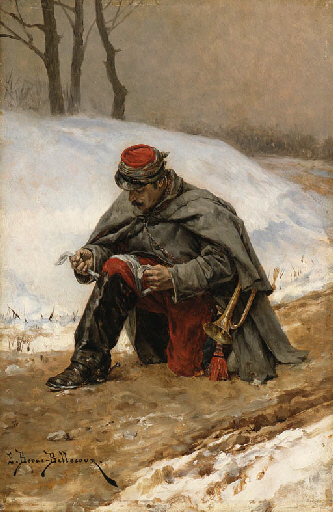
Étienne Prosper Berne-Bellecour – The wounded soldier
As soon as I saw the title of this post from Cold Case Christianity, I knew it would be significant to me.
J. Warner Wallace writes:
Popularity often requires agreement. It’s easy to like people who hold the same opinions and values. It’s not really surprising, therefore, that many of us, in an effort to be liked, try to find a way to come to agreement with the people around us. And that’s where the trouble usually starts. There are two ways to form agreement:
1. Influence others toward our position, or
2. Simply embrace the positions of others
We can try to move them toward us, or we can simply move toward them. One of these strategies will ensure our likability but the other is the path to respect.
[…]We want our kids to influence others rather than allow their friends to influence them, don’t we? While it may be easy to embrace the beliefs of others to gain approval, we know the courageous path requires us to point others to the truth, even when it’s inconvenient or unpopular. It’s time for the Church to take this second path. We’ve spent far too much time trying to become like the world in order to win its acceptance, rather than having the moral courage to make the case for what we believe. Only this second way will win the respect of those around us. I want to hear people say, “Jim, I don’t agree with you at all, but I respect the fact that you’ve tried to be thoughtful about your position and you were kind to me along the way.” That’s the kind of reaction I’m looking for.
Recently, I had to make a hard choice about whether to agree with someone else, or tell her the truth. I found myself discussing education, career and finances with a young lady. I was telling her about the likely consequences of some of the choices that she was making that were related to one of the two areas that I actually know something about. (The other area is apologetics, and she already knows lots about that)
I gave her some advice based on my understanding of these things – from my experience. There was no doubt that when it came to these areas, I had more experience than she did, and more results to show for my past decisions in those areas. But I could feel her slipping away the more evidence I showed her. She preferred to listen to people who agreed with what her feelings were telling her. Eventually, I lost her. But there was nothing else I could do. I spoke the truth based on what I knew and experienced myself in those areas. I wouldn’t have given her advice in many other areas where she knew much more than I did – just in this one, where I actually knew what I was talking about.
Fortunately other young people do take my advice in those areas, and it does work out well for them. But for me to tell them what they don’t want to hear does take courage. And sometimes, you end up losing someone close who just doesn’t believe that you know what you are talking about. So I would say that telling the truth and pointing to evidence does not always get you respect for what you know about. It gives you a chance of being respected.
By the way, I could still be proven wrong with that lady I was advising. It’s happened before. I think I told her the truth, and I hope one day she will see that.
Moral relativism is the view that moral values and moral duties do not exist in reality, but only exist as opinions in people’s minds. When you ask a moral relativist where the belief that stealing is wrong comes wrong, he may tell you that it is his opinion, or that it is the opinion of most people in his society. But he cannot tell you that stealing is wrong independent of what people think, because morality (on moral relativism) is just personal preference.
So what’s wrong with it?
I found this list of the seven flaws of moral relativism at the Australian site Faith Interface.
Here’s the summary:
Moral relativists can’t accuse others of wrongdoing.
Relativists can’t complain about the problem of evil.
Relativists can’t place blame or accept praise.
Relativists can’t make charges of unfairness or injustice.
Relativists can’t improve their morality.
Relativists can’t hold meaningful moral discussions.
Relativists can’t promote the obligation of tolerance.
Here’s my favorite flaw of relativism (#6):
Relativists can’t hold meaningful moral discussions. What’s there to talk about? If morals are entirely relative and all views are equal, then no way of thinking is better than another. No moral position can be judged as adequate or deficient, unreasonable, acceptable, or even barbaric. If ethical disputes make sense only when morals are objective, then relativism can only be consistently lived out in silence. For this reason, it is rare to meet a rational and consistent relativist, as most are quick to impose their own moral rules like “It’s wrong to push your own morality on others”. This puts relativists in an untenable position – if they speak up about moral issues, they surrender their relativism; if they do not speak up, they surrender their humanity. If the notion of moral discourse makes sense intuitively, then moral relativism is false.
I sometimes get a lot of flack from atheists who complain that I don’t let them make any moral statements without asking them first to ground morality on their worldview. And that’s because on atheism morality IS NOT rationally grounded, so they can’t answer. In an accidental universe, you can only describe people’s personal preferences or social customs, that vary by time and place. It’s all arbitrary – like having discussions about what food is best or what clothing is best. The answer is always going to be “it depends”. It depends on the person who is speaking because it’s a subjective claim, not an objective claim. There is no objective way we ought to behave.
The whole point of atheism is to pursue pleasure without the bonds of morality – there is no other reason to do anything on atheism except for the pleasure it gives you. You do fashionable things to feel good getting praise from your neighbors, and you do unfashionable things in private to make yourself feel good and you hope that no one who is powerful enough to hold you accountable ever finds out. There’s no way you were made to be.


 WINTERY KNIGHT