

Tag Archives: Relativism

William Lane Craig asks: are there objective truths about God?

A conflict of worldviews

In a lecture entitled “Are there Objective Truths About God?”, philosopher William Lane Craig discusses the problem that Christians face when they make truth claims about God to non-Christians. We think that there are objective truths about God – that there are some propositions that describe the way God really is, in reality. We think that people who don’t believe in those objective are factually wrong, in the same way that someone who thinks that Toronto is the capital of Canada is factually wrong.

But some people want to say that every statement about God is true “for each person” – so that conflicting claims about God are fine and no one is wrong. This could only be the case if everyone is just describing their own preferences, though – if they are making subjective claims about themselves, and not objective claims about God. Unfortunately, Christianity claims to be true for everyone – (e.g. – God is three persons and one being), so that Christians are committed to defending the idea that there are objective truths about God.

Here’s the link to a page containing the lecture audio. (H/T Be Thinking)

The MP3 file is here.

So what questions does Bill answer in the lecture?

What is a self-refuting statement?

The main concept in the lecture is self-refutation. A self-refuting sentence is a sentence that, if true, makes itself false or meaningless. For example, suppose someone said to you: “there are no sentences longer than 5 words” then that would be self-refuting since it falsifies itself. Bill argues that objections to the idea that there are objective truths about God are all self-refuting.

What is truth?

Craig holds that “truth” is a property of a proposition such that a proposition is true if it corresponds to the external world. For example, if I claim that there is a crocodile in your closet and we find a crocodile in your closet, then my statement was true. If there is no crocodile in your closet then my statement was false. The real objective world out there is what makes propositional claims true or false – these are not claims about an individual’s preferences, they are claims about the world. Bill is concerned with truth claims about God that are objective – whether there are propositions about God that are true regardless of what anyone thinks.

Objections to objective truth

Bill discusses 3 objections to the idea that there are objective truths about God. Each objection seeks to make religion subjective, (true for each person, like food preferences or clothing fashion).

Objection #1:The Challenge of Verificationism

The first challenge is that religious claims cannot be verified using the 5 senses, and therefore religious statements are objectively meaningless.

Consider the statement “Only propositions that can be verified with the 5 senses are meaningful”. That statement cannot be verified with the 5 senses. If the statement is true, it makes itself meaningless. It’s self-refuting.

Objection #2: The Challenge of Mystical Anti-Realism

The second challenge is that religious claims, and claims about God, are neither true nor false.

Consider the statement “Propositions about God cannot be true or false”. Craig asks – why should we accept that? Any reason given would have to assert something about God that is true or false, and those reasons would contradict the original statement. For example, “God is too great to be grasped by human categories of thought” is a proposition about God that the speaker thinks is true, which contradicts the original assertion.

Objection #3: The Challenge of Radical Pluralism

The third challenge is that each person invents an entire reality of their own, and that there is no mind-independent objective world shared by individuals.

Consider the statement “There is no objective reality shared by all individuals”. That statement is a statement that applies to all individuals, regardless of what they think.  It’s self-refuting.

Conclusion

Craig ends the lecture by arguing that it is OK for Christians to think that other people’s views are false. It does not follow that just because someone thinks other people’s views are wrong that they am going to mistreat other people. In fact, in Christianity it is objectively true that it is good for Christians to love their enemies. It is objectively true that all human beings have value, because human beings are made by God. So even if Christians disagree with others, they still treat them well, because they think that there are moral truths that they have to conform to.

My thoughts

Sometimes, non-Christians think that it is dangerous to hold beliefs too strongly. But I think what really matters is the content of the belief – some beliefs are false and some are true – you want to believe the true beliefs as strongly as you can, as long as the evidence warrants it. In Christianity, I am absolutely obligated to treat people with whom I disagree with respect and gentleness (1 Pet 3:15-16). The more convinced I am about that belief, the better my opponents will be treated. A stronger belief in Christianity means more tolerance for those who disagree.

Why do non-Christians get so offended when Christians claim to be right about there being only one way to be rightly related to God? Well, for many it’s because their worldview is a personal preference, and they feel uncomfortable having to defend it rationally and evidentially. For most people, religion is just their cultural preference – like cooking style, or favorite sport, or clothing style. That’s why they respond to your truth claims with name-calling like “you’re intolerant” and “you’re judgmental” and “you’re arrogant”. These are just shorthand ways of saying, “I’m offended that you’ve thought things through more than I have, and now I look dumb”. My family is from a non-Christian culture, so I have to talk to my relatives about this all the time. They feel judged, but it’s not my fault that they haven’t done any homework to prove out their beliefs.

I got this “you’re mean” reaction a lot from people who are raised to think that their religion is a racial, national or cultural identity. They think that if you tell them they are wrong  on matters of fact that somehow this amounts to some sort of racism or prejudice. You make factual claims, and they hear discrimination. But that’s not how Christians think of religion – we only care if it’s true or not – just like we care whether the claims of history or science are true or not. We not trying to be mean, any more than it’s mean to say things like “water boils at 100 C”. That’s just the way it is, and we’re more than happy to discuss the reasons why we think that, and to look at your reasons to see why you don’t think that.
 

Christian NHS worker who gave a book to Muslim co-worker loses her appeal

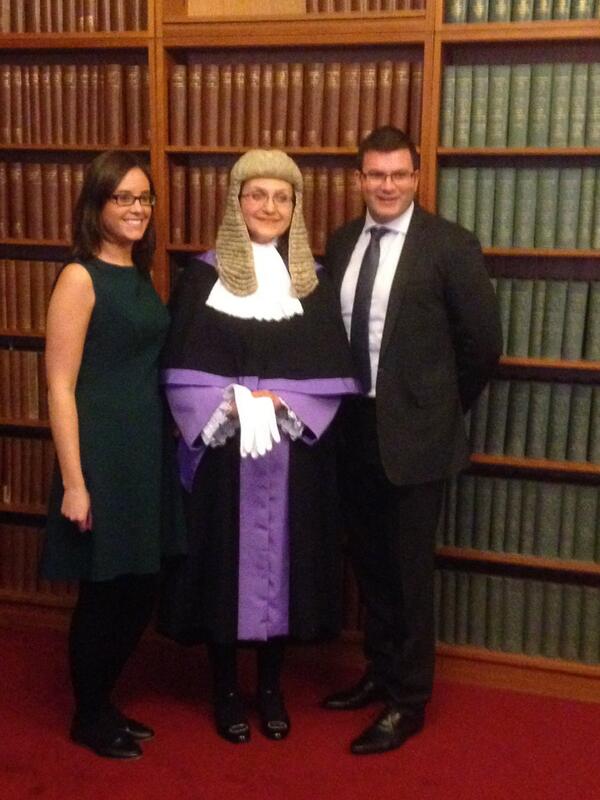
Judge Jennifer Jane Eady, Queens Counsel

The UK Telegraph reports on the state of religious liberty in the United Kingdom.

Excerpt:

A Christian NHS worker suspended for giving a religious book to a Muslim colleague has lost her appeal against a ruling that the decision to discipline her was lawful.

Victoria Wasteney, 39, was found guilty by her NHS employer in 2014 of “harassing and bullying” a work friend for giving her a book about a Muslim woman’s encounter with Christianity, praying with her and asking her to church.

She was suspended for nine months and given a written warning, even though the woman had been happy to discuss faith with her and never gave evidence about her allegations to the NHS.

Ms Wasteney, a senior occupational therapist, challenged the decision by East London NHS Foundation Trust at an employment tribunal last year, but it ruled that her employer had not discriminated against her.

A judge gave her the chance to appeal against that decision, saying it should consider whether the original ruling had correctly applied the European Convention on Human Rights’ strong protection of freedom of religion and expression.

But at a hearing in central London on Thursday, Her Honour Judge Eady QC dismissed the appeal.

Following the decision, Miss Wasteney, from Epping, Essex, said: “What the court clearly failed to do was to say how, in today’s politically correct world, any Christian can even enter into a conversation with a fellow employee on the subject of religion and not, potentially, later end up in an employment tribunal.

“If someone sends you friendly text messages, how is one to know that they are offended? I had no idea that I was upsetting her.”

[…]The woman, who quit her job shortly after making the complaints, never gave any evidence about her allegations to the NHS or later to the employment tribunal.

It sounded to me like the Muslim woman encouraged the Christian woman and the Christian woman was later surprised by the complaints. I think most Christians can take no for an answer, but Christians are caring, and they see offering to pray and offering to bring someone to church as a caring thing to do. If they don’t hear a no, then they keep right on doing what comes naturally to Christians – talking about spiritual things and trying to lead others to the Lord.

It was much easier to do this in the past, before people got more concerned about not feeling offended than they were about discussing what is or is not true. So now, even in a country like England, you can be anything you want to be as long as you’re not behaving like a Christian in public. I think this is especially the case when the people who adjudicate these cases are more focused on feelings… the person who feels the most offended seems to win all the time.

Before I had an alias, I had experience dealing with co-workers who did not much like me talking about spiritual things at work. Some types of people are more risky than others, I’ve found. That’s when I started to make rules based on my experiences, about who was and who was not safe to talk to. And that’s when I decided that to really say what I wanted to say, I’d have to get an alias, and not tell too many co-workers about it.

So who is dangerous? Obviously, people who are committed to a sinful lifestyle already are dangerous to talk to. I don’t talk to people about anything interesting if they are committed to a sinful lifestyle, because they will feel obligated to discuss issues defensively, rather than in a truth-focused way. I also avoid people who are more focused on feelings, family and community above truth. They tend to be more focused on feeling good and getting along, and they are the worst people to disagree with. The safest people are people who like to argue about what is true, and who respond to evidence.

So how to detect who is safe? Well, If the person talks about themselves a lot, and about their feelings, and happy experiences, and their vacations, their families and popular culture fluff, then I would avoid them. Don’t say a word to them. The ones who are safer are the ones who accept disagreements and don’t just rush to agree with you while hiding their own opinions in order to be liked. You also want to avoid people who take everything personally, instead of debating the outside world with a focus on what is true.

I am terrified of people who try to agree with me on everything, or who cannot explain both sides of an issue respectfully. I watch what people watch on TV in the gym – if it’s sports, housewives of beverly hills, or other shallow life enhancement fluff, then I don’t talk to them. If it’s news or business, then it’s safer to talk to them – because then you can talk about facts. Beware of people who try to jump to agreement quickly, without showing any evidence or reasons for their view. It’s always better to talk about issues in the abstract, rather than offering to pray or asking someone to church. For example, you can discuss whether the universe had a beginning, or which books of the Bible were written early. Christians need to learn how to do that – how to talk about facts.

A good question to ask to test a person is to ask where they get their news. If there is no balance there, then it’s a good sign to avoid them. Two of my leftist co-workers this week asked me why I thought that the Washington Post and the New York Times were “radically leftist”. I asked them to name conservative columnists at either paper. They couldn’t name a single one. One tried to google it right in front of me! I named Arthur Brooks, Ross Douthat, Jennifer Rubin, etc. and explained why they weren’t conservative. Then I listed off a half-dozen liberal names at the Washington Post. If the person you are talking to is in a bubble, then they are too risky to talk to. Pretty much everyone on the secular left is that way, and you should check first by seeing what they read for news. If they’re not safe, then get yourself an alias and write something online, instead.

What percentage of Muslims approve of radical Islam and terrorism?

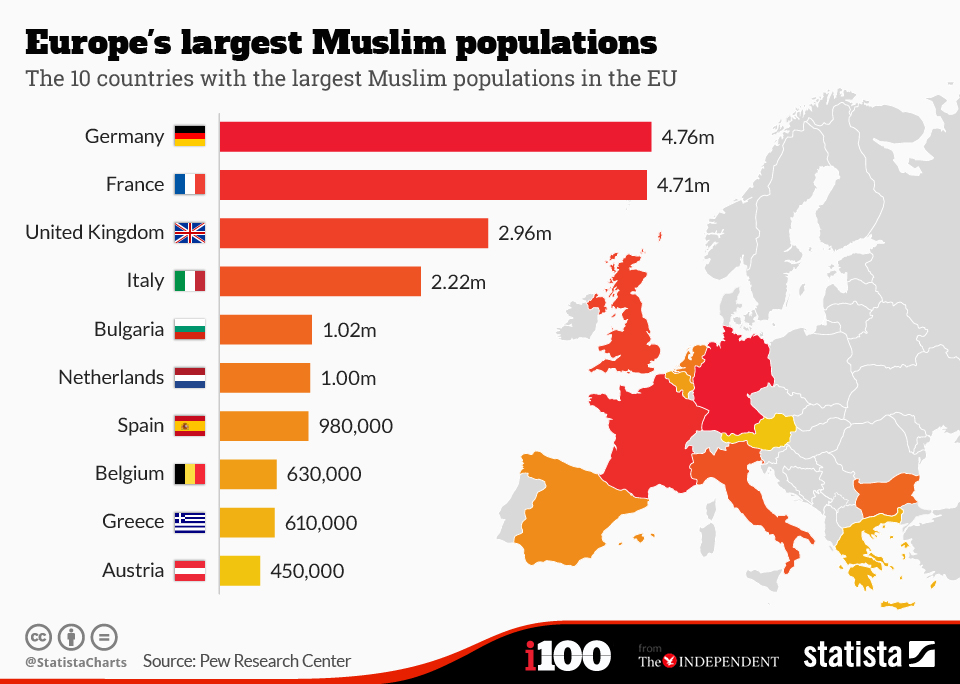
Muslim populations in Europe

Normally, when people ask me about this question, I go straight to the 2013 Pew Research survey which I blogged about before. But now I have something even better.

Here’s a post from Ben Shapiro at Breitbart News which looks at several polls from several different countries.

Shapiro writes: (links to polls removed)

So, here is the evidence that the enemy we face is not a “tiny minority” of Muslims, let alone a rootless philosophy unconnected to Islam entirely. It’s not just the thousands of westerners now attempting to join ISIS. It’s millions of Muslims who support their general goals, even if they don’t support the group itself.

France. A new, widely-covered poll shows that a full 16% of French people have positive attitudes toward ISIS. That includes 27% of French between the ages of 18-24. Anne-Elizabeth Moutet of Newsweek wrote, “This is the ideology of young French Muslims from immigrant backgrounds…these are the same people who torch synagogues.”

Britain. In 2006, a poll for the Sunday Telegraph found that 40% of British Muslims wanted shariah law in the United Kingdom, and that 20% backed the 7/7 bombers.Another poll from that year showed that 45% of British Muslims said that 9/11 was an American/Israeli conspiracy; that poll showed that one-quarter of British Muslims believed that the 7/7 bombings were justified.

Palestinian Areas. A poll in 2011 showed that 32% of Palestinians supported the brutal murder of five Israeli family members, including a three-month-old baby. In 2009, a poll showed that 78% of Palestinians had positive or mixed feelings about Osama Bin Laden. A 2013 poll showed 40% of Palestinians supporting suicide bombings and attacks against civilians. 89% favored sharia law. Currently, 89% of Palestinians support terror attacks on Israel.

Pakistan. After the killing of Osama Bin Laden, the Gilani Foundation did a poll of Pakistanis and found that 51% of them grieved for the terrorist mastermind, with 44% of them stating that he was a martyr. In 2009, 26% of Pakistanis approved of attacks on US troops in Iraq. That number was 29% for troops in Afghanistan. Overall, 76% of Pakistanis wanted strict shariah law in every Islamic country.

Morocco. A 2009 poll showed that 68% of Moroccans approved of terrorist attacks on US troops in Iraq; 61% backed attacks on American troops in Afghanistan as of 2006. 76% said they wanted strict sharia law in every Islamic country.

Jordan. 72% of Jordanians backed terror attacks against US troops in Iraq as of 2009. In 2010, the terrorist group Hezbollah had a 55% approval rating; Hamas had a 60% approval rating.

Indonesia: In 2009, a poll demonstrated that 26% of Indonesians approved of attacks on US troops in Iraq; 22% backed attacks on American troops in Afghanistan. 65% said they agreed with Al Qaeda on pushing US troops out of the Middle East. 49% said they supported strict sharia law in every Islamic country. 70% of Indonesians blamed 9/11 on the United States, Israel, someone else, or didn’t know. Just 30% said Al Qaeda was responsible.

Egypt. As of 2009, 87% of Egyptians said they agreed with the goals of Al Qaeda in forcing the US to withdraw forces from the Middle East. 65% said they wanted strict sharia law in every Islamic country. As of that same date, 69% of Egyptians said they had either positive or mixed feelings about Osama Bin Laden. In 2010, 95% of Egyptians said it was good that Islam is playing a major role in politics.

United States. A 2013 poll from Pew showed that 13% of American Muslims said that violence against civilians is often, sometimes or rarely justified to defend Islam. A 2011 poll from Pew showed that 21 percent of Muslims are concerned about extremism among Muslim Americans. 19 percent of American Muslims as of 2011 said they were either favorable toward Al Qaeda or didn’t know.

In short, tens of millions of Muslims all over the world sympathize with the goals or tactics of terrorist groups – or both. That support is stronger outside the West, but it is present even in the West. Islamist extremism is not a passing or fading phenomenon – it is shockingly consistent over time. And the West’s attempts to brush off the ideology of fanaticism has been an overwhelming failure.

A more recent poll says that 13% of Syrian refugees support Islamic State:

A first-of-its-kind survey of the hordes of Syrian refugees entering Europe found 13% support the Islamic State. The poll should raise alarms about the risks posed by the resettlement of 10,000 refugees in the U.S.

The poll of 900 Syrian refugees by the Arab Center for Research and Policy Studies also found that another 10% of the displaced Syrians have a lukewarm, but not entirely negative, view of the terror group. That means 23% — or almost 1 in 4 — could be susceptible to ISIS recruitment.

It also means as many 2,500 of the 10,000 Syrian refugees that the Obama administration is resettling inside American cities are potential terrorist threats.

Now contrast those facts with the views of Barack Obama and his allies in the mainstream media.

That video is from The Weekly Standard, here’s the text:

President Obama told CNN’s Fareed Zakaria that 99.9 percent of Muslims reject radical Islam. He made the comments in response to a question about the White House avoiding using the phrase “Islamic terrorists.”

“You know, I think that the way to understand this is there is an element growing out of Muslim communities in certain parts of the world that have perverted the religion, have embraced a nihilistic, violent, almost medieval interpretation of Islam, and they’re doing damage in a lot of countries around the world,” said Obama.

“But it is absolutely true that I reject a notion that somehow that creates a religious war because the overwhelming majority of Muslims reject that interpretation of Islam. They don’t even recognize it as being Islam, and I think that for us to be successful in fighting this scourge, it’s very important for us to align ourselves with the 99.9 percent of Muslims who are looking for the same thing we’re looking for–order, peace, prosperity.”

So Obama denies all of these surveys, and instead invents a view of the world that is consistent with his feelings. A true man of the secular left.

This gap between belief and reality explains why he is now bringing 200,000 Syrian Muslim refugees into America, keeping Syrian Christian refugees out of America, and generally underestimating Islamic State (ISIS / ISIL) because he cannot believe that radical Islam is anything for us to be concerned about.

Is the government capable of vetting Syrian refugees to find threats?

Not so much:

The administration argues that it’s conducting interviews with Syrians at camps in Turkey, Jordan and Lebanon. But without security forces on the ground in Syria who can verify details, there is no way to back-check a refugee’s story to see if he is telling the truth and is, in fact, not a security threat.

Even when we had people on the ground in Iraq to screen refugees, terrorists got through the safety net.

In 2011, for instance, two Kentucky immigrants who had been resettled as Iraqi refugees were busted for trying to buy stinger missiles for al-Qaida.

It turned out that their fingerprints matched those linked to roadside bombs in Iraq. It was a major red flag that should have barred their entry, but U.S. screeners failed to take note. And the terrorists slipped into the U.S.

The administration’s vetting process for the massive influx of Syrian refugees is completely unreliable, admits the FBI official in charge of such security background checks.

“It’s not even close to being under control,” warned assistant FBI director Michael Steinbach.

We should not be believing the man who promised us that we could keep our doctor, keep our health plans, and that our health insurance premiums would go down $2,500. He is either lying, or he likes to speak on matters where he is not competent to know the truth of the matter.

UPDATE: ECM sends me this video from Ben Shapiro:

Awesome!