Tag Archives: Regulation

How do job creators perceive Obama’s anti-business policies?

Here’s an interview with Bernie Marcus, the co-founder of Home Depot, from Investors Business Daily.

Intro:

Bernie Marcus co-founded Home Depot (HD) in 1978 and brought it public in 1981 as the U.S. was suffering from the worst recession and unemployment in 40 years. The company thrived, creating hundreds of thousands of jobs and redefining home improvement retailing.

But Marcus says Home Depot “would never have succeeded” if it launched today due to onerous regulation. He recently helped launch the Job Creators Alliance, a Dallas-based nonprofit of CEOs and entrepreneurs dedicated to preserving the free enterprise system. IBD recently spoke to him about jobs and the economy.

Excerpt:

IBD: What’s the single biggest impediment to job growth today?

Marcus: The U.S. government. Having built a small business into a big one, I can tell you that today the impediments that the government imposes are impossible to deal with. Home Depot would never have succeeded if we’d tried to start it today. Every day you see rules and regulations from a group of Washington bureaucrats who know nothing about running a business. And I mean every day. It’s become stifling.

If you’re a small businessman, the only way to deal with it is to work harder, put in more hours, and let people go. When you consider that something like 70% of the American people work for small businesses, you are talking about a big economic impact.

IBD: President Obama has promised to streamline and eliminate regulations. What’s your take?

Marcus: His speeches are wonderful. His output is absolutely, incredibly bad. As he speaks about cutting out regulations, they are now producing thousands of pages of new ones. With just ObamaCare by itself, you have a 2,000 page bill that’s probably going end up being 150,000 pages of regulations.

IBD: If you could sit down with Obama and talk to him about job creation, what would you say?

Marcus: I’m not sure Obama would understand anything that I’d say, because he’s never really worked a day outside the political or legal area. He doesn’t know how to make a payroll, he doesn’t understand the problems businesses face. I would try to explain that the plight of the busi nessman is very reactive to Washington. As Washington piles on regulations and mandates, the impact is tremendous. I don’t think he’s a bad guy. I just think he has no knowledge of this.

And Bernie is not the only one – we saw the recent rant from a Democrat CEO named Steve Wynn.

Excerpt:

And I’m saying it bluntly, that this administration is the greatest wet blanket to business, and progress and job creation in my lifetime. And I can prove it and I could spend the next 3 hours giving you examples of all of us in this market place that are frightened to death about all the new regulations, our healthcare costs escalate, regulations coming from left and right. A President that seems, that keeps using that word redistribution. Well, my customers and the companies that provide the vitality for the hospitality and restaurant industry, in the United States of America, they are frightened of this administration.And it makes you slow down and not invest your money. Everybody complains about how much money is on the side in America.

You bet and until we change the tempo and the conversation from Washington, it’s not going to change. And those of us who have business opportunities and the capital to do it are going to sit in fear of the President. And a lot of people don’t want to say that. They’ll say, God, don’t be attacking Obama. Well, this is Obama’s deal and it’s Obama that’s responsible for this fear in America.

The guy keeps making speeches about redistribution and maybe we ought to do something to businesses that don’t invest, their holding too much money. We haven’t heard that kind of talk except from pure socialists. Everybody’s afraid of the government and there’s no need soft peddling it, it’s the truth. It is the truth.

But there are many more CEOs saying the same thing.

Excerpt:

Wynn’s remarks echo those on a lengthening list of CEOs including:

  • 3M’s George Buckley, who blasted Obama last February as anti-business. “We know what his instincts are,” Buckley said. “We’ve got a real choice between manufacturing in Canada or Mexico — which tends to be more pro-business — and America,” he told the Financial Times.
  • Boeing’s Jim McNerney, who in the Wall Street Journal last May called Obama’s handpicked National Labor Relations Board’s suit against his company a “fundamental assault on the capitalist principles that have sustained America’s competitiveness since it became the world’s largest economy nearly 140 years ago.”
  • Intel’s Paul Otellini, who told CNET last August that the U.S. legal environment has become so hostile to business that there is likely to be “an inevitable erosion and shift of wealth, much like we’re seeing today in Europe — this is the bitter truth.”
  • Home Depot co-founder Bernie Marcus, who observed to radio host Hugh Hewitt last month that Obama “never had to make payroll,” that “nobody has ever created a job in this administration” and that the president is “surrounded by college professors.”
  • GE’s Jeffrey Immelt, one of Obama’s biggest supporters, who hit out at the president last year. “Business did not like the U.S. president and the president did not like business,” the FT reported him saying. “People are in a really bad mood. We have to become an industrial powerhouse again, but you don’t do this when government and entrepreneurs are not in sync.”
  • Berkshire Hathaway CEO Warren Buffett, another Obama backer, who blasted Obama’s bank tax in January 2010 as a “guilt tax,” once called Obama’s carbon tax idea “regressive” and this month denounced Obama’s obsession with corporate jets.

These aren’t the only ones. CEOs of battered oil companies like Chevron and Exxon Mobil, media companies like Fox News and Forbes, and business groups like the Chamber of Commerce have also spoken out. When the creators of jobs and wealth are saying the same thing, isn’t it time for the White House to listen up?

When will the American people realize that you can’t support tax increases for the rich, and then be surprised when they just stop hiring – or worse they outsource jobs to more business-friendly countries. Obama’s anti-business economic policies cause outsourcing. The only reason for job creators to take a risk by trying to expand their businesses is because they might be able to make a profit. Take away their profit, and there is no reason for them to hire anyone. The profit motive is what creates jobs. Obama is attacking the profit motive, and that’s why no one is hiring. Anyone who understands economics understands that.

And it’s not just Obama’s anti-business rhetoric that is to blame for the high unemployment rate. It’s higher regulation of job creators and job-killing leftist boondoggles like Obamacare.

The Gang of Six proposal: what’s in it and what do conservatives think of it?

A good analysis from Dan Mitchell of the libertarian Cato Institute. (With links removed – you have to click through for the links he included)

Excerpt:

The Good

  • Unlike President Obama, the Gang of Six is not consumed by class-warfare resentment. The plan envisions that the top personal income tax rate will fall to no higher than 29 percent.
  • The corporate income tax rate will fall to no higher than 29 percent as well, something that is long overdue since the average corporate tax rate in Europe is now down to 23 percent.
  • The alternative minimum tax (which should be called the mandatory maximum tax) will be repealed.
  • The plan would repeal the CLASS Act, a provision of Obamacare for long-term-care insurance that will significantly expand the burden of federal spending once implemented.
  • The plan targets some inefficient and distorting tax preference such as the health care exclusion.

The Bad

  • The much-heralded spending caps do not apply to entitlement programs. This is like going to the doctor because you have cancer and getting treated for a sprained wrist.
  • A net tax increase of more than $1 trillion (I expect that number to be much higher when further details are divulged).
  • The plan targets some provisions of the tax code – such as IRAs and 401(k)s) – that are not preferences, but instead exist to mitigate against the double taxation of saving and investment.
  • There is no Medicare reform, just tinkering and adjustments to the current system.
  • There in no Medicaid reform, just tinkering and adjustments to the current system.

The Ugly

  • The entire package is based on dishonest Washington budget math. Spending increases under the plan, but the politicians claim to be cutting spending because the budget didn’t grow even faster.
  • Speaking of spending, why is there no information, anywhere in the summary document, showing how big government will be five years from now? Ten years from now? The perhaps-all-too-convenient absence of this critical information should set off alarm bells.
  • There’s a back-door scheme to change the consumer price index in such a way as to reduce expenditures (i.e., smaller cost-of-living-adjustments) and increase tax revenue (i.e., smaller adjustments in tax brackets and personal exemptions). The current CPI may be flawed, but it would be far better to give the Bureau of Labor Statistics further authority, if necessary, to make changes. A politically imposed change seems like nothing more than a ruse to impose a hidden tax hike.
  • A requirement that the internal revenue code maintain the existing bias against investors, entrepreneurs, small business owners, and other upper-income taxpayers. This “progressivity” mandate implies very bad things for the double taxation of dividends and capital gains.

I’m more of a Heritage Foundation guy, myself, but this post is really very good.

Now let’s see Paul Ryan’s evaluation of it, courtesy of Jennifer Rubin in the Washington Post.

Excerpt:

Meanwhile, the president has heaped praise on the Gang of Six plan, which envisions more than $1.2 trillion in tax hikes and more than $880 billion in defense cuts. (So much for Obama making “sure that we’re cutting it in a way that recognizes we’re still in the middle of a war, we’re winding down another war, and we’ve got a whole bunch of veterans that we’ve got to care for as they come home.”) As Rep. Paul Ryan (R-Wis.) points out, the president’s new favorite plan includes just about every bad idea advanced so far in the debt debate:

Heavy Reliance on Revenues. The plan claims to increase revenues by $1.2 trillion relative to a “plausible baseline.” It also claims to provide $1.5 trillion in tax relief relative to the CBO March baseline. The CBO baseline assumes the expiration of tax relief, resulting in a $3.5 trillion revenue increase. As a result, the plan appears to include a $2 trillion revenue increase relative to a current policy baseline. If the $800 billion in tax increases from the new health care law are included, the plan appears to increase revenues by $2.8 trillion, without addressing unsustainable health care spending that is driving our debt problems.

Elusive Spending Restraint. It is unclear how much the plan achieves in spending savings. Based on released documents, it appears to primarily rely on cuts in the defense budget through $886 billion in reductions from the President’s budget for “security programs.”

Lack of Entitlement Reform. The plan does not address the $1.4 trillion in spending expansions in the new health care law. The health care law increases eligibility for the Medicaid program by one-third and creates a brand new health care entitlement. It does not appear to include reforms to the Medicare program. While it appears to pursue Social Security reform, it could end up creating barriers to enactment of these reforms.

Well, at least we know what Obama stands for: huge tax hikes, ephemeral domestic spending cuts, savaging the defense budget, and zero entitlement reform. I imagine that will come up in ads for the Republican presidential nominee next year.

Sounds like it’s not a good deal for conservatives.

Do right-to-work or forced union states create more high-paying jobs?

Neil Simpson writes about a CNBC report entitled “America’s Top States for Business 2011“. At the top of the list: right-to-work states where workers are not forced to join unions that collect union dues to support Democrat policies like amnesty for illegal immigrants, taxpayer-funded abortion and legalizing same-sex marriage.

Here are the criteria used to rank states in the CNBC survey:

  • Cost of Doing Business
  • Workforce
  • Quality of Life
  • Economy
  • Transportation & Infrastructure
  • Technology & Innovation
  • Education
  • Business Friendliness
  • Access to Capital
  • Cost of Living

Red State writes:

When it comes to America’s Top States for Business 2011, when it comes to a quality workforce, 18 out of the top 20 states are Right-to-Work states. Moreover, all 22 Right-to-Work states are in the top 25 states for having the best workforces.

CNBC defines its criteria as this:

Many states point with great pride to the quality and availability of their workers, as well as government-sponsored programs to train them. We rated states based on the education level of their workforce, as well as the numbers of available workers. We also considered union membership. While organized labor contends that a union workforce is a quality workforce, that argument, more often than not, doesn’t resonate with business. We also looked at the relative success of each state’s worker training programs in placing their participants in jobs.

Since nine out of 10 of the states cited for having the best education are not right to work states, it appears that those who receive their educations in forced-union states get smart, pack up and leave, leaving the not-so-smart union extremists to invent myths about their own superiority while they pay their forced union dues.

And here’s a map of right to work states:

Right to Work State Map

Notice that they are mostly Republican states, because are the states that are run by economists and people with business experience – people who know how to create jobs, as opposed to giving speeches that demonize and threaten the people who create jobs.

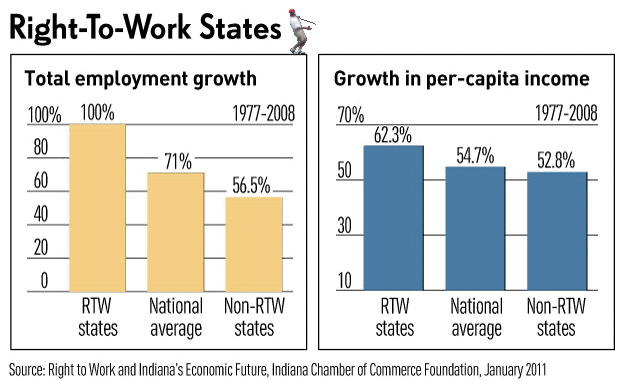
Doug Ross posted these charts a while back that show that employees also do better in right to work states. There are more jobs being created, and the income growth is higher than the forced union states.

Employment growth:

Right To Work States: Employment Growth

Income growth:

Right To Work States: Income Growth

The only losers are the unions. In right to work states, businesses and workers WIN.