
Tag Archives: Regulation

How Obama’s opposition to clean coal raises energy prices

From the Washington Times.

Excerpt:

GenOn Energy said it would shutter seven coal plants and one oil-fired plant in Pennsylvania, Ohio and Illinois with a total generating capacity of 3,140 megawatts. Midwest Generation followed suit with an advisory that it would close two coal plants serving Chicago.

The shutdowns represent a victory for President Obama, who in a 2008 interview as a candidate signaled his intention to run the coal industry into the ground: “So if somebody wants to build a coal-powered plant, they can, it’s just that it will bankrupt them because they’re going to be charged a huge sum for all that greenhouse gas that’s emitted.”

The president has made good on his promise. The Environmental Protection Agency (EPA) has squeezed coal producers in its campaign to halt carbon dioxide, the same “greenhouse gas” all animals produce when exhaling. In December, the agency announced new regulations limiting mercury emissions that will force many power plants out of business within four years.

The EPA estimates utilities across the country will need to shell out at least $9.4 billion in 2015 to meet its new mandate, but House Republicans put the true cost at $84 billion. Companies that stay in business will have to install expensive equipment that will drive up consumers’ monthly electric bills. The average retail price of electricity in America already has climbed 46 percent since 1997, says the U.S. Energy Information Administration (EIA).

Cleaner-burning natural gas is touted as a viable substitute for coal but the transition can’t be completed overnight. In the meantime, the nation’s net electricity generation is falling, down 7.1 percent from 2010 to 2011, says the EIA. Demand for electricity is projected to rise by 35 percent by 2035.

Green-energy enthusiasts look to windmills, solar panels and vegetable oil to save the day, but these trendy energy sources combined generate less than 5 percent of the nation’s energy – despite billions in subsidies. The net result of this policy could be electricity shortfalls when usage peaks in the summer. The energy brain trust has a remedy: Millions of homes across the country have been equipped with “smart meters” that can be instructed to hold back the juice. Brownouts might dim the future as Americans in the Age of Obama learn to get by with less.

The troublesome thing is that it is always the poorest families that have to pay the price for Obama’s Peter Pan energy policy. The rich Hollywood celebrities and wealthy Wall Street bankers who backed Obama in 2008 don’t mind paying a few more dollars.
Democrat Jim Cramer explains how Obamacare forces businesses to outsource

Transcript:

CNBC’s Jim Cramer:  “This is — look, I think the debate is a fabulous one to have, but it has completely taken away from the fact that we are really going to have a hard time hiring once this plan is put in place. I’ve had a couple of CEOs come on just in the last few weeks. When you talk about whether they want to hire, this is what they bring up. Chipotle, look, use this as maybe one of the great job creators in this country and they pay a lot for their people. This is a company that is very forward. When I ask them, what does ObamaCare do for you? They just say well, nothing we hope because the Supreme Court has got to say no to it. I mean, this is at the front and center of what could derail the economy.”

MSNBC’s Joe Scarbarough: “You’re talking about health care reform?”

CNBC’s Jim Cramer:  “I’m just saying, look, the issue the Catholic charities issue, front and center, I want church and state separation, but whatever I want doesn’t matter as much as what I’m telling you. Business leaders fear this more than anything, they don’t want to hire, this is part of the underground economy. It’s gonna develop because no one wants people on the books because of ObamaCare and people have to recognize that this is a front and center issue for every CEO I deal with and another reason why they don’t want to hire here, they want to hire there. They want to put the jobs in Asia, they want to put the jobs in Mexico because they don’t want to think about how much more it’s going to cost to hire a new person. Don’t lose that debate. That is a major debate for the economy.”

Is Jim Cramer some sort of radical tea party conservative?

He wrote this in 2008:

What will New York look like a year from now? The answer: bad and probably worse, and perhaps downright catastrophic. Three degrees of awful. The first step was passing the bank-bailout legislation. Now that it’s done—and if it didn’t get done we would have been looking at a guaranteed economic collapse—the critical issue will be presidential leadership. And while any president will be an improvement over the current one, there is a growing belief on Wall Street that Barack Obama has the capacity to lead us out of this wilderness while John McCain does not. I’ll go a step further: Obama is a recession. McCain is a depression.

Cramer back Barack Obama for President and is a well-known Democrat.

Environmentalists and protectionists block economic growth in Puerto Rico

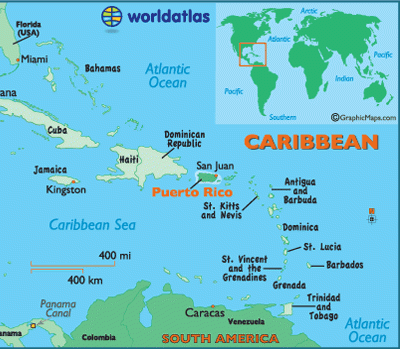
Puerto Rico Map
Puerto Rico Map

Here’s a story from Mary Anastasia O’Grady at the Wall Street Journal. She interviewed Puerto Rican Gov. Luis Fortuño and learned about his plan to boost the island’s economic growth.

Excerpt:

If [Luis Fortuño’s] plan to boost the island’s competitiveness by switching electricity generation from oil to natural gas is to succeed, he’s going to need relief from the pernicious 1920 Jones Act. It prohibits any ship not made in the U.S. from carrying cargo between U.S. ports. There are no liquefied-natural-gas (LNG) tankers made in the U.S. Unless Puerto Rico gets a Jones Act exemption, it cannot take advantage of the U.S. natural gas bonanza to make itself more competitive.

The Jones Act is good if you are a union shipbuilder who doesn’t like competition, or a member of Congress who takes political contributions from the maritime lobby. But it’s bad if you are a low-income Puerto Rican who needs a job. And there are plenty of those.

Puerto Ricans are American citizens but they are significantly poorer than the rest of the country. Per capita income on the island in 2010 was roughly $16,300 compared to just over $47,000 for the nation as a whole.

Life on the island is also expensive, in part because of the high price of electricity, 68% of which is produced using imported oil. The governor’s office says that the price of electricity here went up 100% from 2001 to 2011.

[…][B]ringing down high energy costs remains a fundamental challenge, and one that is exacerbated by new costly federal regulations on emissions that would require the installation of scrubbers on oil-fired electricity plants. To meet those regulations affordably, Mr. Fortuño wants to convert the island’s oil-fired plants to cheaper, cleaner natural gas. To that end, he proposes a pipeline from the southern LNG terminal at Punta Guayanilla across the island to San Juan. The U.S. Army Corps of Engineers has assessed the proposal and said it would produce no significant environmental impact.

It sounds like a plan to help the poor and unemployed. There are only two problems. First, the Sierra Club and local environmentalists have ginned up fears about the project and promised to sue to stop construction. Second, the Jones Act is still in the way.

The governor admits that his administration could have done a better job communicating the pipeline plan to Puerto Ricans, but he also points out that “some of the same groups that have opposed the pipeline have also opposed wind-power and solar projects. They are opposing everything, including waste-to-energy” projects which he maintains are less polluting than landfills.

Mr. Fortuño says that he expects Washington to give him a carve-out for LNG tankers, but he doesn’t have it yet. He also says that a large part of the environmentalist push-back is political, suggesting to me that he ought to be more worried than he is. This kind of politics needs to preserve the status quo of the welfare state. And that implies blocking Mr. Fortuño’s development agenda no matter what it means to the poor.

I thought this article was a neat little way to see how groups of people who understand economics try to pull themselves up out of messes, and who stands in their way. It’s something to think about when you think about poverty – what will really work to lift people out of poverty? And what is the real effect of labor unions and environmentalists on economies?