
Tag Archives: Regulation

A primer on the fiscal cliff facing us in January 2013: tax hikes and Obamacare

This is a medium-length article from the Tax Foundation. I found it fascinating to read, because I am busy making plans myself to deal with the next four years under Barack Obama.

Excerpt:

On December 31, 2012, a large swath of the federal income tax code is scheduled to expire, an event which has come to be known as the “fiscal cliff.” Among the expiring provisions are the 2001 and 2003 tax cuts enacted under President Bush, a compromise on the estate tax, a “patch” in the Alternative Minimum Tax (AMT) reducing its impact, the temporary 2 percent payroll tax holiday, increased business expensing, and the “extenders” package of miscellaneous tax deductions. On January 1, 2013, five taxes enacted as part of the Patient Protection and Affordable Care Act (PPACA)—popularly referred to as Obamacare—also take effect, along with sequester spending reductions of $109 billion due to the failure of the “Supercommittee” to reach consensus on budget reductions.

In late February, the U.S. government will hit the debt ceiling, exhausting its ability to borrow to finance ongoing spending without an increase by Congress. Finally, the federal government’s continuing resolution appropriating spending expires on March 27, 2013.

Here are some of the things to look out for, which are all described in detail in the article:

  • 2001 and 2003 Tax Cuts Expiration
  • Estate Tax Increase
  • Alternative Minimum Tax
  • Payroll Tax Increase
  • Business Depreciation Expense
  • Taxes in PPACA (Obamacare)
  • Debt Ceiling
  • Sequestration

I am most concerned about income tax increase, the capital gains tax increase, the dividend tax increase and the payroll tax increase. These are all going to clobber me. I will have less money for charity and savings, and will have to retire later – and have less time for my Christian activities as a result of having to work longer. The voters in the last election have decided that I must sacrifice more of my earnings so that Obama can hand it all out to his constituents in exchange for their votes.

It helps to know exactly what will be changing in the future, because I have to know how to respond to this. Some adjustments that I might make cannot be done at the drop of a hat. Some take months to plan and execute. It’s best to think about things in advance. We have two deadlines: December 31st and March 27th. It will be interesting to see  what Washington decides to do.

UPDATE: James Pethokoukis of AEI explains the significance of the tax increases for capital gains and dividends. Other countries have lower rates on these taxes, so expect the capital that funds businesses and creates jobs to leave the country. Obama likes to rail against outsourcing, but he actually causes it – because of his ignorance.
Polls show voters swinging to Romney after decisive debate victory

Robert Stacy McCain reports on the latest post-debate polls, but urges us to be cautious about believing them now, just because they are in our favor.

He writes: (links removed)

Nevertheless, for several months, I had been saying that I thought the outcome of the election would hinge on the debates, and the one-sided ass-whupping Romney put on Obama may have triggered a decisive shift that the polls are already beginning to detect.

If you check the Real Clear Politics national average, you see that Sept. 26/Oct. 1, Obama held a lead of four or more points after having been tied with Romney just a month earlier. According to Gallup’s tracking poll, Obama had led by 6 points most of the way from Sept. 19/Oct. 2. Both of these key indicators now show a trend toward Romney, who has closed the gap to 3 points in Gallup and 1.6 points in the RCP, which is mirrored in recent state-by-state results for Florida, Ohio, Colorado andWisconsin.

However, to emphasize again, polls are a lagging indicator. What is important in studying election polls is to follow the trendline, and we don’t yet have enough results from different firms to be able to say (on Oct. 7) that Romney’s looking like a definite winner for Nov. 6.

And McCain also links to this story about one of the bluest counties in the United States: (links removed)

You’d have to reckon that our president’s handlers thought that he would be safe visiting Cleveland, Ohio, a place that helped him win Ohio four years ago. Cuyahoga County yields the majority of Democratic votes from our state. But there’s trouble for Team Obama there today, in a dearth of Democrat registrations.

Here was how Mr. Obama was greeted at a local market:

An Ohio market vendor told President Barack Obama on Friday that his business has been going “terrible” since the president’s arrival, according to media reports.

Obama was greeting different vendors at Cleveland’s West Side Market when he came upon the proprietor of Rolston Poultry.

According to the White House pool report, Obama asked the man how business was going.

“Terrible since you got here,” he replied.

[…]That small business owner summed up the sentiments of many Ohioans, reflected in the new Rasmussen poll, also cited in the PJ Media piece on Obama’s Buckeye state woes.

So, there’s a problem with registering Dems in Cuyahoga County? That’s according to analysis by Clinton Cooper of Election Insights, who has been involved in local and regional government and politics for the last 10 years, including at The Ohio State University and in a policy advisory role for several government agencies and consulting firms in Ohio. Mr. Cooper claims that his data shows that the changes in voter registration in Cuyahoga County have made it extremely difficult for Obama to win Ohio.

Remember, the Paul Ryan vs Joe Biden VP debate is on Thursday night this week.

A critical evaluation of Obama’s economic narrative, using evidence

This article is currently the most popular one on Investors Business Daily.

Excerpt:

In making his case for re-election in the face of historically high unemployment and sluggish growth, President Obama has a simple and straightforward argument.

Things were terrible when I arrived, he says, thanks to Bush-era policies of tax cuts and deregulation. We stopped the decline, but the ditch was so deep that it will take time to get out. Still, we are making progress, even if it isn’t as fast as everyone would like.

So the last thing we want to do is return to the failed Bush policies that, he says, drove us into the ditch.

That argument appears to be working. More people continue to blame Bush than Obama for the current poor state of affairs, and some surveys show that consumer confidence has recently increased.

But each part of Obama’s argument is based on claims that are not accurate…

The article lists 5 claims made by Obama, and assesses each claim against the evidence.

Here are the 5 claims:

  1. Bush tax cuts and deregulation caused the recession.
  2. I stopped a second Great Depression.
  3. My policies are working.
  4. A slow recovery was inevitable.
  5. Nobody could have done any better.

And here’s the critique of point number one: (links removed)

At a campaign rally, Obama said Romney is “just churning out the same ideas that we saw in the decade before I took office . . . the same tax cuts and deregulation agenda that helped get us into this mess in the first place.”

It’s a standard Obama talking point. But it’s not true. Bush’s tax cuts did not cause the last recession.

In fact, once they were fully in effect in 2003, they sparked stronger growth — generating more than 8 million new jobs over the next four years, and GDP growth averaging close to 3%.

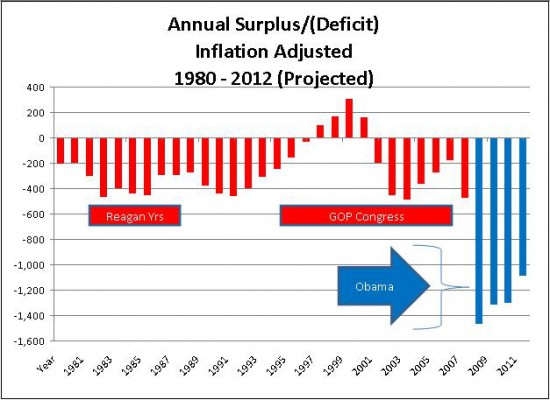
Those tax cuts didn’t explode the deficit, either, as Obama frequently claims. Deficits steadily declined after 2003, until the recession hit.

Nor was Bush a deregulator. Conservative Heritage Foundation’s regulation expert James Gattuso concluded, after reviewing Bush’s record, that “regulation grew substantially during the Bush years.”

Even the Washington Post’s fact-checker, Glenn Kessler, gave Obama’s claim three out of four “Pinocchios,” saying “it is time for the Obama campaign to retire this talking point, no matter how much it seems to resonate with voters.”

What did cause the economic crisis? The housing bubble. And that, in turn, was the result of a determined federal effort to boost homeownership by, among other things, pressuring banks to lower lending standards.

Now I know that some people (like Jerry) who get their policy news from the Comedy Channel think that the Bush tax cuts made the deficits explode, but of course, deficits were shrinking until the two spendthrifts Nancy Pelosi and Harry Reid got hold of the purse strings after taking the House and Senate in 2007.

Look:

Barack Obama: Budget Deficits
Barack Obama: Budget Deficits – last GOP budget was 2007

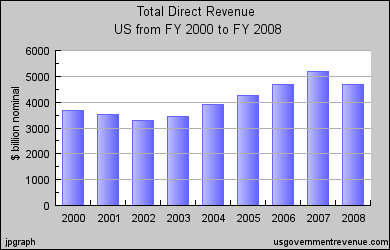
Similarly, Obama clowns on the Comedy Channel and MSNBC also think that the Bush tax cuts made revenues go down.

Ooops:

Did the Bush tax cuts make revenues decrease? No!

You can tune into MSNBC and the Comedy Channel on any given night and see the clowns there claiming that Bush’s $160 billion deficit in 2007 is actually higher than the $450 billion deficit in 2004, after the 2.2 trillion of tax cuts were passed.

Read the whole thing, it will help you to be persuasive when discussing Obama’s rhetoric. People aren’t saying that Romney won the debate because he had “zingers”. People are saying that Romney won the debate because he had facts and evidence. 

My prescription for voters in this election is more economics, and cut back on the Comedy Channel. Democrats must all buy Thomas Sowell’s “Basic Economics” and read that all the way through. I know that graphs aren’t as entertaining as Rachel Madclown, but we all must make an effort for the sake of the prosperity of our children, and our children’s children.