
Tag Archives: Quebec

Gay porn actor Luka Rocco Magnotta wanted by police for murder

Here’s the National Post. (WARNING: Graphic details of murder)

Excerpt:

The hunt for Luka Rocco Magnotta has gone worldwide, with INTERPOL issuing an international warrant for the arrest of the Canadian man accused in a Montreal murder that saw a torso left in a suitcase and a hand and foot mailed to the Ottawa offices of the Liberal and Conservative parties.

The global bulletin follows a Canada-wide warrant issued by Montreal police hours after officers first entered the 29-year-old suspect’s apartment — the scene of one of the most gruesome killings in Montreal in recent memory.

The police had finished their work inside and Apartment 208 was pretty much stripped bare, but the stomach-turning stench and darkened red stain on the mattress left little doubt that something terrible had happened there.

“The smell of death is not funny,” Eric Schorer, the building’s superintendent, said as he opened the door Wednesday afternoon. “If you look at the bed, that’s where it happened.”

Not only was the unidentified victim dismembered, not only were two body parts apparently mailed to political parties in Ottawa, but it has emerged that the killer filmed his crime and posted it on the Internet. The snuff film titled 1 Lunatic 1 Ice Pick, depicting the dismemberment of an Asian male body and various indignities to the remains, has provoked online debate about its veracity since it was posted last week. Police have confirmed the video depicts the actual crime.

[…]Mr. Magnotta, who has also been known as Eric Clinton Newman and Vladimir Romanov, has left abundant traces on the Internet. A Toronto native, he had worked in gay porn and as a model, but more recently he attracted attention after being linked to a 2010 online video showing kittens being suffocated with the aid of a vacuum cleaner.

A blog attributed to him and titled “Necrophilia Serial Killer Luka Magnotta” included this March 2012 post:

“It’s not cool to the world being a necrophiliac. It’s bloody lonely. But I dont (sic) really care, I have never cared what people thought of me, most people are judgemental idiots. I’m unable to talk to anybody about it and there’s always the knowledge that 99% of people would be repulsed by me if they found out about my feelings. Some people would even want to harm me.”

[…]The online video shows a naked male, tied to a bed frame, being attacked with both an ice pick and a kitchen knife, according to the description on a website called Best Gore. The victim is stabbed, has his throat slashed and is later decapitated and dismembered. The video was posted on Best Gore on May 25, but it is unclear when, or where, it was filmed.

There seems to be a lot of people who excuse their actions by saying they were “born that way” and they need to be true to their feelings – there’s even a Lady Gaga song about it. Basically, the idea is that people have a right to be happy, and to act out their feelings, and they should not have to care about what anyone else (especially God) thinks about it. Anyone who tells them that what they are doing wrong is just called names, like “intolerant” or “bigot”. The public schools in Quebec have a mandatory curriculum that is designed to affirm all points of view on moral questions as equally valid, and to undermine the influence of religion so that moral judgments are not grounded in any sort of objective moral hierarchy. It is even forced on homeschoolers.

Are the crimes of this gay porn actor the result of the marginalization of morality by the secular left? Is the antagonism of being judged so strong in society that people like this feel empowered to act on their feelings? I think that the lesson of this story is that we need to rethink what it means to tell young people that “anything goes” and that moral judgments and moral disagreement are essentially bigotry that offends people. That’s the message of the Human Rights Commissions in Canada. The HRCs think that it’s a criminal offense to make people feel bad by making moral judgments about whatever they are doing. They’ve prosecuted people for expressing their opinions on moral issues many times – often over many years and with huge legal costs.

I think that Canada needs to return to their free speech roots and turn away from these speech-censoring HRCs and pro-relativism education standards in Quebec schools. Canada needs to reaffirm that it’s OK to say that someone is wrong on moral issues. Not everything that every person feels like doing is equally good. Sometimes, it’s better to just say to someone early on in their lives “I think that what you are doing is wrong” even if they feel badly, so that a line is drawn before it turns into murder. Just expressing an opinion on moral boundaries early on might stop someone like this from carrying out the crimes that he has now committed. There are worse things in the world than hurt feelings. Some things are wrong, and people should be able to say so.

A look at redistribution of wealth from the workers to the non-workers in Canada

Canada election 2011: Conservatives in Blue, Socialists in Red, Communists in Orange
Election 2011: Conservatives in Blue, Socialists in Red, Communists in Orange

I found two examples of policies that promote the redistribution of wealth from producers to non-producers in Canada. I think it’s worth taking a look at their policies so that we understand more about our own redistribution policies.

The first example of redistribution has to do with unemployment insurance, where productive taxpayers who choose low-risk, high-pay jobs must subsidize other citizens who get high-risk, low-pay jobs. Their program is called “Employment Insurance”. Canadians who work have to pay into the system, and when any of them loses their jobs, then they get to take money out of it. Those who work more pay more, those who work less pay less. Those with safe jobs collect nothing, and those with risky jobs collect more.

Is this program fair? In this article from Brian Lilley’s Lilley Pad blog, Canadian columnist Lorne Gunter explains what’s wrong with this program.

Excerpt:

Employment Insurance is a lot of things, but an insurance plan to encourage employment it is not.

For one thing, the premiums aren’t based on the risk of making a claim.

Young drivers pay higher auto insurance premiums because they are much more likely to get in an accident. Yet Canadians in high-unemployment industries and high-unemployment regions make no higher EI contributions than those who live where they are never likely to be without work.

Indeed, those most likely to make EI claims will make far lower lifetime contributions than those who are unlikely ever to claim. That makes EI a welfare program underwritten by a tax on employment, rather than an insurance plan.

In the 1990s, I interviewed a Statistics Canada researcher who had made the study of EI his life’s work. He told me that he had discovered one New Brunswick town of 3,000 people where every adult had made at least one EI claim. Most had claimed three or more times.

In some areas, EI is an accepted part of the culture. It’s that entitlement mentality the Tories’ changes are aimed at breaking.

In the CBC’s fawning 1994 biography of Pierre Trudeau, St. Pierre admitted that one of the goals of his government’s ’70s-era reforms to Unemployment Insurance (as it was more accurately known then) was to enable Canadians to stay in their home regions if they wanted to, even if they were never likely to find steady work there.

So the scheme is also an interregional transfer of wealth — from have to have-not provinces.

Of course, every year thousands of Canadians move from have-not regions to more prosperous areas in search of better jobs and higher pay. So it is not as though everyone who could collects EI to stay put.

But the question is why should hard-working Canadians be compelled to subsidize anyone who refuses to move or turns down locally available work?

It’s very similar to their health care programs, which transfers wealth from producers to health care users – and remember that not all health care is from stuff like car accidents. Abortions, IVF and sex changes are entirely voluntary – based on lifestyle choices.

But this is not the only program that transfers wealth from workers to non-workers. It turns out that there is an entire province of Canada that has a majority of secular socialist slackers who can’t pay their own way, but must instead depend on the rest of Canada to support them.

Eric Duhaime explains in this article on the Lilley Pad.

Excerpt:

Although we live in the same house, we certainly don’t sleep in the same room anymore. Our romantic days are long gone. Quebec and the rest of Canada have grown apart. Young Quebecers have no appetite for constitutional quarrels, although they define themselves more and more as Quebecois and less and less as Canadians. They have even invented the word “decanadianization.”

Conversely, English-Canadians are becoming more and more fed up with paying for Quebec, which receives more than half the money given through the so-called equalization program, the equivalent of $8 billion a year.

The solution might not be to ask Quebec to become an independent nation but to become less dependent on its neighbours and more fiscally autonomous. To calm English Canada down, the equalization formula — which will be reviewed before 2014 anyway — could be modernized.

Canada has evolved over the years. The need for interprovincial welfare is not as necessary as it used to be. The principle of redistribution is part of our Constitution but could focus exclusively on funding very essential social programs, which wouldn’t include $7-a-day daycare or a fully subsidized year of parental leave after the birth of each child.

I think it would be an excellent idea to cut Quebec loose. Whatever goods and services they produce could still be bought by the rest of Canada – if there are any such things. Let them pay for their own exorbitant abortion and day care costs, for a start.

Why am I posting about Canada? I think it’s important for us to look at other countries so that we understand how public policies that are sold to us as “compassionate” actually punish hard work, thrift and risk-taking while at the same time rewarding ignorance, wastefulness and sloth. In fact, one could argue that Obamacare itself is nothing more than a way to transfer wealth from those who are take care of their health and work hard for their money, to those who are unemployed and want free contraceptives, abortions and sex changes. You can get all three of those things in the Canadian province of Ontario, and in the UK as well. But the UK goes even further and provides taxpayer-funded IVF and breast implants. This is what liberal compassion really means: pillaging those who sacrifice their leisure to work, in order to buy votes from unproductive, reckless and lazy special interest groups.

In California, students protest the results of their own liberal voting

Victor Davis Hanson writes about it National Review.

Excerpt:

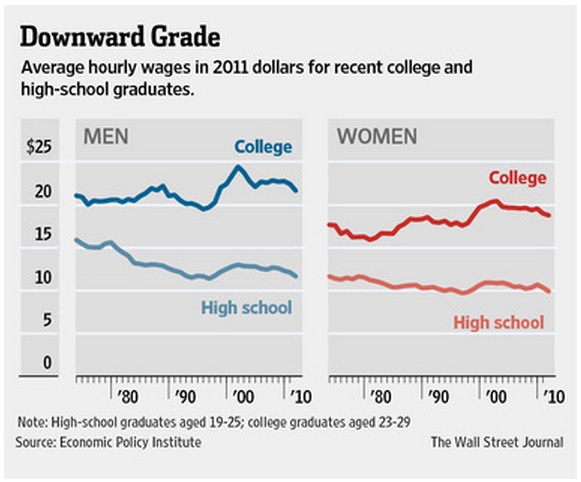
Here in California, students just marched on Sacramento in outrage that state-subsidized tuition at the UC and CSU campuses keeps climbing. It is true that per-unit tuition costs are rising, despite even greater exploitation of poorly paid part-time teachers and graduate-student TAs. But the protests are sort of surreal. The California legislature is overwhelmingly Democratic. The governor is a Democrat. The faculties and administrative classes are largely Democratic. Who then, in the students’ minds, have established these supposedly unfair budget priorities?

Sales, income, and gas taxes are still among the highest in the nation (and are proposed to rise even higher) — prompting one of the largest out-of-state exoduses of upper-income brackets in the nation. The state budget is pretty much entirely committed to K–12 education (whose state-by-state comparative test scores in math and science hover between 45th and 49th in the nation), prisons, social services, and public-employee salaries and pensions. Whom, then, can the students be angry at?

Are students angry at public-union salaries and pensions that are among the highest in the nation? Do they think the many highly compensated retired Highway patrol officers have shorted students at UC Davis? Are they mad at the 50,000 illegal aliens in the California prison system that might have siphoned off scholarship funds from CSU Monterey Bay? Or is the rub the influx of hundreds of thousands of children of illegal aliens who require all sorts of language remediation and extra instruction in the public schools, and so might in theory divert library funds from UC Santa Cruz?

Perhaps the students don’t want billions to be committed to high-speed rail that might rob Berkeley of needed funding, or environmental efforts to introduce salmon into the San Joaquin River, in which the $70 million spent so far in studies and surveys might have come from nearby CSU Fresno? Are they mad at state social services, whose medical expenses have skyrocketed to address the health-care needs of millions of illegal aliens, and thus in theory could curb the choice of classes at CSU Stanislaus? Are they angry that some $10–15 billion a year probably leaves the state as remittances to Mexico?

If one cannot blame the wealthy for “not paying their fair share” (the top 1 percent of Californians now pay about 37 percent of all income-tax revenue — and their numbers have decreased by one-third in recent years, as the state has come to rely on the income tax for half its revenue), or Republican majorities in government, who, then, is left to blame?

Not only are their tuition costs going UP but their likely salary is going DOWN.

Students majoring in booze and hook-up sex
How's that hopey-changey stuff workin' for ya?

I got that image from a post at the American Enterprise Institute.

Excerpt:

  • Only 35 percent of students starting a four-year degree program will graduate within four years, and less than 60 percent will graduate within six years.
  • The U.S. college dropout rate is about 40 percent, the highest college dropout rate in the industrialized world.
  • Over the past 25 years, the total number of students in college has increased by about 50 percent. But the number of students graduating with degrees in STEM subjects has remained more or less constant.
  • In 2009, the United States graduated 37,994 students with bachelor’s degrees in computer and information science. That’s not bad, but we graduated more students with computer-science degrees 25 years ago!
  • Few disciplines have changed as much in recent years as microbiology, but in 2009 we graduated just 2,480 students with bachelor’s degrees in microbiology—about the same number as 25 years ago. Who will solve the problem of antibiotic resistance?
  • If students aren’t studying science, technology, engineering, and math, what are they studying?
  • In 2009, the United States graduated 89,140 students in the visual and performing arts, more than in computer science, math, and chemical engineering combined and more than double the number of visual-and-performing-arts graduates in 1985.
  • Moreover, more than half of all humanities graduates end up in jobs that don’t require college degrees, and those graduates don’t get a big income boost from having gone to college.

I think this is interesting. What exactly are these students paying for?

If there is one thing I learned from my love of Shakespeare, it’s that it is tragic to be the cause of your own downfall because of your own tragic flaw. Right now, there are a bunch of young people who have been totally brainwashed by the unionized public school teachers and professors to have views on economics that are completely opposite to what works in the real world. They keep voting for bigger and bigger government, which creates more and more debt in order to provide their parents with bigger and bigger benefits. They have lots of self-esteem, but very few marketable skills. Eventually, the bill for all the government spending on “helping the poor”, (e.g. – food stamps for millionaires and bailouts for bankrupt green energy firms), comes due, and it’s the students who will be paying the bill. I wonder if they will look as favorably on socialism and global warming alarmism then?

UPDATE: I noticed that in Quebec, the most liberal province in Canada, students are doing the same thing.