Tag Archives: Purpose

An exchange on purpose from one of William Lane Craig’s early debates

The full transcript of this 1991 debate is here on the Reasonable Faith site. Keep in mind that this is young William Lane Craig  against old, experienced Kai Nielsen.

Nevertheless, here is an exchange I wanted to highlight.

William Lane Craig:

The chief purpose of life is not happiness per se, but the knowledge of God. One reason the problem of evil seems so puzzling is that we tend to think that the goal of human life is happiness in this world. But on the Christian view this is false. Man’s end is not happiness as such, but the knowledge of God–which in the end will bring true and everlasting human fulfillment. Many evils occur in life which seem utterly pointless with respect to producing human happiness, but they may not be unjustified with respect to producing the knowledge of God. Innocent human suffering provides an occasion for deeper dependency and trust in God, either on the part of the sufferer or perhaps those around him. Whether God’s purpose is achieved through our suffering all depends on how we freely respond.

Kai Nielsen:

The first thing you should come to recognize is that there can be purposes in life that are perfectly intact even if there is no purpose to life. If there is no God or telos of any sort, there is no purpose to life; you weren’t made for a purpose. But even if you weren’t made for a purpose, you could find plenty of purposes in life, things worth doing and having and believing and struggling for. Some religious people will say, “That’s all right for little individual small purposes, but you can’t have any overarching purpose in life without belief in God. You can little, fairly trivial things, but no really deep and pervading conception of a purpose in life without God.” But that’s not true. There are many atheists who have had such overarching purposes. They’ve fought relentlessly “the plague” (to use Camus’ metaphor). They’ve sought to lessen the sum total of human suffering, of human degradation, of blighted hopes; they’ve positively sought to bring about a world with more happiness in it and more understanding of each other–more human flourishing, more human solidarity, a brotherhood and sisterhood. They’ve sought, in short, to bring about a classless, raceless, genderless world. Those big purposes – overarching purposes in life – are perfectly available to anyone who is an atheist as well as to someone who is a theist. I don’t deny that believers haven’t done that, but you don’t need God to have either small purposes in life or an overarching purpose in life.

William Lane Craig:

First of all, I have never denied that you can have subjective purposes in life, but what I am arguing is that there is no objective basis to assume the moral worth of your purpose in life on an atheistic view. All purposes in life you choose are morally equal–whether you want to live a life as a doctor caring for the poor or choose instead to be a Ferdinand Marcos. There’s no objective basis for assessing the moral worth of those purposes.

Kai Nielsen:

He says that I don’t meet his objection that moral purposes in life all are perfectly arbitrary without God. I don’t see the slightest reason for that. Some of them are arbitrary if they are silly and thoughtless purposes. Some purposes, if they are integrated, carefully thought-out, related to everything else we know, reflective (where human beings work through long traditions, including working with Christian traditions, in which you put together everything you know and think carefully about these purposes), are perfectly objective. And they are the only kind you can give much sense to.

You’ll note that what counts as a good purpose on Kai’s view is not objective. Every purpose that he mentioned (e.g. – genderless world) was meaningful to him. But do these purposes have any significance, ultimately?

Consider the heat death of the universe:

The ‘heat-death’ of the universe is when the universe has reached a state of maximum entropy. This happens when all available energy (such as from a hot source) has moved to places of less energy (such as a colder source). Once this has happened, no more work can be extracted from the universe. Since heat ceases to flow, no more work can be acquired from heat transfer. This same kind of equilibrium state will also happen with all other forms of energy (mechanical, electrical, etc.). Since no more work can be extracted from the universe at that point, it is effectively dead, especially for the purposes of humankind. 

This is how the universe ends, on atheism. No purpose achieved by any atheist matters, ultimately – the end destination is the same. Humans are going to die out individually and collectively on atheism, nothing anyone does to affect anyone else is going to change a thing. Nothing atheists do matters.

Atheists like to make much of this life being all they have, and to live it to the fullest, etc. But nothing ultimately matters if atheism is true, because the end result of the universe is the same. Nothing they do matters to them, because they’re dead. Nothing they do matters to anyone else, because we’re all dead. It will be as if we never existed or did anything, one way or the other.

In Christian theism, however, what you do in this life has ultimate meaning beyond our earthly lives. What you choose affects your afterlife. What you do with others affects their afterlife. Plans made with respect to that objective goal of knowing God do stand the test of time. They matter, even if they don’t feel good now. If your actions help to turn someone towards God or away from God, it makes a huge difference. A difference that lasts.
Are Christians responsible for making plans and making good decisions?

Here’s a wonderful post on decision making and the will of God posted on Neil’s blog. Neil links to another post where someone is trying to figure out what God wants him to do.

Excerpt:

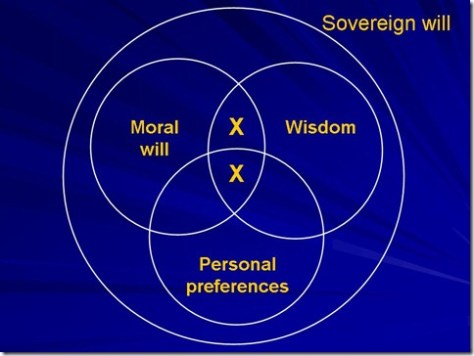
Really short version: Aside from direct and clear personal revelation from God, you don’t have access to his sovereign will when making decisions.  Therefore you must look at other factors.  If it isn’t moral, don’t do it.  If it is moral but not wise, don’t do it.  If it is moral and wise, then use your personal preferences.

Using this model you can end up with a wise and biblical decision, but you have avoided the traps of the “God told me to ____” routine.  People who run around saying that God told them this and that convey a super-spirituality that can leave less mature believers wondering if they really have a relationship with God (i.e., “God doesn’t tell me every little thing to do, so maybe I don’t really know him.”).

He has a helpful picture posted as well:

This is actually a very important topic for me, because I like making plans and making good decisions. I like being the quarterback or squad leader of my own life. I like to pick objectives and then make plans to achieve them. (Nothing too exotic, just simple stuff like saving money or reading more books)

Actually, I really oppose the idea that God has a magical fairy tale will for each person that will make them happy and fulfilled. For me, life isn’t like that. I don’t expect God to lead me along like a child at a scavenger hunt. I expect to survey the battlefield where I am and then do something to make a difference. There are lots of things you can do that will please God. Should you focus on your career and sponsor apologetics conferences? Or should you use your spare time preparing Sunday school lessons? There are lots of good things you could do to please God. Your job is to pick the one that will be the most effective. It doesn’t matter if it makes you happy, it only matters if it’s effective and if you are good at it.

Who is Rifleman Dodd?

A while back, I was busily working my way through the U.S. Marine Corps Official Reading List, and I came across a book by C.S. Forester called Rifleman Dodd, or alternatively titled Death to the French. It’s a work of historical fiction that takes place during the Napoleonic wars. The story is about a British marksman named Dodd, who is cut off from his own lines during a withdrawal maneuver. He is subsequently left to fend for himself behind enemy lines. An ordinary man might be full of despair and forget about his mission entirely. But Dodd is no ordinary man. Not only does he find a way to survive by finding food to eat, water to drink and places to sleep, but he also tries to remember his orders and to think about what he can do to advance the cause of his General, the Duke of Wellington.

Here’s an excerpt from a gritty book review:

It’s about a green-coated British infantry rifleman in the Napoleonic Wars, an age when rifles were a novelty and most of the army was red-coated and carried muskets. Private Matthew Dodd gets separated from his regiment during a retreat and finds himself stranded behind enemy (French) lines in Portugal. With the occasional aid of some natives, but mostly on his own, he harasses the French with his rifle and tries to prevent them from building a bridge across the Tagus River. It’s a remarkable tale of survival and solitary achievement, of a rank-and-file soldier who lives by his wits and slowly learns to make plans without orders, and shows leadership qualities and a knowledge of warfare.

I think we’re in the same situation as Dodd.

There is no point in us looking for breadcrumb trails to happiness at this point. That’s not the point of Christianity. The point of Christianity is friendship with God, imitation of Christ, honoring moral obligations, self-sacrificial love for your neighbor (and even your enemies!), and dedication to the truth – whether anyone else likes you or not. It’s not supposed to make you happy, and it’s not necessarily going to be a normal life like everyone else has. Things may not work out the way you’d like them to.

We seem to be making such a big deal about compassion and forgiveness in the Christian life these days – such a big emphasis on our feelings. Almost like we have forgotten that we have obligations to our friend – and his objectives. A relationship doesn’t mean that one person completely disregards the character and goals of the other person and then is automatically granted forgiveness whenever they want it. That’s not a friendship – that’s using someone else for your own ends. Maybe it’s time to remember what this is all about.

Reasonable Faith podcast: the real consequences of atheism

If you love to listen to the Please Convince Me podcast, as I do, then you know that in a recent episode, J. Warner Wallace mentioned a blog post on an atheistic blog that clearly delineated the implications of an atheistic worldview. He promised he was going to write about it and link to the post, and he has now done so.

The latest episode of Reasonable Faith discusses the post mentioned in the episode.

Details:

An atheist blogger gets brutally honest about his view and tells other atheists to quit fooling themselves!

The MP3 file is here on the Reasonable Faith web site. (23 minutes)

Kevin Harris (KH) and William Lane Craig: (WLC) discuss this post on the Wintery Knight blog.

Summary:

  • KH: New Atheists always try to portray themselves as having meaningful lives, and good without God
  • WLC: Exactly, they would say you don’t nee God to do positive things, so God makes no difference
  • KH: but what happens when an atheist explains the real consequences of atheism?

KH then reads a quote by an atheist blogger:

“[To] all my Atheist friends.

Let us stop sugar coating it. I know, it’s hard to come out and be blunt with the friendly Theists who frequent sites like this. However in your efforts to “play nice” and “be civil” you actually do them a great disservice.

We are Atheists. We believe that the Universe is a great uncaused, random accident. All life in the Universe past and future are the results of random chance acting on itself. While we acknowledge concepts like morality, politeness, civility seem to exist, we know they do not. Our highly evolved brains imagine that these things have a cause or a use, and they have in the past, they’ve allowed life to continue on this planet for a short blip of time. But make no mistake: all our dreams, loves, opinions, and desires are figments of our primordial imagination. They are fleeting electrical signals that fire across our synapses for a moment in time. They served some purpose in the past. They got us here. That’s it. All human achievement and plans for the future are the result of some ancient, evolved brain and accompanying chemical reactions that once served a survival purpose. Ex: I’ll marry and nurture children because my genes demand reproduction, I’ll create because creativity served a survival advantage to my ancient ape ancestors, I’ll build cities and laws because this allowed my ape grandfather time and peace to reproduce and protect his genes. My only directive is to obey my genes. Eat, sleep, reproduce, die. That is our bible.

We deride the Theists for having created myths and holy books. We imagine ourselves superior. But we too imagine there are reasons to obey laws, be polite, protect the weak etc. Rubbish. We are nurturing a new religion, one where we imagine that such conventions have any basis in reality. Have they allowed life to exist? Absolutely. But who cares? Outside of my greedy little gene’s need to reproduce, there is nothing in my world that stops me from killing you and reproducing with your wife. Only the fear that I might be incarcerated and thus be deprived of the opportunity to do the same with the next guy’s wife stops me. Some of my Atheist friends have fooled themselves into acting like the general population. They live in suburban homes, drive Toyota Camrys, attend school plays. But underneath they know the truth. They are a bag of DNA whose only purpose is to make more of themselves. So be nice if you want. Be involved, have polite conversations, be a model citizen. Just be aware that while technically an Atheist, you are an inferior one. You’re just a little bit less evolved, that’s all. When you are ready to join me, let me know, I’ll be reproducing with your wife.

I know it’s not PC to speak so bluntly about the ramifications of our beliefs, but in our discussions with Theists we sometimes tip toe around what we really know to be factual. Maybe it’s time we Atheists were a little more truthful and let the chips fall where they may. At least that’s what my genes are telling me to say.”

Back to the summary:

  • WLC: this quote explains that on naturalism, moral values and duties are just the by products of biological evolution
  • WLC: he is deriding other atheists who put on a civil facade, and that the superior atheist is the one who acts openly like an atheist
  • KH: he wants atheists to stop acting like Christians (being outwardly nice)
  • WLC: there is no evidence for atheism presented in the quote, so why should he think that morality and meaning are illusory
  • WLC: he is saying that morality is not real because our beliefs form by Darwinian evolution
  • WLC: even if those beliefs formed that way, that doesn’t mean that our moral judgments are not true (genetic fallacy)
  • KH: the moral judgments are only false if naturalism is true, and he didn’t defend that
  • WLC: if objective moral values and duties exist, then naturalism is false

KH quotes Richard Dawkins:

In a universe of blind physical forces and genetic replication, some people are going to get hurt, other people are going to get lucky, and you won’t find any rhyme or reason in it, or any justice. The universe that we observe has precisely the properties we should expect if there is, at bottom, no design, no purpose, no evil and no good, nothing but blind, pitiless indifference… DNA neither knows nor cares. DNA just is. And we dance to its music.

More:

  • WLC: yes, that’s his view, but what reason is there to accept the naturalism that requires all that?
  • KH: yet he pushes various moral judgments
  • WLC: yes, in his book, he pushes a bunch of moral judgments in his book, all of which are invalid on naturalism?
  • KH: he wants humans to choose to show pity, even though nature is pitiless
  • WLC: he thinks that these altruistic behaviors can emerge because humans are sociable beings
  • WLC: but this “herd morality” is just an evolved convention, there are not objective moral truths

KH quotes Will Provine:

Let me summarize my views on what modern evolutionary biology tells us loud and clear — and these are basically Darwin’s views. There are no gods, no purposes, and no goal-directed forces of any kind. There is no life after death. When I die, I am absolutely certain that I am going to be dead. That’s the end of me. There is no ultimate foundation for ethics, no ultimate meaning in life, and no free will for humans, either.

More:

  • WLC: it’s his naturalism that is causing him to say that, theistic evolution is compatible with morality
  • WLC: naturalism is what conflicts with objective morality, science doesn’t invalidate objective morality
  • KH: atheists deny objective meaning, but atheists can invent subjective meanings and purposes
  • WLC: yes, but these invented subjective meanings and purposes are illusory
  • WLC: I don’t think that anyone can live happily by think

KH quotes Michael Ruse:

“The position of the modern evolutionist is that humans have an awareness of morality because such an awareness of biological worth. Morality is a biological adaptation no less than are hands and feet and teeth. Considered as a rationally justifiable set of claims about an objective something, ethics is illusory. I appreciate when someone says, ‘Love thy neighbor as thyself,’ they think they are referring above and beyond themselves. Nevertheless, such reference is truly without foundation. Morality is just an aid to survival and reproduction, . . . and any deeper meaning is illusory.”

  • WLC: again, science is neutral against morality, it’s the philosophy of naturalism that is inconsistent with objective morality
  • KH: just because theists and atheists get along, it’s still important to remind atheists of the consequences of their view
  • WLC: I do that in my work on the absurdity of life without God, and in the moral argument for God’s existence
  • WLC: I love it when they say things like this, because it supports the first premise in Craig’s moral argument
  • KH: even if the evidence were 50-50, why would atheists lean towards the meaningless view
  • WLC: yes, if the evidence is 50-50, then people ought to prefer life, significance and moral value
  • KH: you’re not saying that people ought to the believe that in theism because it’s more palatable to us
  • WLC: right, I am saying that naturalism should be rejected on the evidence, including our experience of moral values

If you like this podcast, the RSS feed for the Reasonable Faith podcast is here. I subscribe to it. If you liked the post they were discussing, please click here and share and/or tweet it.