Tag Archives: Politics

How serious is Obama about stopping the persecution of Christians abroad?

Consider this article from National Review. (H/T Muddling Towards Maturity)

Excerpt:

Connect these dots: In Nigeria this week, Muslim youths set fire to a church, killing more than two dozen Christian worshippers. In Egypt, Coptic Christians have been suffering increased persecution including, this month, a drive-by shooting outside a church in which seven people were murdered. In Pakistan, Christian churches were bombed over Christmas. In Turkey, authorities have been closing Christian churches, monasteries, and schools, and seizing Christian properties. Recently, churches in Malaysia have been attacked, too, provoked by this grievance: Christians inside the churches were referring to God as “Allah.” How dare infidels use the same name for the Almighty as do Muslims!

In response to all this, Western journalists, academics, diplomats, and politicians mainly avert their eyes and hold their tongues. They pretend there are no stories to be written, no social pathologies to be documented, no actions to be taken. They focus instead on Switzerland’s vote against minarets and anything Israel might be doing to prevent terrorists from claiming additional victims.

[…]Not so long ago, the Broader Middle East was a diverse region. Lebanon had a Christian majority for centuries but that ended around 1990 — the result of years of civil war among the country’s religious and ethnic communities. The Christian population of Turkey has diminished substantially in recent years. Islamists have driven Christians out of Bethlehem and other parts of the West Bank; almost all Christians have fled Gaza since Hamas’s takeover.

Muddling has some pictures of a protest by Egyptian Coptic Christians in front of the United Nations building.

CNS News notes that Obama has yet to appoint an ambassador for international religious freedom.

Excerpt:

One year after President Obama took office, the administration’s top international religious freedom post remains empty, at a time when a wave of religious persecution is troubling veteran campaigners.

“President Obama has not yet named an ambassador-at-large for international religious freedom,” a State Department press officer confirmed by phone late Wednesday.

The Christian advocacy organization Open Doors USA launched a petition Wednesday urging Obama to appoint an ambassador immediately, saying that leaving the position unfilled violated U.S. law.

“By not having an ambassador-at-large for the past 12 months, the U.S. has failed to demonstrate the importance of religious freedom,” said advocacy director Lindsay Vessey.

The liberties of Christians and other persecuted religious minorities abroad must not be a real big blip on his secular leftist radar.
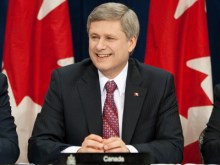
Supreme Court sides with Conservative Party against price-fixing monopoly

Prime Minister Stephen Harper

Story here from the Vancouver Sun. (H/T Andrew)

Excerpt:

The Canadian Wheat Board cannot spend money on advocacy to protect its monopoly, following a Supreme Court of Canada decision Thursday against hearing an appeal from the Winnipeg-based agency, which asserts that it has been silenced by the Conservative government.

Without giving reasons, the high court declined the appeal application to a Federal Court of Appeal ruling that sided with the federal government in its 2006 order from then-agriculture minister Chuck Strahl for the board to refrain from spending its money on lobbying.

[…]The federal Conservatives are seeking to end the board’s monopoly, which is controlled by farmers. The monopoly makes the agency one of the world’s biggest exporters of wheat and barley.

The board maintains that the monopoly ensures farmers receive the best prices for their grain, but the federal government, along with some farmers, say that they would be better off in a free market, selling their products on their own.

Conservatives are for a free market and competition, because we believe that it is the best way for consumers to get a low price and high quality. The proper role of government is to ensure that no organization or business enjoys monopoly status due to the government insulating them from competition. The Canadian Wheat Board is just one option, but farmers should have other choices to sell their product.

Capitalism is opposed to monopolies and it is the proper role of government to make sure that no government policy is set up to favor one corporation over any competitor. Let the farmers choose what is best for them. Choice and competition.

Socialists defeated by free-market conservative in Chile election

Story from Investors Business Daily.

Excerpt:

Amazingly, Concertacion’s center-left candidate, Eduardo Frei, lost the election… to pro-free-market Sebastian Pinera, a self-made billionaire who vows to expand free markets even more. Following his exuberant 52%-48% victory Sunday, Pinera vowed to make Chile “the best country in the world.”

Saying he meant to be an “entrepreneurial president,” Pinera promised to cut red tape, improve investment, make it easier to hire and fire workers, make bureaucrats accountable and improve the climate for Chileans to start businesses.

He wants to partially privatize state copper giant Codelco to attract investment. He also wants to get tough on crime. Because he’ll have to work with the Concertacion congress, he may not achieve all of it. But given the political winds, he’s sure to achieve some of it.

[…]So instead of the 3%-range economic growth seen lately, Pinera vows to grow in the vicinity of the 7.2% pace Chile racked up in the first heady years after Pinochet’s dictatorship, when economist Milton Friedman’s Chilean Chicago Boys were in charge.

Instead of producing just wine, fruit and fish, Pinera wants new measures to encourage new industries to enrich Chile and its buyers around the world.

Can a billionaire like Pinera lead Chile? His past suggests he won’t rest on his laurels. As a businessman, he liked introducing new things to Chile; during the ’80s he introduced credit cards when these were barely known and made them a fact of life.

He also has a knack for rescuing failing industries and transforming them. In the 1990s he bought Chile’s battered state airline and turned it into LAN Airlines, now South America’s biggest carrier.

Chile’s markets are optimistic. The stock market rose 1% to its highest level ever on news of Pinera’s election.

Although Chile was being run by socialists, they were actually really good on fiscal issues.

I blogged before about how a pro-free-trade economic policy had produced so much economic growth that Chile received an invitation to join the prestigious OECD, an organization of 30 economic super-powers! Well, Chile accepted the invitation – they are the first South American nation to ever be in the OECD!

The Wall Street Journal has the new rankings for the freest economies in the world. Chile is #10! Talk about punching above your weight!

Rank Country Year Score Change
1 Hong Kong 2010 89.7 -0.3
2 Singapore 2010 86.1 -1
3 Australia 2010 82.6 0
4 New Zealand 2010 82.1 0.1
5 Ireland 2010 81.3 -0.9
6 Switzerland 2010 81.1 1.7
7 Canada 2010 80.4 -0.1
8 United States 2010 78 -2.7
9 Denmark 2010 77.9 -1.7
10 Chile 2010 77.2 -1.1

Chile is the number one place I would like to live if I could choose to live anywhere. But they have these terrible earthquakes! I don’t know what to do about that. I have this crazy idea to live in an earth-sheltered house, just to save money on utilities and to lower maintenance costs, so that I have more time for pets and friends. I wonder if they have those in Chile?

I also like Honduras (#99) and Colombia (#58). I was showing off my Honduras-made shirts today at work to one of the atheist-Democrat guys who is suspicious of free trade. I explained the difference between between foreign investment and foreign aid. I prefer foreign investment. The clothes are well-made, and I like to help poorer nations to grow their economy by trading with them – so that they have jobs they can be proud of. Today, clothes, tomorrow, LCD monitors! My parents were born in a poor country, just like Honduras or Colombia.