
Tag Archives: Percent

MUST-READ: Why Obama’s spending took us to 10% unemployment

First, let’s see Obama’s record on economic policy. (H/T ECM)

$1,650,971,205,167 added to the national debt, bringing the total to $7.5 trillion.

99 banks taken over by the Federal Deposit Insurance Company.

684 banks receiving support from the Troubled Asset Relief Program that doesn’t buy troubled assets.

11.2 percent: the percentage of the federal deficit to GDP. This is the highest that ratio has been since Japan surrendered in 1945.

$164 billion spent out of the entire $787 billion in stimulus funding in the American Recovery and Reinvestment Act. Most of this has gone to Medicaid, unemployment and the Making Work Pay Tax Credit.

And, now, Keith Hennessey takes a look at Obama’s record on reducing unemployment.

Here’s the graph of total employment since Obama took office:
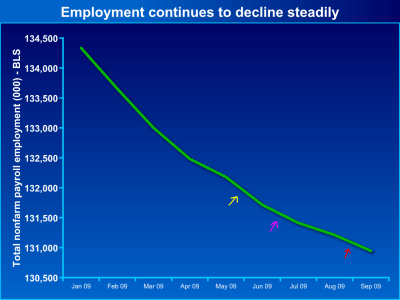
Employment has declined steadily since Obama took office

Now, you may be hearing Obama say that we’ve turned the corner on unemployment. For instance, look at how the White House is spinning this graph.

Hennessey writes:

Check out the slightly different slopes of the three line segments indicated by arrows.  The purple arrow shows a segment that slopes downward slightly less than the yellow arrow.  A mathematician would say the shift from yellow to purple was an inflection point, shifting the curve from convex to concave.

This is what led the President in early August to say the economy was “pointed in the right direction.”  The red arrow shows the worse news of last Friday’s jobs report, with a line that slopes downward slightly more sharply.  The curve shifted back to a convex shape, in which the slope was more sharply downward than in the prior month.

If you’re saying to yourself, “That’s ridiculous!  They’re all going down, and the differences in slopes are almost too hard to see!” then you’ve got my point.

And below I’m going to explain why Obama’s massive government spending created this worsening unemployment.

Economics in One Lesson

We are going to have to pay for all this spending on Obama’s favored special interest groups eventually, and that means that taxes will go up, or that the value of the dollar will go down, due to inflation. It has to be one or the other or both. There is no third way. When employers see that higher taxes or inflation are coming, they stop hiring people because they know that higher taxes and/or inflation kills the economy.

Perhaps it is time to review Henry Hazlitt’s Economics in One Lesson, chapter 4, entitled “Public Works Mean Taxes”.

Excerpt:

Therefore, for every public job created by the bridge project a private job has been destroyed somewhere else. We can see the men employed on the bridge. We can watch them at work. The employment argument of the government spenders becomes vivid, and probably for most people convincing. But there are other things that we do not see, because, alas, they have never been permitted to come into existence. They are the jobs destroyed by the $10 million taken from the taxpayers. All that has happened, at best, is that there has been a diversion of jobs because of the project. More bridge builders; fewer automobile workers, television technicians, clothing workers, farmers.

And consider Chapter 5 as well, entitled “Taxes Discourage Production”.

In our modern world there is never the same percentage of income tax levied on everybody. The great burden of income taxes is imposed on a minor percentage of the nation’s income; and these income taxes have to be supplemented by taxes of other kinds. These taxes inevitably affect the actions and incentives of those from whom they are taken. When a corporation loses a hundred cents of every dollar it loses, and is permitted to keep only fifty-two cents of every dollar it gains, and when it cannot adequately offset its years of losses against its years of gains, its policies are affected. It does not expand its operations, or it expands only those attended with a minimum of risk. People who recognize this situation are deterred from starting new enterprises. Thus old employers do not give more employment, or not as much more as they might have; and others decide not to become employers at all. Improved machinery and better-equipped factories come into existence much more slowly than they otherwise would. The result in the long run is that consumers are prevented from getting better and cheaper products to the extent that they otherwise would, and that real wages are held down, compared with what they might have been.

There is a similar effect when personal incomes are taxed 50, 60 or 70 percent. People begin to ask themselves why they should work six, eight or nine months of the entire year for the government, and only six, four or three months for themselves and their families. If they lose the whole dollar when they lose, but can keep only a fraction of it when they win, they decide that it is foolish to take risks with their capital. In addition, the capital available for risk-taking itself shrinks enormously. It is being taxed away before it can be accumulated. In brief, capital to provide new private jobs is first prevented from coming into existence, and the part that does come into existence is then discouraged from starting new enterprises. The government spenders create the very problem of unemployment that they profess to solve.

What Obama did, in effect, is to fire all of those millions of private sector people, so that he could reward the people who voted for him. And jobs are created far more efficiently by small businesses than they are by big government. What creates new jobs is entrepreneurs with ideas who hire people. And government spending diverts money away from these efficient entrepreneurs and towards inefficient government bureaucracies.

MUST-READ: How does health care in the USA compare with other countries?

Story from the Hoover Institute at Stanford University, via ECM.

The article compares American health care to health care in other places like Canada, the UK and Europe.

I am particularly interested in prostate cancer rates, because that is a cancer that will necessarily be neglected by states that have single-payer systems. Why, you ask? Because only men get prostate cancer. And in a welfare state where leftist politicians are always catering to their special interest victim groups, men will definitely be discriminated against.

The full article. I almost never cite the full article, but this is a must read.

MEDICINE AND HEALTH:
Here’s a Second Opinion

By Scott W. Atlas

Ten reasons why America’s health care system is in better condition than you might suppose. By Scott W. Atlas.

Medical care in the United States is derided as miserable compared to health care systems in the rest of the developed world. Economists, government officials, insurers, and academics beat the drum for a far larger government role in health care. Much of the public assumes that their arguments are sound because the calls for change are so ubiquitous and the topic so complex. Before we turn to government as the solution, however, we should consider some unheralded facts about America’s health care system.

1. Americans have better survival rates than Europeans for common cancers. Breast cancer mortality is 52 percent higher in Germany than in the United States and 88 percent higher in the United Kingdom. Prostate cancer mortality is 604 percent higher in the United Kingdom and 457 percent higher in Norway. The mortality rate for colorectal cancer among British men and women is about 40 percent higher.

2. Americans have lower cancer mortality rates than Canadians. Breast cancer mortality in Canada is 9 percent higher than in the United States, prostate cancer is 184 percent higher, and colon cancer among men is about 10 percent higher.

3. Americans have better access to treatment for chronic diseases than patients in other developed countries. Some 56 percent of Americans who could benefit from statin drugs, which reduce cholesterol and protect against heart disease, are taking them. By comparison, of those patients who could benefit from these drugs, only 36 percent of the Dutch, 29 percent of the Swiss, 26 percent of Germans, 23 percent of Britons, and 17 percent of Italians receive them.

4. Americans have better access to preventive cancer screening than Canadians. Take the proportion of the appropriate-age population groups who have received recommended tests for breast, cervical, prostate, and colon cancer:

  • Nine out of ten middle-aged American women (89 percent) have had a mammogram, compared to fewer than three-fourths of Canadians (72 percent).
  • Nearly all American women (96 percent) have had a Pap smear, compared to fewer than 90 percent of Canadians.
  • More than half of American men (54 percent) have had a prostatespecific antigen (PSA) test, compared to fewer than one in six Canadians (16 percent).
  • Nearly one-third of Americans (30 percent) have had a colonoscopy, compared with fewer than one in twenty Canadians (5 percent).

5. Lower-income Americans are in better health than comparable Canadians. Twice as many American seniors with below-median incomes self-report “excellent” health (11.7 percent) compared to Canadian seniors (5.8 percent). Conversely, white, young Canadian adults with below-median incomes are 20 percent more likely than lower-income Americans to describe their health as “fair or poor.”

6. Americans spend less time waiting for care than patients in Canada and the United Kingdom. Canadian and British patients wait about twice as long—sometimes more than a year—to see a specialist, have elective surgery such as hip replacements, or get radiation treatment for cancer. All told, 827,429 people are waiting for some type of procedure in Canada. In Britain, nearly 1.8 million people are waiting for a hospital admission or outpatient treatment.

7. People in countries with more government control of health care are highly dissatisfied and believe reform is needed. More than 70 percent of German, Canadian, Australian, New Zealand, and British adults say their health system needs either “fundamental change” or “complete rebuilding.”

8. Americans are more satisfied with the care they receive than Canadians. When asked about their own health care instead of the “health care system,” more than half of Americans (51.3 percent) are very satisfied with their health care services, compared with only 41.5 percent of Canadians; a lower proportion of Americans are dissatisfied (6.8 percent) than Canadians (8.5 percent).

9. Americans have better access to important new technologies such as medical imaging than do patients in Canada or Britain. An overwhelming majority of leading American physicians identify computerized tomography (CT) and magnetic resonance imaging (MRI) as the most important medical innovations for improving patient care during the previous decade—even as economists and policy makers unfamiliar with actual medical practice decry these techniques as wasteful. The United States has thirty-four CT scanners per million Americans, compared to twelve in Canada and eight in Britain. The United States has almost twenty-seven MRI machines per million people compared to about six per million in Canada and Britain.

10. Americans are responsible for the vast majority of all health care innovations. The top five U.S. hospitals conduct more clinical trials than all the hospitals in any other developed country. Since the mid- 1970s, the Nobel Prize in medicine or physiology has gone to U.S. residents more often than recipients from all other countries combined. In only five of the past thirty-four years did a scientist living in the United States not win or share in the prize. Most important recent medical innovations were developed in the United States.

Despite serious challenges, such as escalating costs and care for the uninsured, the U.S. health care system compares favorably to those in other developed countries.


This essay appeared on the website of the National Center for Policy Analysis on March 24, 2009. An earlier version was published in the Washington Times.

Available from the Hoover Press is Power to the Patient: Selected Health Care Issues and Policy Solutions, edited by Scott W. Atlas. To order, call 800.935.2882 or visit www.hooverpress.org.


Scott W. Atlas is a senior fellow at the Hoover Institution and a professor of radiology and chief of neuroradiology at Stanford University Medical School.

Please forward this article to all of your friends! It’s important!

MUST-SEE: New ad compares Obama’s job-creation rhetoric then and now

The video is up at Hot Air. (H/T 4Simpsons)

So what is the unemployment rate now? How well is Obammunism working?

WHTR News reports:

President Obama’s $787 billion stimulus bill to revive the economy is a staggering figure. So why then is there talk in Washington about a possible second stimulus package to jolt the American economy out of recession?

Economists say that only 10 percent of stimulus dollars have been spent and the president’s plan has been criticized for not creating enough jobs.

“You can’t justify it logically. You have to justify it politically and that’s what this comes down to. It’s political distribution of dollars,” said Matt Will, University of Indianapolis.

When the president signed the Recovery and Reinvestment Act into law in February, he said it would create new jobs. Yet unemployment now stands at almost 9.7 percent, the highest in over two decades.

When will voters learn that there is no way to stimulate an economy by spending? The right way to stimulate an economy is by creating jobs, by passing laws to encourage businesses to expand and hire more employees. For example, we could have spent 400 billion dollars and cut the employer portion of payroll taxes, so American workers would go on sale. The Democrat porkulus bills (1 and 2) did noting to create private sector jobs.

Remember, Democrats caused this recession and Republicans tried to stop them. Why should we trust Democrats to get us out of the mess they put us into?