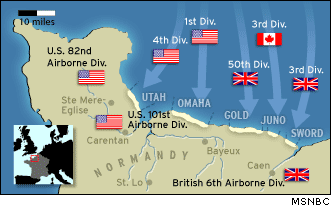
It’s June 6th, today, and it’s the anniversary of D-Day: the Allied invasion of northern France – the beginning of the end of World War 2. One of the most pivotal events of that day was the assault on German gun emplacements by members of the Army Rangers at a fortified position called “Pointe du Hoc”.
President Ronald Reagan recognized the soldiers who attacked Pointe du Hoc back in 1984:
Ronald Reagan also made the case for gratitude and vigilance:
Here’s the hymn that starts to play at the end:
The Boys of Pointe du Hoc
Here’s a summary of the Pointe du Hoc mission:
[Lt. Col. James Earl] Rudder took part in the D-Day landings as Commanding Officer of the United States Army’s 2nd Ranger Battalion. His U.S. Army Rangers stormed the beach at Pointe du Hoc and, under constant enemy fire, scaled 100-foot (30 meter) cliffs to reach and destroy German gun batteries. The battalion’s casualty rate for this perilous mission was greater than 50 percent. Rudder himself was wounded twice during the course of the fighting. In spite of this, they dug in and fought off German counter-attacks for two days until relieved. He and his men helped to successfully establish a beachhead for the Allied forces.
You can watch a three-clip documentary on it, too: part 1, part 2, part 3.
Although initially, the Rangers did not find the guns where they had expected them, they did find them further back behind the cliffs and destroyed them there, removing a threat to the forces that would be landing later.
What does D-Day mean to Christians in particular?
A Christian friend asked me what she should be thinking about when I sent her one of the videos above, and so I wrote her this to explain why I sent her the video:
To make you close your eyes and think in a more practical way about what it means for someone to sacrifice their lives to save you, of course. What it means to look up cliffs at machine guns, barbed wire and mortars raining death on you and to take a rope in your hands and to climb up a sheer cliff, under heavy fire, in order to save generations yet unborn and freedom itself.
To think about a concrete example helps us to be able to appreciate what Christ did for us in giving his life for us so that we could be free of sin, as well.
This is the insight that drives my entire interest in war and military history, in fact.
What does this mean: “Greater love has no man than this, that a man lay down his life for his friends.”
The more you know about D-Day, the more fearful what Jesus did appears, and the more you can be grateful.
Bullets and shrapnel are scary… and so are nails and lashes. Why on Earth would anyone endure either for me? And what should my response be to it?
I think it is helpful to explain Christianity to those who are not yet Christian, and for Christians to fully appreciate what Christianity is all about.
We were in peril. And now we have been saved. But at a cost.
I think that it’s important for Christians to look to history, art, poetry and music to help them to reflect and comprehend the sacrifice that Christ made for us in dying on the cross to protect us from peril. What must the cross have looked like to Jesus? It must have been something like what the Omaha beach looked like to the Americans landing in Normandy. Jesus saw whips, thorns and nails, and the heroes of Normandy saw 88 mm AT guns, 81 mm mortars and MG42 machine guns. How should you feel about people who face death on your behalf? Think about it.
Despite Churchill’s legendary status today, he was not merely ignored but ridiculed at the time, when he was repeatedly warning in vain. Knowing that his warnings provoked only mocking laughter in some quarters, even among some members of his own party, he said on March 14, 1938 in the House of Commons, “Laugh but listen.”
Just two years later, with Hitler’s planes bombing London, night after night, the laughter was gone. Many at the time thought that Britain itself would soon be gone as well, like other European nations that succumbed to the Nazi blitzkrieg in weeks (like France) or days (like Holland).
How did things get to such a desperate situation, with Britain alone continuing the fight, and struggling to survive, against the massive Nazi war machine that now controlled much of the material resources on the continent of Europe?
Things got that desperate by following policies strikingly similar to the policies being followed by the Western democracies today, including some of the very same notions and catchwords being used today.
Just recently, a State Department official in the Obama administration said that Americans have remained safe in a nuclear age, not because of our own nuclear arsenal but because “we created an intricate and essential system of treaties, laws and agreements.”
If “treaties, laws and agreements” produced peace, there would never have been a Second World War. The years leading up to that monumental catastrophe were filled with international treaties and arms control agreements.
The Treaty of Versailles, which ended the First World War, imposed strong restrictions on Germany’s military forces — on paper. The Washington Naval Agreements of 1922 imposed restrictions on all the major naval powers of the world — on paper. The Kellogg-Briand pact of 1928 created an international renunciation of war — on paper.
The Munich agreement of 1938 produced a paper with Hitler’s signature on it that British Prime Minister Neville Chamberlain waved to the cheering crowds when he returned to England, and said that it meant “Peace for our time.” Less than a year later, World War II began.
Winston Churchill never bought any of this. He understood that military deterrence was what preserved peace. With England playing a leadership role in Europe, “England’s hour of weakness is Europe’s hour of danger,” he said in the House of Commons in 1931.
[…]While Russia and China increased the share of their national output that went to military spending in 2014, the United States reduced its share. Churchill deplored the “inexhaustible gullibility” of disarmament advocates in 1932. That gullibility is still not exhausted in 2015.
“Not one of the lessons of the past has been learned, not one of them has been applied, and the situation is incomparably more dangerous,” Churchill said in 1934. And every one of those words is more urgently true today, in a nuclear age.
In France, after the First World War, the teachers’ unions launched a systematic purge of textbooks, in order to promote internationalism and pacifism.
Books that depicted the courage and self-sacrifice of soldiers who had defended France against the German invaders were called “bellicose” books to be banished from the schools.
Textbook publishers caved in to the power of the teachers’ unions, rather than lose a large market for their books. History books were sharply revised to conform to internationalism and pacifism.
The once epic story of the French soldiers’ heroic defense against the German invaders at Verdun, despite the massive casualties suffered by the French, was now transformed into a story of horrible suffering by all soldiers at Verdun— French and German alike.
In short, soldiers once depicted as national heroes were now depicted as victims— and just like victims in other nations’ armies.
[…]France, where pacifism and internationalism were strongest, became a classic example of how much it can matter.
During the First World War, France fought on against the German invaders for four long years, despite having more of its soldiers killed than all the American soldiers killed in all the wars in the history of the United States, put together.
But during the Second World War, France collapsed after just six weeks of fighting and surrendered to Nazi Germany.
At the bitter moment of defeat the head of the French teachers’ union was told, “You are partially responsible for the defeat.”
Charles de Gaulle, Francois Mauriac, and other Frenchmen blamed a lack of national will or general moral decay, for the sudden and humiliating collapse of France in 1940.
Is the same thing happening in our public schools? Are our children taught to think that wars can be prevented by unilaterally disarming?
The lesson we need to learn from history is that the way to stop wars is by making the people who want to start them understand that there will be a price to pay if they start a war. That means that we need a certain amount of military power, and that we should have demonstrated that we are willing to use it. That is counter-intuitive to people on the left who cannot imagine that evil tyrants really are evil tyrants. They want to believe that problems can be solved with talk, but history teaches that talk is cheap.
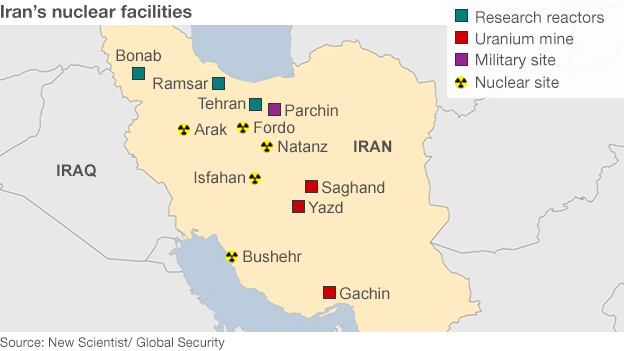
Secretary of State John Kerry told Congress this week that no one should pre-judge a nuclear deal with Iran because only the negotiators know what’s in it. But the truth is that the framework of an accord has been emerging thanks to Administration leaks to friendly journalists. The leaks suggest the U.S. has already given away so much that any deal on current terms will put Iran on the cusp of nuclear-power status.
The latest startling detail is Monday’s leak that the U.S. has conceded to Iran’s demand that an agreement would last as little as a decade, perhaps with an additional five-year phase-out. After that Iran would be allowed to build its uranium enrichment capabilities to whatever size it wants. In theory it would be forbidden from building nuclear weapons, but by then all sanctions would have long ago been lifted and Iran would have the capability to enrich on an industrial scale.
Is Iran our friend? Not really:
That is some gamble on a regime that continues to sponsor terrorist groups around the world, prop up the Assad regime in Syria, use proxies to overthrow the Yemen government, jail U.S. reporter Jason Rezaian on trumped-up espionage charges, and this week blew up a mock U.S. aircraft carrier in naval exercises near the Strait of Hormuz.
News leaked Monday of the “sunset clause.” President Obama had accepted the Iranian demand that any restrictions on its program be time-limited. After which, the mullahs can crank up their nuclear program at will and produce as much enriched uranium as they want.
Sanctions lifted. Restrictions gone. Nuclear development legitimized. Iran would re-enter the international community, as Obama suggested in an interview last December, as “a very successful regional power.” A few years — probably around 10 — of good behavior and Iran would be home free.
The agreement thus would provide a predictable path to an Iranian bomb. Indeed, a flourishing path, with trade resumed, oil pumping and foreign investment pouring into a restored economy.
Meanwhile, Iran’s intercontinental ballistic missile program is subject to no restrictions at all. It’s not even part of these negotiations.
Why is Iran building them? You don’t build ICBMs in order to deliver sticks of dynamite. Their only purpose is to carry nuclear warheads. Nor does Iran need an ICBM to hit Riyadh or Tel Aviv. Intercontinental missiles are for reaching, well, other continents. North America, for example.
[…]The deal now on offer to the ayatollah would confer legitimacy on the nuclearization of the most rogue of rogue regimes: radically anti-American, deeply jihadist, purveyor of terrorism from Argentina to Bulgaria, puppeteer of a Syrian regime that specializes in dropping barrel bombs on civilians.
Based on past deals, we shouldn’t be surprised by this news.
What makes these deals even worse is that they are all about constraining us, not the other guy. New START didn’t require Russia to destroy a single nuclear missile: it only reduced the size of the U.S. stockpile. The Arms Trade Treaty won’t stop the lawless and incompetent nations of the world from selling arms irresponsibly, but our lawyers will guarantee that it restrains us.
The essence of the Syrian deal was that it saved the U.S. from having to carry out Secretary of State John Kerry’s “unbelievably small” retaliatory strike on the Assad regime, which gets to remain in power. The Iran carve-up removes the lingering threat of any U.S. military action and makes Israeli action all but unthinkable, while the Iranians keep on enriching uranium and can zoom up to weapons-grade levels far faster than we can reimpose sanctions.
The administration is more afraid of having to respond to an Iranian nuclear breakout than it is of a breakout itself. The deal has bought only a six-month delay in the Iranian program, at the cost of easing UN sanctions the U.S. had carefully built up since 2006.
At the core of the accords is the belief that the U.S. is the nation that needs to be restrained. That is why they involve big concessions from us in exchange for far less from the other side. Since we are the problem, we are the ones who need to give things up to get a deal.
When the United States and China announced a surprise carbon-emissions deal, the environmental Left squealed in delight. Al Gore declared it “groundbreaking progress from the world’s largest polluter” (i.e., China), while John Kerry patted himself on the back in the New York Times, gushing about how “the world’s most consequential relationship has just produced something of great consequence in the fight against climate change.” Despite the extraordinary fanfare, there’s abundant reason for skepticism.
Though the announcement is politically expedient for both Barack Obama and Xi Jinping, China almost certainly won’t take significant steps to reduce carbon emissions.
[…]Beijing hasn’t actually agreed to much: It will try to “stop increasing” carbon emissions by 2030 — which is a slanted way of saying its emissions will continue to grow for another 16 years — and derive 20 percent of its energy from renewables by then, up from about 10 percent now. Though these goals may be codified into Chinese law, the CCP does not have a reputation for respecting the rule of law. And the United States and the international community won’t have any way of enforcing these goals. No wonder Reuters called it a “largely symbolic plan.”
[…]Critics of the president’s environmental policies have noted that even the most stringent emissions reductions from the First World won’t have much of an impact unless the developing world also cuts back. The environmental Left is marketing the new U.S.–China deal as a way to eliminate that objection and plow forward with the president’s hardline proposals for carbon regulations. “Now there is no longer an excuse for Congress to block action on climate change,” Senator Barbara Boxer said in today’s New York Times. “The biggest carbon polluter on our planet, China, has agreed to cut back on dangerous emissions, and now we should make sure all countries do their part because this is a threat to the people that we all represent.”
Boxer ignores the myriad other valid objections to the Obama administration’s proposed regulations, which seek to cut carbon emissions 30 percent from their 2005 levels by 2030. In reality, it’s bad policy because, despite enormous economic cost, it would yield very few environmental benefits.
We are cutting deals with every bad actor on the planet that will undermine our interests at home and abroad for years to come. And why? Well, it’s because Democrats think that United States is more of a threat to world peace than a force for good, and so they think the best way to save the planet is to strengthen countries like Russia, Iran and China. I think in one way this plan will work – Democrats will feel as if they are doing something, and they will congratulate themselves on their moral superiority. But as far as actually achieving good results? It’s not going to happen.


 WINTERY KNIGHT