Tag Archives: Peace Through Strength

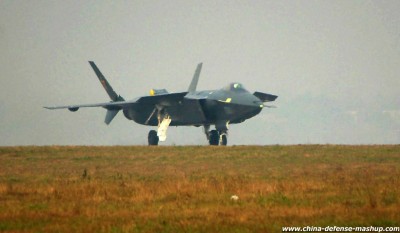
China unveils new J-20 stealth fighter, rival to the canceled F-22 Raptor

We need to restart the F-22 plant now

Story from Investors Business Daily.

Excerpt:

While America has stopped production of its stealth fighter, China prepares to challenge U.S. air supremacy in the Western Pacific with its own.

China is on another Long March, one it hopes will lead to military supremacy over the U.S. at least in the Western Pacific. It is deploying a carrier-killing mobile missile, the Dong Feng 21D, and is expected to launch its first aircraft carrier this year, the refurbished ex-Soviet carrier Varyag. China is also conducting preflight tests on a fifth-generation stealth fighter expected to challenge the best the U.S. has to offer.

Photographs reportedly showing China’s J-20 undergoing high-speed taxi tests at the Chengdu Aircraft Design Institute in western China have appeared, first on unofficial Chinese and foreign defense-related websites. Such tests are the last stage before actual flight tests.

[…]China’s stealth fighter appears to have “the potential to be a competitor with the F-22 (Raptor) and to be decisively superior to the F-35,” according to Richard Fisher, a Chinese military expert with the International Strategy and Assessment Center in Washington. The F-35 Joint Strike Fighter, the designated replacement for the Raptor, has had its troubles. The general in charge of the program was fired amid concerns of spiraling costs and program delays.

It was felt we couldn’t afford both an F-22 dedicated to air superiority and the F-35, even though the latter is vastly inferior in air-to-air combat and ground defense penetration. The Raptor is perhaps the only plane that could evade sophisticated surface-to-air missile defense systems such as Russia’s S-300 and S-400.

“Only the F-22 can survive in airspace defended by increasingly capable surface-to-air missiles,” declares Air Force Association President Mike Dunn. The F-22 can fly 300 to 400 mph faster and two miles higher than the F-35. The F-35 is cheaper, but you get what you pay for. And it’s still under development. The F-22 is operational now, when we need it.

[…]During recent military exercises with South Korea, the F-22 was conspicuous by its absence. Deploying a squadron of F-22s to Osan Air Base in South Korea would send a powerful “keep off the grass” message to Beijing and Pyongyang. So why haven’t we done it? Why haven’t we sent the world’s most advanced combat aircraft into any potential combat zone?

Perhaps because letting the F-22 Raptor prove its worth would be a visible reminder of the stupidity of building only 187 of them in a world where the Russians and Chinese are building their own stealth fighters, and thugocracies like Iran and North Korea go nuclear. It would be a reminder that the once-feared arsenal of democracy needs some serious retooling.

Let me be clear. The F-35 is overpriced junk. We should immediately resume, and even max out, production of the F-22 Raptor. That’s what Obama would be doing if he cared a whit about national security, and didn’t have his head stuck in the sand. We need more F-22s, and we need them yesterday and we need them deployed to South Korea and Japan yesterday.

It doesn’t help that we are firing Admirals for making insensitive training videos, either. We are the laughingstock of the world because of Obama’s weakness, incompetence and cowardice. Our enemies are laughing at us, and growing bolder.
52 Christian hostages killed by Al Quaeda Baghdad church attack

UPDATE: The number of victims who were killed is up to 52, now.

The SA Times Live reports on an Al Quaeda attack on a Christian church in Baghdad.

Excerpt:

Thirty-seven worshippers were killed and 56 wounded in a hostage drama at a Baghdad church, says an official.

“The latest toll is that 37 of the hostages were killed and 56 wounded,” an Iraqi interior ministry official said after Sunday’s attack on the church, claimed by an Al-Qaeda group.

He said that seven security forces personnel also were killed and 15 wounded, but did not specify if any were Americans.

Five attackers were killed and eight arrested, he said, adding there had been more than 100 worshippers at the Sayidat al-Nejat church in central Baghdad when the hostage-takers stormed in.

The SITE monitoring group said Monday that Al-Qaeda group The Islamic State of Iraq claimed its fighters were behind the attack

This story makes me think about some of my Christian co-workers who voted for Obama because they thought the Iraq war was too expensive. Christians need to care about other Christians in other countries, and we need to think about the most effective means for making their lives a little safer. Thank God that our forces were deployed so they could do something about this. To stop terrorists, you need good men armed with weapons. Talking doesn’t work.

Colombia’s war on terrorism and Chile’s war on poverty

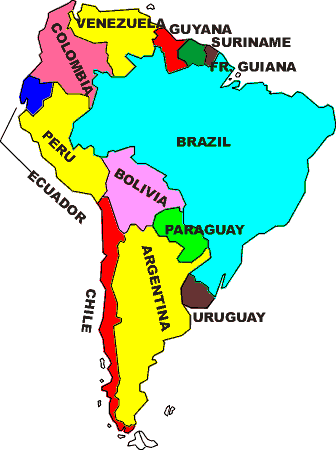
Map of South America

A magnificent column about Colombia’s war on FARC.

Excerpt:

When Juan Manuel Santos came into office as Colombia’s president and emphasized economic issues over the fight against terrorist guerrillas, he was suspected of going soft on those he had combated as minister of defense under the previous administration. Little did his critics know that he was planning the “coup de grace” against the Revolutionary Armed Forces of Colombia (FARC).

The devastating Sept. 22 attack on FARC headquarters in Colombia’s central Meta province all but signifies the end of the five-decade-old conflict. It will take a little while for the official end to be declared, but this war is pretty much over.

[…]For decades, politicians, academics, human rights activists and journalists on both sides of the Atlantic failed to see that there was nothing romantic, “bien-pensant” or Robin Hoodesque about an organization that killed, maimed, kidnapped and extorted for a totalitarian objective.

Colombia’s solitude was such that even the U.S. began to lose faith in its ally a couple of years ago, refusing to approve a free-trade agreement that Bogota had negotiated at a major political cost.

Colombians did not give up and continued to reclaim territory for civilian rule. Much like the defeat of Venezuela’s Cuba-inspired terrorist guerrillas in the 1960s, Colombia’s victory against FARC is the result of civilians awakening to the evil of totalitarian terror.

We get to hear about spectacular military feats, but how many outside Colombia realize that peasants, factory workers, teachers, students and others joined the struggle to defeat FARC, beautifully symbolized by the hundreds of thousands who took to the streets inside Colombia and around the world in 2008 to clamor for the end of terror?

There are still many challenges ahead. The lesson in courage and perseverance that Colombians have given us suggests they are ready to meet them.

I wish that we could sign a free trade deal with them like Canada’s conservative government. Canada is led by a conservative business-friendly economist, and they are very supportive of capitalist democracies like Colombia. Stephen Harper is Canada’s prime minister. He has economics degrees from the University of Calgary. Like Santos, he is very, very tough on terrorism – favoring increased defense spending to protect Canadian interests abroad. And guess what? Canada also has a free trade agreement with another South American country – Chile.

And Chile is also doing very well, even after the massive earthquake.

Excerpt:

Chile’s peso rose to a 27-month high after a report showed the country’s industrial growth accelerated to the fastest since 2006.

The peso appreciated 0.2 percent to 485.23 per U.S. dollar at 11:43 a.m. New York time, from 486.17 yesterday. The currency touched 483.61, the strongest since June 11, 2008. The peso has risen 13 percent during the quarter and 3.6 percent this month.

Chile’s economy is accelerating after the fifth-largest earthquake in a century struck in February, delaying its recovery from a 2009 recession.

“Retail sales grew and industrial production was better than expected,” said Roberto Melzi, a strategist at Barclays Capital in New York.

Retail sales expanded 13 percent in August from a year earlier, and industrial output grew 6.9 percent, the National Statistics Institute said in Santiago. That’s the most since January 2006. Industrial production shrank 17 percent after the 8.8-magnitude Feb. 27 earthquake and its accompanying tsunami, which caused damage worth more than a sixth of Chile’s gross domestic product.

Chile and Colombia are my two favorite South American countries. Both are led by conservative business-friendly economists. Chile’s president Sebastián Piñerahas a Masters and a Ph.D in economics from Harvard, and is successful in the private sector. The Colombian President Juan Manuel Santos specializes in business and economics, with graduate degrees from Harvard and the London School of Economics.