Tag Archives: Peace Through Strength

Ronald Reagan’s 40th anniversary D-Day speech: the boys of Pointe du Hoc

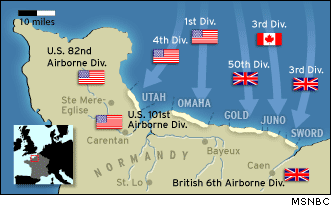
June 6, 1944 D-Day Normandy Invasion Map

It’s June 6th, today, and it’s the anniversary of D-Day: the Allied invasion of northern France – the beginning of the end of World War 2. One of the most pivotal events of that day was the assault on German gun emplacements by members of the Army Rangers at a fortified position called “Pointe du Hoc”.

President Ronald Reagan recognized the soldiers who attacked Pointe du Hoc back in 1984:

You can read the full transcript of that speech here.

Ronald Reagan also made the case for gratitude and vigilance:

Here’s the hymn that starts to play at the end:

The Boys of Pointe du Hoc

Here’s a summary of the Pointe du Hoc mission:

[Lt. Col. James Earl] Rudder took part in the D-Day landings as Commanding Officer of the United States Army’s 2nd Ranger Battalion. His U.S. Army Rangers stormed the beach at Pointe du Hoc and, under constant enemy fire, scaled 100-foot (30 meter) cliffs to reach and destroy German gun batteries. The battalion’s casualty rate for this perilous mission was greater than 50 percent. Rudder himself was wounded twice during the course of the fighting. In spite of this, they dug in and fought off German counter-attacks for two days until relieved. He and his men helped to successfully establish a beachhead for the Allied forces.

You can watch a three-clip documentary on it, too: part 1, part 2, part 3.

You can read the complete story about their successful effort to destroy the 6 155mm German guns here on Military History Online. Although initially, the Rangers did not find the guns where they had expected them, they did find them further back behind the cliffs and destroyed them there, removing a threat to the forces that would be landing later.

What does D-Day mean to Christians in particular?

A female Christian friend asked me what she should be thinking about when I sent her one of the videos above, and so I wrote her this to explain why I sent her the video:

To make you close your eyes and think in a more practical way about what it means for someone to sacrifice their lives to save you, of course. What it means to look up cliffs at machine guns, barbed wire and mortars raining death on you and to take a rope in your hands and to climb up a sheer cliff, under heavy fire, in order to save generations yet unborn and freedom itself.

To think about a concrete example helps us to be able to appreciate what Christ did for us in giving his life for us so that we could be free of sin, as well.

This is the insight that drives my entire interest in war and military history, in fact.

What does this mean: “Greater love has no man than this, that a man lay down his life for his friends.”

The more you know about D-Day, the more fearful what Jesus did appears, and the more you can be grateful.

Bullets and shrapnel are scary… and so are nails and lashes. Why on Earth would anyone endure either for me? And what should my response be to it?

I think it is helpful to explain Christianity to those who are not yet Christian, and for Christians to fully appreciate what Christianity is all about.

We were in peril. And now we have been saved. But at a cost.

I think that it’s important for Christians to look to history, art, poetry and music to help them to reflect and comprehend the sacrifice that Christ made for us in dying on the cross to protect us from peril. What must the cross have looked like to Jesus? It must have been something like what the Omaha beach looked like to the Americans landing in Normandy. Jesus saw whips, thorns and nails, and the heroes of Normandy saw 88 mm AT guns, 81 mm mortars and MG42 machine guns. How should you feel about people who face death on your behalf? Think about it.

Defense cuts to an already weakened military exposes us to aggression

Mackenzie Eaglen is a defense policy analyst for the American Enterprise Institute.

Here’s a recent article that she wrote from the Wall Street Journal. (Full text also here on the AEI web site)

Excerpt:

Washington is battling these days over “sequestration,” the $500 billion additional cut to the defense budget looming in January.

[…]In April 2011—long before the near shutdown of the government and the last-minute debt-ceiling deal, which paved the way for sequestration—the president outlined $400 billion in defense cuts he had already approved. He also said that he wanted to “do that again” and find another $400 billion in military spending reductions. All this without any talk of threats, strategy or requirements—just arbitrary budget targets imposed on the military.

Even before sequestration and the possible loss of a half-trillion dollars, the U.S. military has seen three years of budget cuts. The consequences are already here. We have to look all the way back to 1916 to find a year when the Air Force purchased fewer aircraft than are included in Mr. Obama’s 2013 budget request.

Many of the Air Force’s aerial refueling tankers predate human space flight. Training aircraft are twice as old as the students flying them. The F-15 fighter first flew 40 years ago. A-10 ground-attack planes were developed in the Carter years. And all of our B-52 bombers predate the Cuban missile crisis.

Then there’s the Navy, which is the smallest it has been since 1916. At 286 combat and combat-support ships, the Navy today is less than half the size it reached during the Reagan administration. And what about those men and women who have been fighting America’s wars in Afghanistan and Iraq since 2001? They’re losing 100,000 in active duty personnel. Surely some will go from the front lines to unemployment lines as a result.

[…]Military leaders have suggested that taking on Syrian President Bashar al-Assad and his Third World army would be an operation of “many, many months.” The so-called “pivot” to Asia is being mimed with fewer ships on longer deployments and a shrinking, aging air force. We’re ignoring a wholesale Chinese power grab in the South China Sea and watching the nuclearization of Iran.

In another article on AOL Defense, she focuses in on the cuts to the U.S. Air Force. (Full text also here on the AEI web site)

Excerpt:

Between the existing reduction of $487 billion and sequestration’s additional half-trillion dollar cut, the Pentagon faces a very profound strategic turning point — one entirely different than that articulated by Secretary Panetta. Instead of prudently posturing for future successes, America’s armed forces are headed for a crash.

These pressures are perhaps best illustrated within the Air Force. The service absorbed 90 percent of the cuts levied on the Department of Defense in the 2013 budget — $4.8 billion of $5.2 billion. The effects have been immediate and pronounced: nearly 10,000 airmen are being cut; 227 aircraft are being prematurely retired; and critical capability shortfalls are on the rise.

[…]These budget cuts would not present such dire effects if the Air Force had been able to use the past decade to recapitalize its fleet and overarching infrastructure. At the end of World War Two, the Korean War, Vietnam, and the Cold War, the service was able to weather post-war budget downturns precisely because it had reset the majority of its capabilities during wartime.

Circumstances were different this past decade. The Air Force, already stretched thin by the 1990s procurement holiday, actually saw its percentage of the defense budget decline by one-third during the wars in Iraq and Afghanistan. The service canceled or delayed the vast majority of its modernization portfolio to sustain wartime operational demands.

So 20 years of underfunding has given us an Air Force on the brink. Its aircraft average a quarter of a century in age-with many dating back to the Eisenhower Administration. The wings of Carter-era A-10 ground attack airplanes are riddled with structural cracks. Airmen learning to fly are strapping into T-38s over twice their age. B-52s, all of which pre-date the Cuban missile crisis, are spending up to a year in depot-level maintenance. In light of the F-22 shortage, the Air Force is now extending the lifespan of its 28 year-old F-15s to 18,000 hours — more than three times their original design life.

The Air Force also spent the last decade retiring nearly a quarter of its bombers, fighters, and cargo aircraft in an attempt to free up money for immediate priorities. While helpful on a budget spreadsheet in the near-term, this has stretched the remaining tails even thinner. Shrinking the fleet makes little sense when the mission demand is constant. Aircraft availability rates and maintenance statistics clearly illustrate the rising costs associated with this decision.

Obama is also in favor of the complete disarmament of the United States with respect to nuclear weapons.

The Wall Street Journal explains:

The White House and Pentagon are considering several proposals that would deeply cut the nation’s stockpile of nuclear weapons, potentially to as low as 300 warheads under one such plan, according to a U.S. official.

The proposals haven’t been presented to President Barack Obama but are being debated by lower-level officials on the national-security staff and in the Pentagon.

The U.S. official said the government isn’t considering a unilateral cut to the nation’s nuclear arsenal. Instead, the different proposals represent arsenal levels that could be negotiated with Russia in a future round of arms-control talks.

Nonetheless, the prospect of nuclear-arsenal cuts during a hard-fought presidential campaign is certain to stoke political controversy.

Under current treaty obligations, the U.S. must reduce its nuclear arsenal to 1,550 warheads by 2018 from just below 1,800 now. One of the new proposals would cut the arsenal to between 1,000 and 1,100; another proposes an arsenal of between 700 to 800; and the most drastic proposal would cut the arsenal to between 300 and 400, according to the official.

The fact of the matter is that there are hot spots and threats all over the world. If we want to work towards peace and protect the weak, then we need a large, capable military force. This is the doctrine of peace through strength. Talk is cheap, and disarmament only emboldens evildoers to be aggressive. If we want to stop war, we have to make it costly for aggressors and tyrants. They have to know that there is a cost.

Ronald Reagan’s 40th anniversary D-Day speech: the boys of Pointe du Hoc

June 6, 1944 D-Day Normandy Invasion Map

It’s June 6th, today, and it’s the anniversary of D-Day: the Allied invasion of northern France – the beginning of the end of World War 2. One of the most pivotal events of that day was the assault on German gun emplacements by members of the Army Rangers at a fortified position called “Pointe du Hoc”.

President Ronald Reagan recognized the soldiers who attacked Pointe du Hoc back in 1984:

You can read the full transcript of that speech here.

Ronald Reagan also made the case for gratitude and vigilance:

Here’s the hymn that starts to play at the end:

The Boys of Pointe du Hoc

Here’s a summary of the Pointe du Hoc mission:

[Lt. Col. James Earl] Rudder took part in the D-Day landings as Commanding Officer of the United States Army’s 2nd Ranger Battalion. His U.S. Army Rangers stormed the beach at Pointe du Hoc and, under constant enemy fire, scaled 100-foot (30 meter) cliffs to reach and destroy German gun batteries. The battalion’s casualty rate for this perilous mission was greater than 50 percent. Rudder himself was wounded twice during the course of the fighting. In spite of this, they dug in and fought off German counter-attacks for two days until relieved. He and his men helped to successfully establish a beachhead for the Allied forces.

You can watch a three-clip documentary on it, too: part 1, part 2, part 3.

You can read the complete story about their successful effort to destroy the 6 155mm German guns here on Military History Online. Although initially, the Rangers did not find the guns where they had expected them, they did find them further back behind the cliffs and destroyed them there, removing a threat to the forces that would be landing later.

What does D-Day mean to Christians in particular?

A female Christian friend asked me what she should be thinking about when I sent her one of the videos above, and so I wrote her this to explain why I sent her the video:

To make you close your eyes and think in a more practical way about what it means for someone to sacrifice their lives to save you, of course. What it means to look up cliffs at machine guns, barbed wire and mortars raining death on you and to take a rope in your hands and to climb up a sheer cliff, under heavy fire, in order to save generations yet unborn and freedom itself.

To think about a concrete example helps us to be able to appreciate what Christ did for us in giving his life for us so that we could be free of sin, as well.

This is the insight that drives my entire interest in war and military history, in fact.

What does this mean: “Greater love has no man than this, that a man lay down his life for his friends.”

The more you know about D-Day, the more fearful what Jesus did appears, and the more you can be grateful.

Bullets and shrapnel are scary… and so are nails and lashes. Why on Earth would anyone endure either for me? And what should my response be to it?

I think it is helpful to explain Christianity to those who are not yet Christian, and for Christians to fully appreciate what Christianity is all about.

We were in peril. And now we have been saved. But at a cost.

I think that it’s important for Christians to look to history, art, poetry and music to help them to reflect and comprehend the sacrifice that Christ made for us in dying on the cross to protect us from peril. What must the cross have looked like to Jesus? It must have been something like what the Omaha beach looked like to the Americans landing in Normandy. Jesus saw whips, thorns and nails, and the heroes of Normandy saw 88 mm AT guns, 81 mm mortars and MG42 machine guns. How should you feel about people who face death on your behalf? Think about it.