Does Barack Obama’s knowledge of policy match his confidence?
Now, many American voters like to think that if the President expresses concern about things like poverty and income inequality, then that means that whatever he does to “fix” it will automatically work to benefit the poor. Is it true?
Here is an article from Investors Business Daily, which talks about a study from the respected, leftist Brookings Institute.
Excerpt:
President Obama’s upbeat assessment of the economy is not likely to sit well with low-income families living in major urban or metro areas. For them, economic decline is a harsh reality, not “fiction.”
In his State of the Union speech, Obama declared that “anyone claiming that America’s economy is in decline is peddling a fiction.”
But a new report from the liberal-leaning Brookings Institution finds that incomes among the poorest fifth of households was significantly lower than it was in 2007. Of the 100 cities it examined, incomes fell an overall average of 12%, according to the report’s data. In some, the drop was huge — 34% in Stockton, Calif., 31% in New Haven, Conn., and 30% in Lakeland, Fla.
At the other end of the spectrum, the top 5% of households saw incomes climb, but not by much. The average income for this group was basically unchanged over those years.
As a result, income inequality has increased, but not — as Obama, Bernie Sanders and the chorus of liberal Democrats would have you believe — because the rich are getting richer.
“It’s really about the poor losing ground rather than these upper-class households pulling away,” Brookings senior fellow Alan Berube told AP.
[…]Added to this, many of the cities that saw the biggest increases in income inequality — like Boston; New Orleans; Providence, R.I.; New Haven, Conn.; San Francisco, Washington, D.C. — have been bastions of “spread the wealth around” liberalism.
Another example of this would be Obamacare. Obama got up in front of his teleprompters and told everyone that he was going to make changes to health care policy. He promised that it would not add one dime to the deficit, that we could keep our doctors, that we could keep our health plans and that our health insurance premiums would go down. Every single one of those promises were lies.
We don’t know if Obama knows that he is lying when he says these things. I prefer to think that he is just too stupid to know what he is talking about. He says things that make him feel good. Things that would have pleased his professors in college. But since he has no practical experience of achieving results in any of these areas, he fails again and again. He is confident because he assumes a knowledge of how to obtain results that he does not actually have, owing to his lack of experience. And yet we elected him, then re-elected him.
He is in his own little world, where the people around him carefully insulate him from a reality where all his confident prescriptions have failed to produce what he intended.
Could it be that the free enterprise system of economics that was “built in” to America at the founding actually works better than the failed systems of socialism and communism that Obama was taught in college? Could it be that if we just stuck with the free enterprise system that made us the most powerful economy in the world, that things would be better for the poor than in places where capitalism is rejected for socialism?
We don’t have to guess at what the economic policies of the left produce. You can see it with your own eyes in socialist countries like Venezuela, Cuba, North Korea, Argentina, and so on.
First, let’s go from the top down to set the context for the profile of William E. Barber.
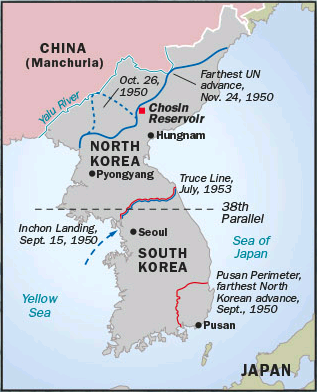
Map of the Korean War
In the summer of 1950, North Korean communists launch a completely unprovoked attack across the 38th parallel against their peaceful, democratic neighbors, the South Koreans. The Americans immediately sent an invasion force by sea to drive them out. The North Koreans easily manage to take over the capital Seoul, and the allies are left with only one port in the southeast – Pusan. In September of 1950, American forces land an invasion force at Inchon, cutting off the North Korean invasion force surrounding Pusan. The North Koreans retreat, and there is hope that American forces will be home by Christmas. But then, unbeknownst to the Americans, the Chines communists invade North Korea from the north and surround the American forces near the Chosin reservoir, threatening to annihilate an entire Marine division.
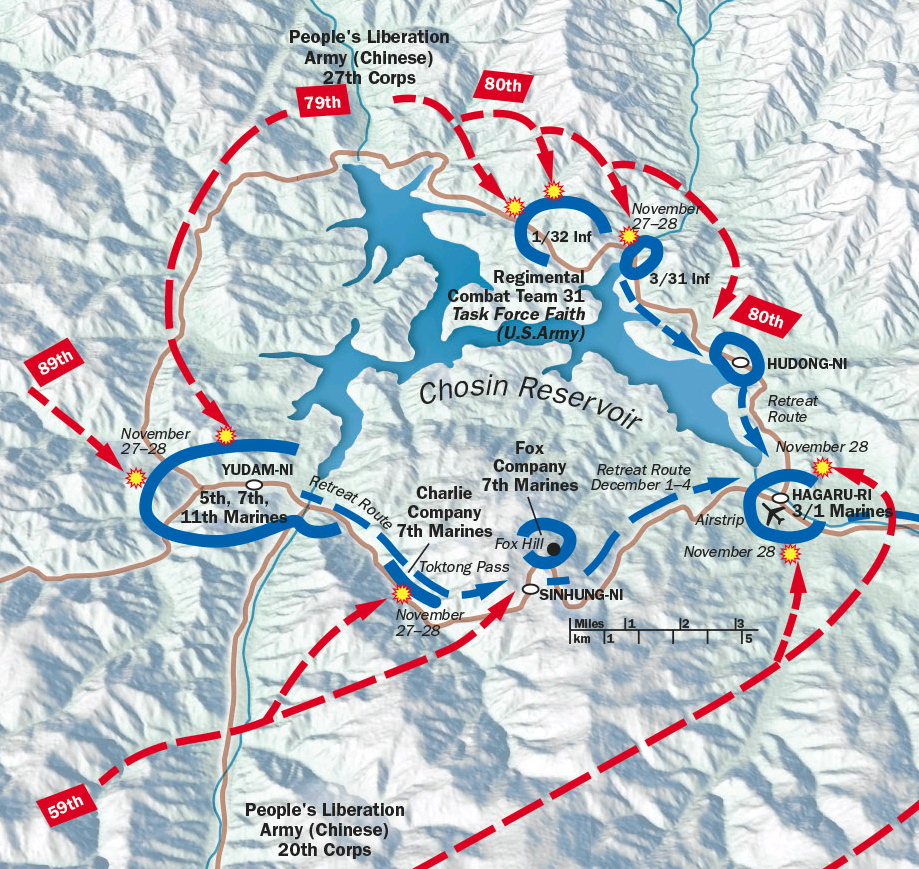
The Marines at Yudam-Ni are surrounded and must retreat to Hagaru-Ri
As you can see from the map, there are a whole bunch of American troops fighting to the north/east and south/west of the Chosin Reservoir. The marines near Yudam-Ni need to retreat along a road called the MSR (main supply road) back to Hagaru-Ri. But in order to conduct that retreat, they have to hold onto the vital Toktong pass, which is overwatched by Fox company from their position on Fox Hill. Can Charlie company and Fox company hold off the entire Chinese 59th division (10,000 men) with only two companies (about 250 men each)?
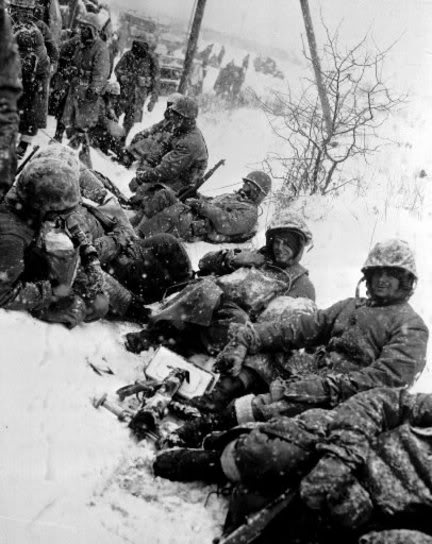
U.S. Marines “The Chosin Few”, December 1950
Well, the book I read (which Dina gave me for Christmas), was about Fox company and their defense of the Toktong pass. This is what the leftist New York Times had to say about the man in charge of Fox company (“F company”) in a 2002 article:
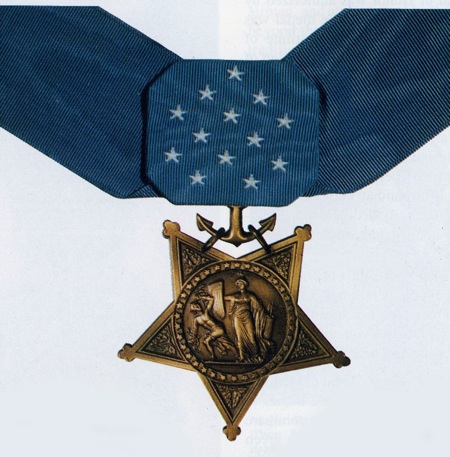
Col. William E. Barber, who won the Medal of Honor for his leadership of a vastly outnumbered company under siege on a snowy hilltop in one of the worst defeats in Marine history, the Battle of the Chosin Reservoir in 1950, died on April 19 at his home in Irvine, Calif. He was 82.
The cause was bone-marrow cancer, said Jerry Courtier, a friend who hopes to write Colonel Barber’s biography.
The reservoir is south of the Yalu River, which separates North Korea from China. After the Americans had pushed the North Koreans almost to the Yalu, 150,000 Chinese troops unexpectedly crossed the river into North Korea. Colonel Barber’s unit, Company F of the Second Battalion of the Seventh Marines, First Marine Division, was on a hill that commanded the Toktong Pass, a vital gap between Yudam Ni and Hagaru Ri, two towns separated by 78 miles.
The stakes were huge. If F Company yielded its position, 8,000 marines at Yudam Ni would be cut off from the 3,000 at Haguru Ri by tens of thousands of Chinese troops.
Through five days and six nights in subzero weather and often swirling snow, Colonel Barber, then a captain, inspired his men, outnumbered more than five to one, to cling to their tenuous positions. He was shot in a bone near his groin on the second day but continued to make the rounds of the hill. He likened the wound to a bee sting.
When the unit was ordered to withdraw and fight its way to safety, Captain Barber refused. Three times, the enemy broke through the line, only to be repulsed.
”I knew that we could probably hold, and I knew that if we didn’t hold we could exact a very heavy toll,” he said in an interview in 1976 with The Los Angeles Times.
His citation for the nation’s top medal said that he commanded his men from a stretcher. But Hector A. Cafferata Jr., who as a rifleman won the Medal of Honor in the same battle, insisted that Captain Barber refused the stretcher.
”He walked the line, he kept us together,” said Mr. Cafferata, who was beside Captain Barber when he was shot.
In the mayhem, the Chinese blew whistles, beat cymbals and tooted bugles as they repeatedly attacked. Coffee froze before men could drink it, and some of the wounded died because plasma froze with no way to thaw it.
When the battle was over, more than 1,000 enemy soldiers were dead. Of Captain Barber’s original 240 men, 82 were able to walk away.
Gen. Raymond G. Davis, who was a lieutenant colonel in the Marines, received a Medal of Honor for leading the unit that rescued F Company.
William Earl Barber was born on Nov. 30, 1919, in Dehart, Ky. He attended what is now Morehead State University in Morehead, Ky., for two years and enlisted in the Marines, at the age of 21, in 1940.
He was so good at shooting a rifle that he was made a weapons instructor. After volunteering for parachute training, he demonstrated such proficiency that he became a parachute instructor.
In World War II, he was promoted to sergeant in 1942 and commissioned a second lieutenant in 1943. He was a rifle platoon commander at Camp Pendleton, Calif., when his unit was shipped to the Pacific.
Colonel Barber was in the first wave to hit Iwo Jima, where he was wounded twice. He received the Silver Star for bravery in addition to two Purple Hearts. At a ceremony on the 50th anniversary of the battle in 1995, he said:
”I am older now, as you are, but I can still see the colors of that February morning. The sky. The island. And sometimes I think I can hear the noise of battle.”
He was treated in Japan for his wounds and returned to the United States, where he worked as a recruiter, among other positions. He was promoted to captain in 1949 and was in the force that occupied Japan.
When he joined F Company in Korea, he saw a raggedy unshaven bunch and immediately ordered the the troops to shave, shine their shoes and look like marines. He suggested that his new charges resembled Pancho Villa’s bandits.
”He was one tough guy,” Mr. Cafferata said. ”He was by the book.”
He was by the book. He enlisted in the Marines because he was grateful to his country for allowing him to escape poverty and go into college, and he wanted to give something back.
So, now that I am done with that book, I have moved on to another Korean War book that Dina gave me, this one about George company. The Korean War might have been our most just war – defending a peaceful democratic ally from a totalitarian communist regime. You just have to compare North Korea and South Korea today to understand the stakes. North Korea is basically a godless concentration camp that tortures and murders its people if they so much as think the wrong thoughts about the atheist state. South Korea is free and prosperous, where the people have human rights, like the right to free speech and freedom of religion.
It’s important for me to read about the hardships that real heroes face, so that I don’t complain too much about my own tiny struggles. When you read about the struggles of great American soldiers, so many good things happen to you. Your own problems get smaller, your humility and gratitude get bigger. And you are reminded about why America is a great country, and what American character is really like. These things are not taught by leftists in the public schools. They are not talked about by leftists in the mainstream media. They are not presented by leftists in the Hollywood film industry. If you want to know the real America, you have to find it yourself.
Here’s the story from the radically leftist CBC News.
Excerpt:
North Korea’s Supreme Court has sentenced a Canadian pastor to life in prison with hard labour for what it called crimes against the state.
Hyeon Soo Lim, who is in his early 60s and is pastor at the Light Korean Presbyterian Church in Toronto, was sentenced after a 90-minute trial. He had been in detention since February.
Lim’s relatives and colleagues have said he travelled on Jan. 31 as part of a regular humanitarian mission to North Korea where he supports a nursing home, a nursery and an orphanage. They said Lim has made more than 100 trips to North Korea since 1997, and that his trips were about helping people and were not political.
[…]Charges against him include:
Harming the dignity of the supreme leadership.
Trying to use religion to destroy the North Korean system.
Disseminating negative propaganda about the North to the overseas Koreans.
Helping U.S. and South Korean authorities to lure and abduct North Korean citizens, and aiding their programs to assist defectors from the North.
State prosecutors sought the death penalty.
Now I would imagine that this is the kind of thing that our own radical atheist groups in America would celebrate, e.g. – the Freedom From Religion Foundation, the ACLU, the Southern Poverty Law Center, the Human Rights Campaign, etc. They are very anxious to get rid of using public expressions of Christianity from the public square, and big government is their preferred weapon to achieve that. I would say that the opinion of Christianity among the North Korean elite is similar to the opinion of Christianity held by the secular elites in the Democrat Party, and I have blogged many times on their anti-Christian statements to that effect,here for example and here for another example and here for yet another example. Personally, I would think that in the Obama administration, more work is done spying on Christians, pro-lifers and conservatives than on radical Islamists and radical environmentalists. Which is why we need to vote the Democrats out – they are not serious about the real threats we face as a nation.
Atheist regimes
Let’s go ahead and review what atheist regimes in other times and places are like.
Let’s take a look at what Josef Stalin did during his rule of Russia in the 1920s and 1930s.
The Soviet Union was the first state to have as an ideological objective the elimination of religion. Toward that end, the Communist regime confiscated church property, ridiculed religion, harassed believers, and propagated atheism in the schools. Actions toward particular religions, however, were determined by State interests, and most organized religions were never outlawed.
The main target of the anti-religious campaign in the 1920s and 1930s was the Russian Orthodox Church, which had the largest number of faithful. Nearly all of its clergy, and many of its believers, were shot or sent to labor camps. Theological schools were closed, and church publications were prohibited. By 1939 only about 500 of over 50,000 churches remained open.
Atheist propaganda and the struggle against religion began immediately after the Bolsheviks seized power in 1917. While social change would, under Marxist theory, bring religion to disappear, Leninists argued that the Party should actively help to eradicate religion as a vital step in creating ‘New Soviet Man’. The energy with which the Party struggled against religion, though, varied considerably from time to time and from place to place, as did its hostility to particular faith groups. The 1920s saw the closure of innumerable churches and synagogues (and to a lesser extent mosques) and the active persecution of clergy and harassment of believers. From 1930, though, Stalin introduced a less aggressive approach, and wartime support for the government earned for the Russian Orthodox Church, at least, a level of toleration which lasted until Stalin’s death. Under Khrushchev antireligious efforts resumed, if spasmodically, and they lasted until the end of the Soviet Union.
An article from the pro-communism Marxist.com web site says this about Stalin:
During the ultra-left period of forcible collectivisation and the Five Year Plan in Four an attempt was made to liquidate the Church and its influence by government decree. Starting in 1929 churches were forcibly closed and priests arrested and exiled all over the Soviet Union. The celebrated Shrine of the Iberian Virgin in Moscow – esteemed by believers to be the “holiest” in all Russia was demolished – Stalin and his Government were not afraid of strengthening religious fanaticism by wounding the feelings of believers as Lenin and Trotsky had been! Religion, they believed, could be liquidated, like the kulak, by a stroke of the pen. The Society of Militant Atheists, under Stalin’s orders, issued on May 15th 1932, the “Five Year Plan of Atheism” – by May 1st 1937, such as the “Plan”, “not a single house of prayer shall remain in the territory of the USSR, and the very concept of God must be banished from the Soviet Union as a survival of the Middle Ages and an instrument for the oppression of the working masses.”!
Take a look at this UK Daily Mail article about a great achievement of the atheist Josef Stalin, which occurred in 1932-1933.
Excerpt:
Now, 75 years after one of the great forgotten crimes of modern times, Stalin’s man-made famine of 1932/3, the former Soviet republic of Ukraine is asking the world to classify it as a genocide.
The Ukrainians call it the Holodomor – the Hunger.
Millions starved as Soviet troops and secret policemen raided their villages, stole the harvest and all the food in villagers’ homes.
They dropped dead in the streets, lay dying and rotting in their houses, and some women became so desperate for food that they ate their own children.
If they managed to fend off starvation, they were deported and shot in their hundreds of thousands.
So terrible was the famine that Igor Yukhnovsky, director of the Institute of National Memory, the Ukrainian institution researching the Holodomor, believes as many as nine million may have died.
[…]Between four and five million died in Ukraine, a million died in Kazakhstan and another million in the north Caucasus and the Volga.
By 1933, 5.7 million households – somewhere between ten million and 15 million people – had vanished. They had been deported, shot or died of starvation.
This is what follows when you believe that the universe is an accident, that there is no objective good and evil, that human beings are just animals, that no God will hold us accountable, and that human beings are not made in the image of God for the purpose of freely choosing to come into a relationship with him. The Ukrainian famine is an action that came from a man whose worldview was passionate, consistent atheism.


 WINTERY KNIGHT