Tag Archives: New Democrat Party

Should pro-life social conservatives vote for Stephen Harper?

Unborn baby scheming about tax cuts for married couples

Don’t listen to me, listen to Dave Warren.

Excerpt:

Our tax code has everything to do with our societal propensity to demographic extinction.

It helps destroy families in two major ways (and many minor ones for which we won’t have space). It forces the mother of small children to work for a second (heavily taxed) family income. Then, offers her the alternative of becoming a “welfare mom” -effectively a ward of the state, but with the bill sent these days to anything that looks like an ex-husband.

Fatherless households, with or without angry mothers, are in turn the source of so many of the children we do have: the ones who have survived the abortion mills. Those, of a certain age, acquainted with the modern schoolyard, will have noticed the general tendency toward juvenile delinquency. Though, overall crime rates balance out, thanks to the diminishing number of juveniles, as a proportion of our aging population.

The tax code isn’t, of course, the only cause contributing to this demographic, social, and moral disaster. The “culture of death” is also communicated through mass media and entertainment industries, and catered to by every sort of commercial advertising.

Yet the tax code is the principal originating cause. Over many decades, it has facilitated the Nanny State, by treating citizens as income-earning atoms. The capitalists feed upon conditions in the resulting market, wherein everyone is an atomized consumer, living narcissistically for the day.

It is against this very real background that the Harper government has proposed the one thing that looks like a serious policy proposal in the current general election campaign. It is to change the tax code to reduce the penalty on one-income families. I’ll leave the technical description of this “income splitting” to the tax experts and policy wonks.

Naturally, the feminists, and all other “progressive” people, are outraged by a scheme that would reduce this penalty. A woman’s place is in the workforce, according to the received progressive view; which holds that men and women must be treated as interchangeable; which makes children, by extension, discardable lifestyle options. (See rude reference to abortion mills, above.) That is why the last Pope called it the “culture of death.”

By contrast, the “culture of life,” to which humans are called by nature -often in the face of social engineering -envisions a world in which mothers and children play an important, and often the commanding part.

Just look at this chart from the Heritage Foundation:

Marriage and Poverty

Job creation reduces abortion. Intact families reduce abortion. A father in the home reduces abortion. Tax credits for children reduces abortion.

There is more than one way to be pro-life, especially in Canada where the majority of the people are not pro-life. Abortion is the consequence of the gender-feminist revolution that destroyed marriage and the family and replaced parents with public schools that push sex education, even onto very young children. The way to turn the tide back to the pro-life position is to first build consensus for pro-life laws by creating the conditions where every unborn child can be welcomed into the world by a loving married couple. There are financial incentives in Stephen Harper’s Family Tax Cut plan that will encourage people to get married and stay married. Harper is a social conservative and social conservatives should vote for Harper. He does the best he can by putting pro-life financial incentives in place.

You can read more about Stephen Harper’s 5-point Here for Canada policy plan and the Conservative plan to promote religious liberty abroad.
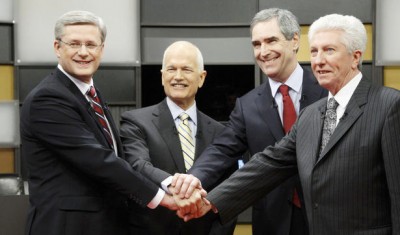
Stephen Harper wins English-language election debate

Stephen Harper shakes hands with petulant children

From left-wing Global TV, a university professor scores the first English-language debate in the Canadian Federal election.

Excerpt:

How well did the four leaders present their points?

Dr. Royce Koop: Harper is very effective at getting his message across. He is very clear, disciplined, and it’s tough to knock him off his game. Ignatieff is not communicating as well as I thought he would. He’s clearly new to this debate format.

Who were the clear aggressors and/or defenders throughout the debate?

Dr. Royce Koop: As can be expected, the three opposition leaders are the aggressors and Harper is the defender. However, Duceppe has distinguished himself as an aggressor. His opening comment was a strong, sharp attack of Harper. However, Harper is effectively defending himself in this debate. His strength is being disciplined, and he’s keeping his cool very well.

Who preformed best?

Dr. Royce Koop: Harper behaved like the PM-in-waiting. These debate formats actually favour the incumbent PM. Everyone is attacking them, and so they are able to rise above it all and act prime-ministerial. This is how Chretien survived the debates in 1997 and 2000, by riding above all the attacks, and Harper is doing so very effectively tonight.

What was your impression of the Harper-Ignatieff face-off? Who won that tete-a-tete?

Dr. Royce Koop: I think that Harper won that exchange, but it was a close call. Ignatieff has to be able to knock Harper off his game, and he hasn’t been able to do so effectively. He came close at the conclusion of the first exchange between them, but Harper came out on top.

A left-wing report from the Markdale Standard.

Excerpt:

Harper projected calm competence and self-assurance from the outset. He carried that through, almost without interruption, to his closing statement two hours later.

There was one moment when Ignatieff had an opening. That was in the prolonged section on democracy. Ignatieff was pressing hard. He scored some good hits on Stephen Harper, branding him a control freak who disrespects democratic institutions and, by extension, Canadians. It was a compelling segment and for a few moments it seemed like Ignatieff might turn the tide.

It didn’t happen. The debate moved on to other topics and ended, advantage Harper, on health care. Here Harper was very strong, looking pragmatic and sensible as the others sought in vain to breach his defence.

Harper’s debating skills, designed for TV, outmatched all three of the other contestants. Most tellingly, he looked constantly at the camera when answering questions, not at his opponents. He was the only one to do so consistently, though NDP leader Jack Layton also used this technique towards the end.

But Harper was rock-solid with it, constantly gazing into the camera, speaking directly Canadians in reassuring tones. With his body language he projected calm confidence. He kept his gestures small and controlled and within the circumference of his body – an effective technique on television.

[…]Tomorrow, look for Harper’s numbers in English Canada to rise sharply, into the low 40s. This will come as bitter brew to Liberal supporters across Canada, but it’s the simple reality: A Conservative majority is back on the table.

How did Harper win the debate? By using evidence.

Excerpt:

Canada’s good economic standing relative to its G8 counterparts, and the country’s relatively quick emergence from recession, can, in part, be credited to encouraging investment in the corporate sector, Mr. Harper said.

While in power, the Stephen Harper Conservatives have cut the corporate tax rate from 22.5% to 16.5%, with a further reduction to 15% scheduled for 2012.

To then foist a sudden reversal in policy on corporate Canada would send the wrong message to investors, Mr. Harper said on Tuesday. He quoted Jack Mintz, a public policy expert at the University of Calgary, as saying that the additional taxes proposed by the Liberals would cost the Canadian economy 200,000 jobs and $40-billion in business investment over the long run.

“Every credible economic analyst, every major business group in this country, says that if you raise taxes, you will hurt growth, hurt jobs and hurt revenue,” Mr. Harper said.

He must be the only politician I know who actually EXPLAINS why corporate tax-hikes are a bad idea. The government needs to cut taxes to attract corporations to move to their country, and to encourage their people to start or grow businesses. That’s where jobs COME FROM. And when people are working, because they have lots of jobs to choose from, they are happier and they pay more in taxes than if they were unemployed. And when people are employed, the government spends less on unemployment and other welfare programs. Notice that our corporate tax rate down here is 36%. More than double the Canadian corporate tax rate. Compared to the Canadians, we spend way too much, and we create far fewer jobs.

If the left-wing newspapers are calling it a victory for Harper, then it was a landslide victory for Harper. I am talking William Lane Craig vs Christopher Hitchens landslide victory. I can hardly wait to see the poll numbers from up north tomorrow. The latest pre-debate poll has Harper leading the socialist Liberal party by 12 points. (H/T Jeanie)

UPDATE: Post-debate poll shows that Harper won the debate.

Related posts

Stephen Harper’s Conservatives unveil “Here for Canada” platform

From Stephen Harper’s Conservative Party web site. (H/T Jeanie)

Excerpt:

Today, Prime Minister Stephen Harper unveiled his “Here for Canada” Conservative policy platform. The platform provides Canadians with a prudent low-tax plan to protect and create jobs by completing our recovery from the global economic recession. “Here for Canada” commits to eliminating the deficit by the 2014-2015 fiscal year without cutting transfer payments to individuals or to the provinces. And it contains concrete measures to secure Canada’s borders and keep our streets and neighbourhoods safe.

[…]The “Here for Canada” plan focuses on five key priorities:

  • Creating jobs through training, trade and low taxes.
  • Supporting families through our Family Tax Cut and more support for seniors and caregivers.
  • Eliminating the deficit by 2014-2015 by controlling spending and cutting waste.
  • Making our streets safe through new laws to protect children and the elderly.
  • Standing on guard for Canada by investing in the development of Canada’s North, cracking down on human smuggling and strengthening the Canadian Armed Forces.

Canada is emerging from the global recession as one of the world’s top-performing advanced economies. Throughout the global crisis of the past two years, the world has looked to Canada as a model and an inspiration. Through the Economic Action Plan, Stephen Harper’s Government is making the necessary investments to protect Canadians and create jobs now, while laying a strong foundation for long-term economic growth. Our low-tax plan is helping businesses create jobs. And we’re reducing taxes on hard-working Canadian families, because we understand that household budgets are tight.

The Conservatives need to get over 40% support to get a majority, so they can enact their 5-point platform. The latest Canadian federal election poll has the Conservatives leading the socialist Liberals 41 to 31, while the communist NDP party trails at 15%.

This large map shows the voting breakdown by region from the 2008 election.