
Tag Archives: New Democrat Party

Conservative Party of Canada wins two seats in by-elections

Congratulations to our conservative neighbors to the North!

Stephen Harper’s Conservatives pulled off an amazing political upset in federal by-elections Monday night, stealing a rural Quebec stronghold seat from the Bloc Quebecois.

The Conservatives also reclaimed a traditionally Tory seat in Nova Scotia, ultimately winning two of the four by-elections held Monday.

The results suggest the minority Conservative government’s political fortunes are undimmed by the recession and far stronger than expected in Quebec.

Let’s compare results:

Montmagny – L’Islet – Kamouraska – Rivière-du-Loup (Quebec)

2008:

  • Bloc Quebecois 20,494
  • Conservative 13,640
  • Liberal 6,835
  • New Democrat 2,428

2009:

  • Conservative 12,162
  • Bloc Quebecois 10,737
  • Liberal 3,768
  • New Democrat 1,363

Cumberland – Colchester – Musquodoboit Valley (Nova Scotia)

2008:

  • Independent 27,303
  • New Democrat 4,874
  • Conservative 3,493
  • Liberal 3,344

2009:

  • Conservative 11,167
  • New Democrat 6,267
  • Liberal 5,193

So, now the Conservatives have 145 of 308 ridings. Closer and closer to a majority.

Aside: why is it so freezing these days?

But I also note that October 2009 was our 3rd coldest in 115 years. Canadian readers: please keep the cold up there, we don’t want any of that down here. But if you could have Stephen Harper visit Washington more often, and perhaps give the ACORN lawyer some advice on how to run a country without bankrupting it, that would be OK with us.

Australia: same deal. We want John Howard to visit us. But keep your record cold October to yourself.

Prime Minister Stephen Harper polling in majority territory in Canada

It’s a Parliamentary system, and Prime Minister Stephen Harper’s currently has a minority government.

But check out the latest poll results from Dr. Roy:

w-fed-vote-graph-cbc

(Click to see enlarged image from CBC)

About the Ekos poll, courtesy of the National Post:

The polling firm this morning reported that the Tories have 40.7% support among Canadians, pushing the party past the symbolic 40% mark and into majority government territory if an election was held now (which it won’t be). The Liberals trail with 25.5% support, with the NDP a distant third at 14.3%. Ekos says the Conservatives are “comprehensively ahead.”

The results put the Conservatives up a full percentage point over the polling firm’s results last week, while the Liberals, NDP and Bloc are slightly down. (Interestingly, the Greens are slightly up, with 10.5% support; they were at 9.7% last week.)

“The Liberals are under siege everywhere they turn,” Frank Graves, president of EKOS, said in a statement. “Even new Canadians, under- 25 Canadians, and the university-educated appear to be turning against them. Most stunning of all, the Conservatives now have a lead among women of almost 11 percentage points.”

The telephone survey was conducted between Oct. 7 and Oct. 13, 2009, for CBC. It included 2,729 Canadians and is considered accurate within 1.9 percentage points, 19 times out of 20.

The PDF of the poll is here.

There are a total of 308 seats, and Harper needs 155 to have a majority. The projection from this poll that the Conservatives would get more than 155 seats, and get their majority, if the election were held today. Anything better than 40% usually means a majority.

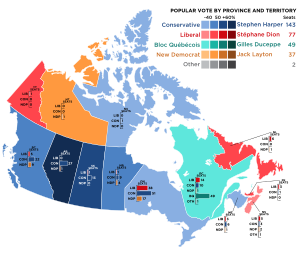
To compare, here are the results from the last federal election, held on October 14, 2008:

  • The Grown-Ups (Conservatives) got 37.7%
  • The Socialists (Liberals) got 26.3%
  • The English Communists (New Democrats) got 18.8%
  • The Green Communists (Greens) got 6.8%
  • The French Communists (Bloc Quebecois) got 10.0%

Here’s a map that show who voted for whom:

706px-Canada_2008_Federal_Election.svg

A “minority” government means that you need the support from another party to get over the 155 barrier so that you can pass a piece of legislation.

Canadian Evangelicals and Catholics more opposed to secularism and socialism

The Hill Times reports. (H/T Joanne from Blue Like You)

Excerpt:

According to the recently-released EFC study, “Canadian Evangelical Voting Trends by Region, 1996-2008,” which uses a series of electoral polls by Ipsos Reid and Angus Reid Strategies, in 1996 the Evangelical support for the Liberals was 35 per cent and it has been rapidly going down to 11 per cent in the last election, as the Conservative vote rose. The Conservatives’ support from evangelical Christians peaked in 2006, with 60 per cent of the Evangelical vote and then dropped to 48 per cent in 2008. The NDP vote in 2008 was at 16 per cent among evangelicals.

Evangelicals make up about 12 per cent of Canada’s population, or four million people distributed throughout Canada and to a lesser degree in Quebec.

[…]”There are two things that are fairly important for evangelicals, as they are important to Canadians who engage in the political system. The first thing is that there’s space created for engagement; so we have identified in the paper some of the incidents where it appeared that the Liberal Party was closing down the opportunity for evangelicals to engage on equal footing with non-evangelicals in the party and we’ve also identified where the Conservative Party had opened some place for evangelicals to engage on an equal footing,” said Don Hutchinson, EFC vice-president and co-author of the report.

[…]According to this research, Catholic support for the Liberal Party has dropped 24 points since 2000. In 2006 they were as likely to vote Conservative as Liberal and by the 2008 election, they showed preference for the Conservative Party.

Joanne (who calls the Liberal leader “Iffy”) adds:

The question is less why it happened – because that is obvious, but rather why do the Liberals even bother?

Being religious usually involves having a moral compass and a set of strong values. It also means showing respect for other folks’ spiritual views.

Clearly Iffy is hardly the poster boy of unwavering commitment and sticking to principles and decisions. Furthermore, his strategists have have often shown contempt for people of faith and great delight in stirring up pseudo-scandals like Wafergate.

In other words, they are unable to walk the talk.

Michael Ignatieff appears to be an atheist. His Liberal party is anti-Christian, anti-marriage, anti-family, anti-liberty and anti-prosperity. I am surprised that anyone could vote for the Liberals, or worse, the New Democrats or the Bloc Quebecois. The left in Canada is hostile to publicly-expressed authentic Christianity across the board. The left is happy to violate the rights of authentic Christians in Canada.

Related posts