Tag Archives: National Security

John Bolton: U.S. deal with Iran is an “abject surrender”

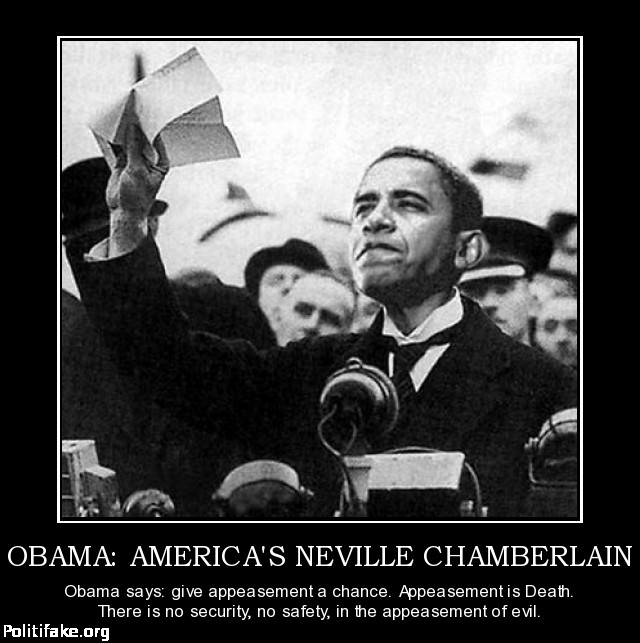
Neville Chamberlain Obama: peace in our time

The Weekly Standard featured a column by foreign policy heavyweight John Bolton.

Excerpt:

Negotiations for an “interim” arrangement over Iran’s nuclear weapons program finally succeeded this past weekend, as Security Council foreign ministers (plus Germany) flew to Geneva to meet their Iranian counterpart.  After raising expectations of a deal by first convening on November 8-10, it would have been beyond humiliating to gather again without result.  So agreement was struck despite solemn incantations earlier that “no deal is better than a bad deal.”

This interim agreement is badly skewed from America’s perspective.  Iran retains its full capacity to enrich uranium, thus abandoning a decade of Western insistence and Security Council resolutions that Iran stop all uranium-enrichment activities. Allowing Iran to continue enriching, and despite modest (indeed, utterly inadequate) measures to prevent it from increasing its enriched-uranium stockpiles and its overall nuclear infrastructure, lays the predicate for Iran fully enjoying its “right” to enrichment in any “final” agreement.  Indeed, the interim agreement itself acknowledges that a “comprehensive solution” will “involve a mutually defined enrichment program.”  This is not, as the Obama administration leaked before the deal became public, a “compromise” on Iran’s claimed “right” to enrichment. This is abject surrender by the United States.

In exchange for superficial concessions, Iran achieved three critical breakthroughs. First, it bought time to continue all aspects of its nuclear-weapons program the agreement does not cover (centrifuge manufacturing and testing; weaponization research and fabrication; and its entire ballistic missile program). Indeed, given that the interim agreement contemplates periodic renewals, Iran may have gained all of the time it needs to achieve weaponization not of simply a handful of nuclear weapons, but of dozens or more.

Second, Iran has gained legitimacy. This central banker of international terrorism and flagrant nuclear proliferator is once again part of the international club.  Much as the Syria chemical-weapons agreement buttressed Bashar al-Assad, the mullahs have escaped the political deep freezer.

Third, Iran has broken the psychological momentum and effect of the international economic sanctions. While estimates differ on Iran’s precise gain, it is considerable ($7 billion is the lowest estimate), and presages much more.  Tehran correctly assessed that a mere six-months’ easing of sanctions will make it extraordinarily hard for the West to reverse direction, even faced with systematic violations of Iran’s nuclear pledges.  Major oil-importing countries (China, India, South Korea, and others) were already chafing under U.S. sanctions, sensing President Obama had no stomach either to impose sanctions on them, or pay the domestic political price of granting further waivers.

Seven billion dollars in funding for a nation that is a known sponsor of anti-American terrorism. What kind of moron makes a deal with a regime that is on record for wanting to attack Israel with nuclear weapons? Some sort of reincarnation of Neville Chamberlain, that’s who.

Previously, the Obama administration had been accuesed of leaking details of a strike plan by Israel against Iranian nuclear facilities.

From ABC News.

Excerpt:

Two reports today about Iran’s nuclear program and the possibility of an Israeli military strike have analysts in Israel accusing the Obama administration leaking information to pressure Israel not to bomb Iran and for Iran to reach a compromise in upcoming nuclear talks.

The first report in Foreign Policy quotes anonymous American officials saying that Israel has been given access to airbases by Iran’s northern neighbor Azerbaijan from which Israel could launch air strikes or at least drones and search and rescue aircraft.

The second report from Bloomberg, based on a leaked congressional report, said that Iran’s nuclear facilities are so dispersed that it is “unclear what the ultimate effect of a strike would be…” A strike could delay Iran as little as six months, a former official told the researchers.

“It seems like a big campaign to prevent Israel from attacking,” analyst Yoel Guzansky at the Institute for National Security Studies told ABC News. “I think the [Obama] administration is really worried Jerusalem will attack and attack soon. They’re trying hard to prevent it in so many ways.”

[…]Thursday’s reports come a week after the results of a classified war game was leaked to the New York Times which predicted that an Israeli strike could lead to a wider regional war and result in hundreds of American deaths. In a column this afternoon titled “Obama Betraying Israel?” longtime defense commentator Ron Ben-Yishai at Yedioth Ahronoth newspaper angrily denounced the leaks as a “targeted assassination campaign.”

“In recent weeks the administration shifted from persuasion efforts vis-à-vis decision-makers and Israel’s public opinion to a practical, targeted assassination of potential Israeli operations in Iran,” Ben-Yishai writes. “The campaign’s aims are fully operational: To make it more difficult for Israeli decision-makers to order the IDF [Israeli Defense Forces] to carry out a strike, and what’s even graver, to erode the IDF’s capacity to launch such strike with minimal casualties.”

Maybe in the next election, Jewish-American voters will think a little more about who to vote for, in view of these facts. Or maybe it will take the actual nuclear destruction of Israel by Iran to get over their prejudices. As a supporter of peaceful democracies like Israel, I hope it doesn’t come to that.

Democrats try to block whistleblower’s Fast and Furious expose

Fox News reports on the latest Democrat cover-up scandal. (H/T Dad)

Excerpt:

The ATF agent who blew the whistle on Operation Fast and Furious has been denied permission to write a book on the botched anti-gun trafficking sting “because it would have a negative impact on morale,” according to the very agency responsible for the scandal.

After first trying to stop the operation internally, ATF Agent John Dodson went to Congress and eventually the media following the death of Border Patrol Agent Brian Terry in December 2010. Two guns found at the murder scene were sold through the ATF operation.

Dodson’s book, titled “The Unarmed Truth,” provides the first inside account of how the federal government permitted and helped sell some 2,000 guns to Mexican drug cartels, despite evidence the guns killed innocent people.

Dodson, who is working with publisher Simon & Schuster, submitted his manuscript to the department for review, per federal rules. However, it was denied.

Greg Serres, an ATF ethics official, told Dodson that any of his supervisors at any level could disapprove outside employment “for any reason.”

[…]Dodson says “The Unarmed Truth” will come out in January, with or without the ATF’s permission.

I hope this book sells a lot of copies.

Related posts

North Korea reactivates nuclear reactor that was closed in 2007 deal

CNS News reports on a disturbing story.

Excerpt:

While the international community has been focused on the crises in Syria and Egypt, North Korea evidently has been quietly preparing to resume operations at a nuclear reactor which it agreed under an international deal eight years ago to shut down, before warning amid heightened tensions last April that it would restart.

Commercial satellite images captured in late August show columns of steam rising from a building alongside the five-megawatt plutonium-based reactor at Yongbyon, prompting experts at the U.S.-Korea Institute at the Johns Hopkins School of Advanced International Studies to say it will likely be operational shortly.

“The white coloration and volume are consistent with steam being vented because the electrical generating system is about to come online, indicating that the reactor is in or nearing operation,” said analysts Nick Hansen and Jeffrey Lewis.

They said the reactor is capable of producing six kilograms of plutonium a year, which the North Korean regime can use “to slowly increase the size of its nuclear weapons stockpile.”

In a separate analysis, the Institute for Science and International Security (ISIS) noted in addition to the reactor developments that the North Koreans has also recently expanded a building housing a centrifuge plant for uranium-enrichment.

Pyongyang has said this is to obtain low-enriched uranium to fuel a separate light-water reactor under construction at the complex, although one of many unknowns in the North Korean program is whether it has also produced weapons-grade uranium, and if so, how much.

The Yongbyon complex, some 60 miles north of Pyongyang, houses both the five-megawatt, graphite-moderated reactor and an associated reprocessing plant and nuclear fuel rod fabrication facility.

Under an agreement at China-hosted at “six-party” talks, first hammered together in Sept. 2005 and then formalized in Feb. 2007, North Korea pledged to shut the facilities in exchange for economic and diplomatic concessions. Among them, the Bush administration agreed to unfreeze $25 million in North Korean funds, frozen in its account at a Macao-based bank.

In July 2007 the International Atomic Energy Agency (IAEA) confirmed that the Yongbyon shutdown was complete, and in 2008 the main cooling tower at the site was demolished in a dramatic supposed symbol of Pyongyang’s commitment to the denuclearization deal.

But after that the six-party talks – involving the U.S., the two Koreas, China, Japan and Russia – ran into more difficulties. In late 2008 they stalled amid disagreements over how to verify North Korean compliance with its commitments, and the talks have not reconvened since.

Pyongyang tested a nuclear device for a second time in 2009, and again early this year.

Last April, it announced plans to restart the Yongbyon reactor. It also vowed never to abandon its nuclear capability for political or economic benefits, and reiterated demands that the international community accept it as a nuclear weapons power.

Has our performance in Syria been a trigger for their decision?

Heritage Foundation scholar Bruce Klingner in an analysis Thursday said Pyongyang was likely encouraged by the Obama administration’s policy on Syria and its chemical weapons use – “a dizzying array of contradictory U.S. statements, crossed redlines, and reticence to fulfill declarations of intent.”

“To the degree that North Korea can penetrate this confusing political morass, the regime is probably heartened by signs of a declining American willingness to intervene overseas even when confronted by evidence of the use of weapons of mass destruction (WMD),” he wrote.

“Pyongyang will conclude that President Obama’s bold rhetoric, including that directed against North Korea, was unlikely to be backed with significant military action,” said Klingner, a senior research fellow for Northeast Asia at Heritage’s Asian Studies Center.

“The regime will incorporate this perceived American passivity into its decision-making in future confrontations with Washington and Seoul.”

The Heritage Foundation is against a strike, so I think what they are saying is that you don’t make threats unless you intend to carry them out. If you say there’s a red line, then don’t follow up on that threat, you look weak. And when you look weak, bullies are emboldened to be aggressive. That’s the way the world is.