President Obama’s budget director Jack Lew in a Sunday opinion piece outlined some off the “tough choices” Obama is willing to make to cut spending in his 2012 budget request due out on Feb. 14.
The piece details cuts that affect initiatives dear to the president: programs to help the poor and to clean up the Great Lakes near the president’s home state of Illinois.
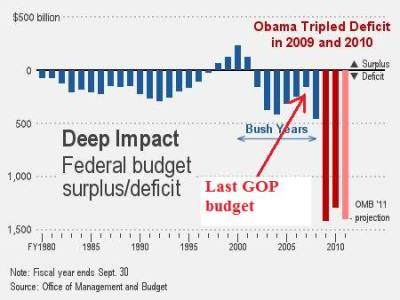
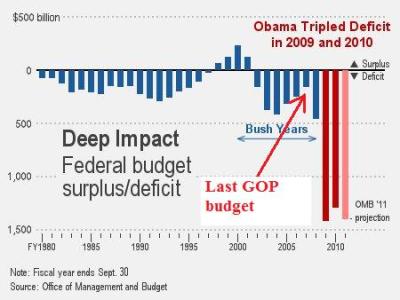
The cuts are relatively small, however, in the larger scheme of things. In total, the $775 million in detailed cuts fall far short of demands by congressional Republicans and will do little toward tackling the deficit, which is estimated to be $1.5 trillion this year by the Congressional Budget Office. The cuts are in addition to a five-year spending freeze which the administration says will save $400 billion over the next decade.
[…][Lew] said “this cut is not easy for” Obama.
The 2012 deficit is projected to be 1,500,000 million. TWELVE TIMES what the last Republican budget was back in 2007, when unemployment was at 4.3%. Government spending means taking money away from productive workers and from the businesses that hire those productive workers.
To see a graphical representation of the cuts as a portion of the entire budget, click here. The cuts cannot be seen with the naked eye, so the there are several images in that post, each one more zoomed in than the last.
Spain announced Friday its jobless rate surged to a 13-year record above 20 percent at the end of 2010, the highest level in the industrialized world, as the economy struggled for air.
It was more bad news for an economy fighting to regain the trust of financial markets and avoid being trapped in a debt quagmire that has engulfed Greece and Ireland and now menaces Portugal.
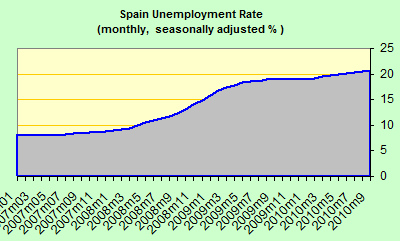
Another 121,900 people joined Spain’s unemployment queues in the final quarter of the year, pushing the total to 4.697 million people, said the national statistics institute INE.
The resulting unemployment rate was 20.33 percent for the end of the year — easily exceeding Prime Minister Jose Luis Rodriguez Zapatero’s target of 19.4 percent.
Spain appears to be stuck in a rut of staggeringly high levels of unemployment.
After posting a jobless rate of 18.83 percent in 2009 and now 20.33 percent in 2010, the government is forecasting 19.3 percent for 2011 and 17.5 percent in 2012.
The Spanish economy, the European Union’s fifth biggest, slumped into recession during the second half of 2008 as the global financial meltdown compounded the collapse of a labour-intensive construction boom
It emerged with tepid growth of just 0.1 percent in the first quarter of 2010 and 0.2 percent in the second but then stalled with zero growth in the third.
Zapatero has said the fourth quarter will show positive growth which would pick up steam in 2011 but he warned that job creation would be “far from what we need and desire. It will be slow and progressive.”
Remember that Spain elected Jose Luis Rodriguez Zapatero in April 2004, who is a member of the Spanish Socialist Workers’ Party, which is very similar in policy to Barack Obama and the Democrats. Let’s see what has happened in Spain. (H/T Spain Economy Watch)
Unemployment:
Spain Unemployment Rate
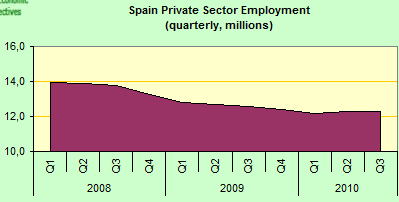
Private sector employment:
Spain Employment - Private Sector
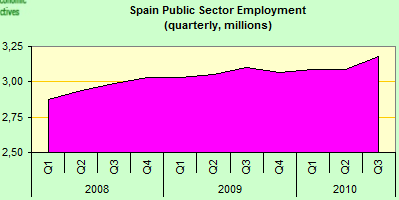
Public sector employment:
Spain Employment - Public Sector
So what do we learn from this?
Well, the public sector doesn’t really sell any products or services, so they don’t really have any customers to please, nor do they have any revenue. They exist by confiscating the wealth of other people (in the private sector) who do have products and services to sell, and do have customers to please. The governments job is to HELP the people in the private sector and not to raise their taxes, or control them, or get in their way except to make sure that they compete fairly and honestly with other people in the private sector. When government oversteps their bounds by raising taxes too high and spending too much, they stop acting like a REFEREE and start acting more like a PARASITE.
You’ll note that Obama is also spending trillions of dollars on government boondoggles – and where is our unemployment rate now?
In the 1,461 days that Rep. Nancy Pelosi (D.-Calif.) served as speaker of the House, the national debt increased by a total of $5.343 trillion ($5,343,452,800,321.37) or $3.66 billion per day ($3.657,394,113.84), according to official debt numbers published by the U.S. Treasury.
Pelosi was the 52nd speaker of the House. During her tenure, she amassed more debt than the first 49 speakers combined.
[…]When Pelosi was sworn in on Jan. 4, 2007, the national debt stood at $8,670,596,242,973.04. At the close of business on Jan. 4, 2011, her last full day in the speakership, it stood at 14,014,049,043,294.41–an increase of $5,343,452,800,321.37.
[…]When Pelosi became speaker in January 2007 she was emphatic that there would be no new deficit spending.
“After years of historic deficits, this 110th Congress will commit itself to a higher standard: Pay as you go, no new deficit spending,” she said in her inaugural address from the speaker’s podium. “Our new America will provide unlimited opportunity for future generations, not burden them with mountains of debt.”
And a quick refresher about who controlled the House and the Senate at different times:
Year
Congress
President
Senate (100)
House (435)
2009
111th
D
D – 55***
D – 256
2007
110th
R
D – 51**
D – 233
2005
109th
R
R – 55
R – 232
2003
108th
R
R – 51
R – 229
2001
107th
R
D*
R – 221
1999
106th
D
R – 55
R – 223
1997
105th
D
R – 55
R – 228
1995
104th
D
R – 52
R – 230
1993
103rd
D
D – 57
D – 258
All government spending originates in the House of Representatives, so spending was a Democrat problem since the Democrats took over the House (and Senate) in January 2007. They own this recession.
And the reason that things went well in the Clinton Presidency is because the Republicans were in control of all the spending.


 WINTERY KNIGHT