
One way to decide whether to be concerned or not, is to look at famous atheist leaders of the past, and to see whether they did a good job of protecting basic human rights.
One of the most famous atheists who ran a country was Mao Zedong, who ran China from 1958 to 1962. His reign was called
“The Great Leap Forward”.
The far-left Washington Post recently had a news article about Mao:
Who was the biggest mass murderer in the history of the world? Most people probably assume that the answer is Adolf Hitler, architect of the Holocaust. Others might guess Soviet dictator Joseph Stalin, who may indeed have managed to kill even more innocent people than Hitler did, many of them as part of a terror famine that likely took more lives than the Holocaust. But both Hitler and Stalin were outdone by Mao Zedong. From 1958 to 1962, his Great Leap Forward policy led to the deaths of up to 45 million people – easily making it the biggest episode of mass murder ever recorded.
Historian Frank Dikötter, author of the important book Mao’s Great Famine recently published an article in History Today, summarizing what happened:
[…]It is not merely the extent of the catastrophe that dwarfs earlier estimates, but also the manner in which many people died: between two and three million victims were tortured to death or summarily killed, often for the slightest infraction. When a boy stole a handful of grain in a Hunan village, local boss Xiong Dechang forced his father to bury him alive. The father died of grief a few days later. The case of Wang Ziyou was reported to the central leadership: one of his ears was chopped off, his legs were tied with iron wire, a ten kilogram stone was dropped on his back and then he was branded with a sizzling tool – punishment for digging up a potato.
The basic facts of the Great Leap Forward have long been known to scholars. Dikötter’s work is noteworthy for demonstrating that the number of victims may have been even greater than previously thought, and that the mass murder was more clearly intentional on Mao’s part, and included large numbers of victims who were executed or tortured, as opposed to “merely” starved to death. Even the previously standard estimates of 30 million or more, would still make this the greatest mass murder in history.
Some may say that the root of this mass murder is communism, but you can’t do these mass murders if you expect to encounter a God on the other side of death whose design for each of his human creatures was for them to love God, and love their neighbor as themselves.
In any case, opposition to religion is a cornerstone of communism, as this article by professor of political science Paul Kengor explains:
As Mikhail Gorbachev aptly stated, the Soviet communist state carried out a comprehensive “war on religion.” 1 He lamented that the Bolsheviks, his predecessors, even after the civil war ended in the early 1920s, during a time of “peace,” had “continued to tear down churches, arrest clergymen, and destroy them. This was no longer understandable or justifiable. Atheism took rather savage forms in our country at that time.” 2
The Soviet Union, reflective of the communist world as a whole, was openly hostile to religion and officially atheist; it was not irreligious or unreligious, with no stance on religion, but took the position that there was no God. Moreover, that atheism translated into a form of vicious anti-religion that included a systematic, often brutal campaign to eliminate belief. This began from the outset of the Soviet communist state and still continues in various forms in communist countries to this day, from China to North Korea to Cuba.
The roots of this hatred and intolerance of religion lie in the essence of communist ideology. Marx dubbed religion the “opiate of the masses,” and opined that, “Communism begins where atheism begins.” 3Speaking on behalf of the Bolsheviks in his famous October 2, 1920 speech, Lenin stated matter-of-factly: “We do not believe in God.” Lenin insisted that “all worship of a divinity is a necrophilia.” 4 He wrote in a November 1913 letter that “any religious idea, any idea of any God at all, any flirtation even with a God is the most inexpressible foulness … the most dangerous foulness, the most shameful ‘infection.’” James Thrower of the University of Virginia (a Russia scholar and also a translator) says that in this letter the type of “infection” Lenin was referring to was venereal disease. 5
“There can be nothing more abominable than religion,” wrote Lenin in a letter to Maxim Gorky in January 1913. 6 On December 25, 1919, Christmas Day, Comrade Lenin issued the following order, in his own writing: “To put up with ‘Nikola’ [the religious holiday] would be stupid—the entire Cheka must be on the alert to see to it that those who do not show up for work because of ‘Nikola’ are shot.” 7 Under Lenin, this was not an isolated occurrence.
Along with Trotsky, Lenin became involved in the creation of groups with names like the Society of the Godless, also known as the League of the Militant Godless, which was responsible for the dissemination of anti-religious propaganda in the USSR. 8 This institutionalized bigotry continued to thrive under Lenin’s disciples, most notably Stalin, and even under more benign leaders like Nikita Khrushchev.
This atheism was endemic to the communist experiment. Even those communists unable to secure political power—and thus lacking the ability to persecute believers—still did their best to persecute the teachings of organized religion and ridicule the idea of the existence of God. Even in America, it was no surprise to stroll by a city newsstand and catch bold front-page headlines like this in the Daily Worker, the communist organ published by CPUSA: “THERE IS NO GOD.” 9 Communists were proud of their atheism, and militant about it.
[…]“Religion is poison,” as Mao Tse-Tung was said to have stated.
The ideas expressed in these quotations of atheist leaders are pretty much every atheist will sign off on, as long as you don’t tell them who said it. These are normal atheist views of religion, and the hatred is especially strong against Christianity.

Let’s take a look at what atheist leader Josef Stalin did during his rule of Russia in the 1920s and 1930s.
The Library of Congress offers this in their “Soviet Archives exhibit”:
The Soviet Union was the first state to have as an ideological objective the elimination of religion. Toward that end, the Communist regime confiscated church property, ridiculed religion, harassed believers, and propagated atheism in the schools. Actions toward particular religions, however, were determined by State interests, and most organized religions were never outlawed.
The main target of the anti-religious campaign in the 1920s and 1930s was the Russian Orthodox Church, which had the largest number of faithful. Nearly all of its clergy, and many of its believers, were shot or sent to labor camps. Theological schools were closed, and church publications were prohibited. By 1939 only about 500 of over 50,000 churches remained open.
Let’s see more from a peer-reviewed journal article authored by Crispin Paine of the University College, London:
Atheist propaganda and the struggle against religion began immediately after the Bolsheviks seized power in 1917. While social change would, under Marxist theory, bring religion to disappear, Leninists argued that the Party should actively help to eradicate religion as a vital step in creating ‘New Soviet Man’. The energy with which the Party struggled against religion, though, varied considerably from time to time and from place to place, as did its hostility to particular faith groups. The 1920s saw the closure of innumerable churches and synagogues (and to a lesser extent mosques) and the active persecution of clergy and harassment of believers.
An article from the pro-communism Marxist.com web site says this about Stalin:
During the ultra-left period of forcible collectivisation and the Five Year Plan in Four an attempt was made to liquidate the Church and its influence by government decree. Starting in 1929 churches were forcibly closed and priests arrested and exiled all over the Soviet Union. The celebrated Shrine of the Iberian Virgin in Moscow – esteemed by believers to be the “holiest” in all Russia was demolished – Stalin and his Government were not afraid of strengthening religious fanaticism by wounding the feelings of believers as Lenin and Trotsky had been! Religion, they believed, could be liquidated, like the kulak, by a stroke of the pen. The Society of Militant Atheists, under Stalin’s orders, issued on May 15th 1932, the “Five Year Plan of Atheism” – by May 1st 1937, such as the “Plan”, “not a single house of prayer shall remain in the territory of the USSR, and the very concept of God must be banished from the Soviet Union as a survival of the Middle Ages and an instrument for the oppression of the working masses.”!
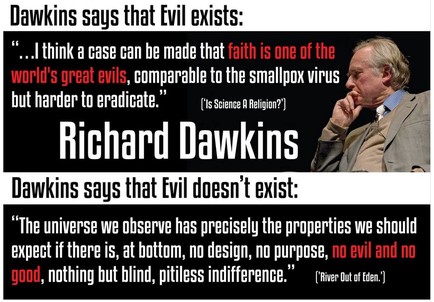
If atheism is true, there is no objective morality out there to make anything you do objectively wrong, and no one to judge you when you die. Humans are just accidental machines produced by random, undirected evolution in a random, undesigned universe. You won’t be able to ground human rights and objective moral obligations in a universe like that.
 WINTERY KNIGHT