
Tag Archives: Marxism

Climate change: is global cooling the emerging consensus view of scientists?

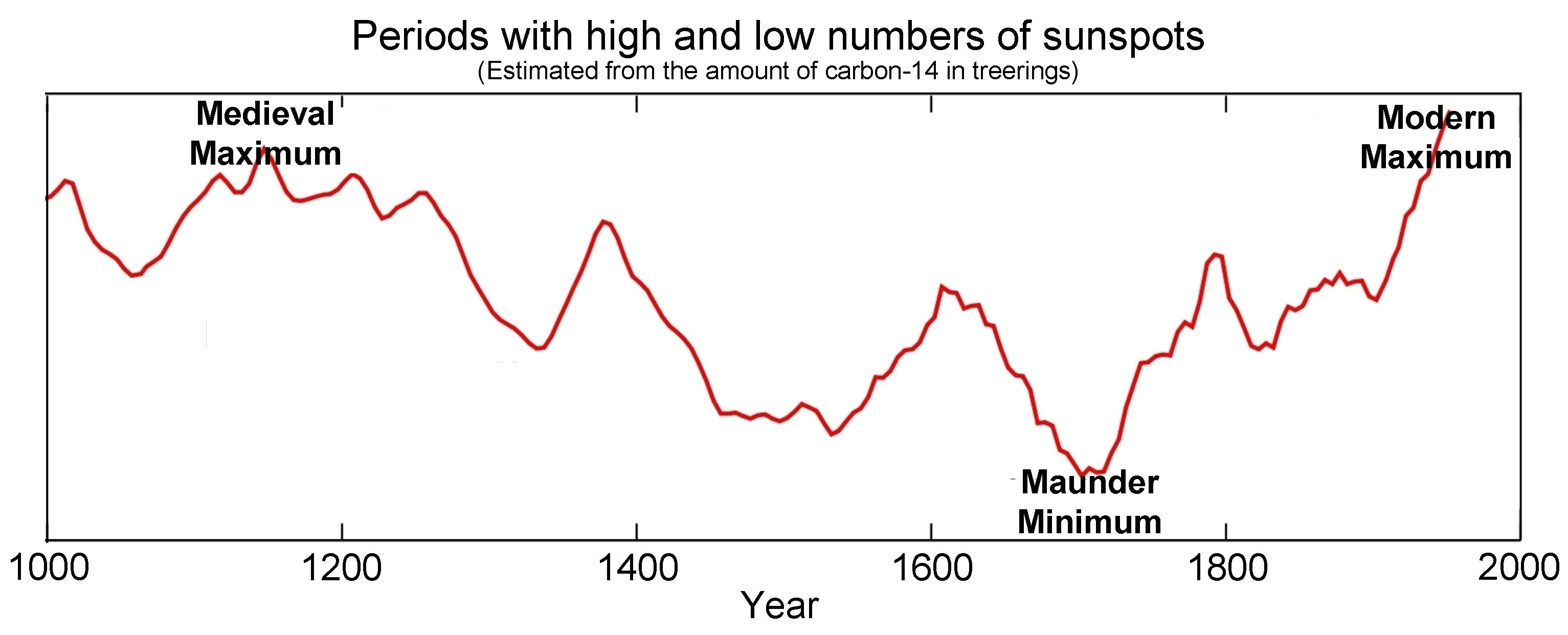
Graph of solar events (Source: GSU.edu)
Graph of solar activity (Source: GSU.edu)

Source: Department of Geosciences, Georgia State University
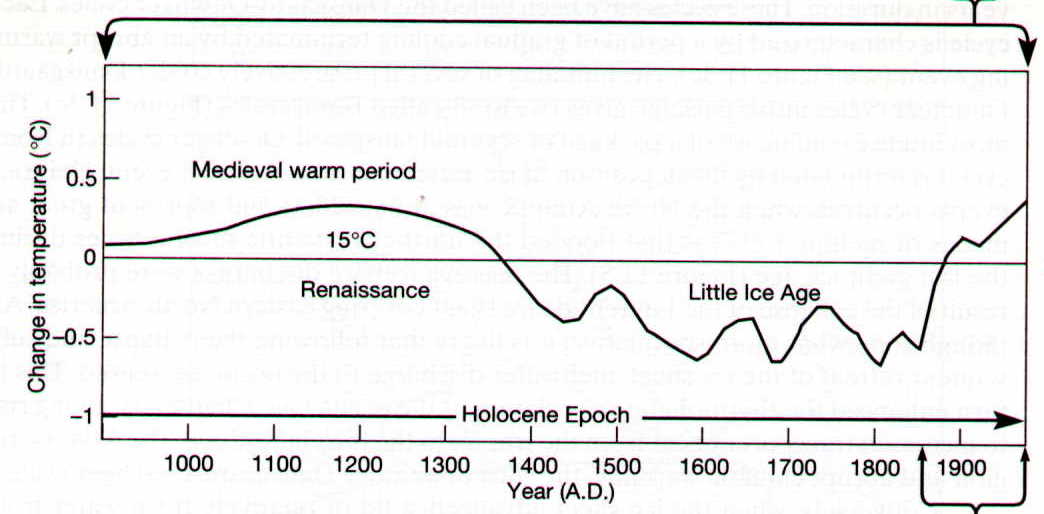
Global temperature (Source: USC.edu)

Source: Department of Earth Sciences, University of Southern California

Now, the consensus view among skeptics of global warming has generally been that naturally-occurring solar cycles are responsible for cooling and warming trends. In the medieval era, global temperatures were higher than today, and that cannot have been caused by the emission of greenhouse gases. It makes more sense to attribute that warming period to the sun than to human behaviors. If that’s the case, then it’s possible that solar cycles could also cause us to go into a cooling period.

Here’s an article about global cooling from the Financial Post, a Canadian newspaper that is part of the National Post.

Excerpt:

In the 1960s and 1970s, a growing scientific consensus held that the Earth was entering a period of global cooling. The CIA announced that the “Western world’s leading climatologists have confirmed recent reports of detrimental global climatic change” akin to the Little Ice Age of the 17th and 18th centuries, “an era of drought, famine and political unrest in the western world.” President Jimmy Carter signed the National Climate Program Act to deal with the coming global cooling crisis. Newsweek magazine published a chilling article entitled “The Cooling World.”

In the decades that followed, as temperatures rose, climate skeptics mocked the global cooling hypothesis and a new theory emerged — that Earth was in fact entering a period of global warming.

Now an increasing number of scientists are swinging back to the thinking of the 1960s and 1970s. The global cooling hypothesis may have been right after all, they say. Earth may be entering a new Little Ice Age.

“Real risk of a Maunder Minimum ‘Little Ice Age,’” announced the BBC this week, in reporting startling findings by Professor Mike Lockwood of Reading University. “Professor Lockwood believes solar activity is now falling more rapidly than at any time in the last 10,000 years [raising the risk of a new Little Ice Age] from less than 10% just a few years ago to 25-30%,” explained Paul Hudson, the BBC’s climate correspondent. If Earth is spared a new Little Ice Age, a severe cooling as “occurred in the early 1800s, which also had its fair share of cold winters and poor summers, is, according to him, ‘more likely than not’ to happen.”

[…]Scientists at the Climate and Environmental Physics and Oeschger Centre for Climate Change Research at the University of Berne in Switzerland back up theories that support the Sun’s importance in determining the climate on Earth. In a paper published this month by the American Meteorological Society, the authors demolish the claims by IPCC scientists that the Sun couldn’t be responsible for major shifts in climate. In a post on her website this month, Judith Curry, Chair of the School of Earth and Atmospheric Sciences at the Georgia Institute of Technology, all-but mocked the IPCC assertions that solar variations don’t matter. Among the many studies and authorities she cited: the National Research Council’s recent report, “The Effects of Solar Variability on Earth’s Climate,” and NASA, former home of global warming guru James Hansen.

The Daily Caller picked up on this article and added more: (H/T Letitia)

Earlier this year, Professor Cliff Ollier of the School of Earth and Environmental Studies at the University of Western Australia presented a study that posited that the sun was a major controller of the climate.

“There is a very good correlation of sunspots and climate,” Ollier wrote. “Solar cycles provide a basis for prediction. Solar Cycle 24 has started and we can expect serious cooling. Many think that political decisions about climate are based on scientific predictions but what politicians get are projections based on computer models.”

Last year, Russian scientists also posited that from next year onward the world could expect the start of the another Little Ice Age.

“After the maximum of solar cycle 24, from approximately 2014 we can expect the start of deep cooling with a Little Ice Age in 2055,” wrote Habibullo Abdussamatov of the Russian Academy of Science.

The “Little Ice Age” occurred during the 1600s when winters were harsh all across Europe. The continent-wide cold weather coincided with an inactive sun, called the Maunder solar minimum.

You’re not likely to hear about the Medieval Warming Period or the Maunder minimum in public schools, but they are there in the data.

Of course, if the majority of people begin to understand that the sun is causing cycles of warming and cooling, then we don’t really need government to regulate job creators and control our consumption. What would happen then? So my suspicion is that the government-funded scientific consensus will try to get us to believe that we have always been fighting against global cooling, not global warming. That way, the massive taxation and regulation of private companies and private individuals can continue.

This reminds me of Oceania’s war with Eastasia or Eurasia in the famous distopian novel 1984: (description from leftist Wikipedia)

In 1984, there is a perpetual war among Oceania, Eurasia and Eastasia, the super-states which emerged from the atomic global war. “The book”, The Theory and Practice of Oligarchical Collectivism by Emmanuel Goldstein, explains that each state is so strong it cannot be defeated, even with the combined forces of two super-states—despite changing alliances. To hide such contradictions, history is re-written to explain that the (new) alliance always was so; the populaces accustomed to doublethink accept it. The war is not fought in Oceanian, Eurasian or Eastasian territory but in the arctic wastes and a disputed zone comprising the sea and land from Tangiers (northern Africa) to Darwin (Australia). At the start, Oceania and Eastasia are allies combatting Eurasia in northern Africa and the Malabar Coast.

That alliance ends and Oceania allied with Eurasia fights Eastasia, a change which occurred during the Hate Week dedicated to creating patriotic fervour for the Party’s perpetual war. The public are blind to the change; in mid-sentence an orator changes the name of the enemy from “Eurasia” to “Eastasia” without pause. When the public are enraged at noticing that the wrong flags and posters are displayed they tear them down—thus the origin of the idiom “We’ve always been at war with Eastasia”…

I wonder if we are coming to the point when the global warming alarmists will switch their pro-socialism narrative so that the threat we face is global cooling.

The neat thing about that article is that it’s the Canadians who are among the most skeptical of global warming. Previously, officials in the Canadian government have been extremely critical of the man-made global warming hypothesis. Consider the comments of Conservative MP Joe Oliver and Conservative MP Peter Kent – they are all for developing energy resources and creating jobs. Canadians are practical on the issue of climate change – they would rather have jobs than feelings of moral superiority. But down here in Obamaland, there’s no critical thinking at all on the issue. If you doubt global warming, then you need to be called names, intimidated, fired or worse.
CNN: Obama administration bullying insurance companies to not criticize Obamacare

From the (normally) radically leftist CNN, of all places.

Excerpt:

White House officials have pressured insurance industry executives to keep quiet amid mounting criticism over Obamacare’s rollout, insurance industry sources told CNN.

After insurance officials publicly criticized the implementation, White House staffers contacted insurers to express their displeasure, industry insiders said.

Multiple sources declined to speak publicly about the push back because they fear retribution.

But Bob Laszewski, who heads a consulting firm for big insurance companies, did talk on the record.

“The White House is exerting massive pressure on the industry, including the trade associations, to keep quiet,” he said.

Laszewski, who’s been a vocal critic of Obamacare, said he’s been asked by insurance executives to speak out because they feel defenseless against an administration that is regulating their business — and a big customer.

[…]Insurers, he said, warned the White House that the regulations would lead to discontinued policies.

“One of the things I think is clear here is the Obama administration has no trust in anything the health insurance industry is telling them about how to run a health plan,” Laszewski said.

Newsbusters has the video and transcript from CNN.

Video, audio and summary: Jim Wallis debates Jay Richards on Christianity and economics

I had to re-post this post again because Facebook decided to mark it as SPAM. This is the same post I put out 4 hours ago.

The video recording:

  • The organizers of the debate tell me that the video will be posted shortly after the debate, and I will link to it in this very post.

The audio recording:

The debaters

Jay Richards:

Jay Richards, Ph.D., is a Senior Fellow of the Discovery Institute where he directs the Center on Wealth, Poverty and Morality, and is a Visiting Scholar at the Institute for Faith, Work & Economics. Most recently he is the co-author with James Robison of the best-selling Indivisible: Restoring Faith, Family, and Freedom Before It’s Too Late”.

In addition to writing many academic articles, books, and popular essays on a wide variety of subjects, he recently edited the new award winning anthology, God & Evolution: Protestants, Catholics and Jews Explore Darwin’s Challenge to Faith . His previous book was Money, Greed, and God: Why Capitalism Is the Solution and Not the Problem (HarperOne, May 2009), for which he received a Templeton Enterprise Award in 2010.

[…]In recent years, he has been a Contributing Editor of The American at the American Enterprise Institute, a Visiting Fellow at the Heritage Foundation, and a Research Fellow and Director of Acton Media at the Acton Institute. Richards has a B.A. with majors in Political Science and Religion, an M.Div. (Master of Divinity) and a Th.M. (Master of Theology), and a Ph.D. (with honors) in philosophy and theology from Princeton Theological Seminary.

Jim Wallis:

Jim Wallis (born June 4, 1948) is a Christian writer and political activist. He is best known as the founder and editor of Sojourners magazine and as the founder of the Washington, D.C.-based Christian community of the same name. Wallis is well known for his advocacy on issues of peace and social justice. Although Wallis actively eschews political labels, he describes himself as an evangelical and is often associated with the evangelical left and the wider Christian left. He works as a spiritual advisor to President Barack Obama. He is married to the Rev. Joy Carroll, who was one of the first female priests in the Church of England. He is also a leader in the Red-Letter Christian movement.

[…]In 2010, Wallis admitted to accepting money for Sojourners from philanthropist George Soros after initially denying having done so. When conservative writer Marvin Olasky pointed this out, and that Soros also financed groups supporting abortion, atheism, and same-sex marriage, in a WORLD magazine column, Wallis said Olasky “lies for a living”; he subsequently apologized to Olasky for the comments. In 2011, Wallis acknowledged that Sojourners had received another $150,000.00 from Soros’ Open Society Foundation.

[…]In regard to the 2011 United States budget proposal, Wallis described Congressman Paul Ryan and his congressional allies as “bullies” and “hypocrites.”

Wallis just came out this month in favor of gay marriage. He is also a strong supporter of Barack Obama, who is radically pro-abortion. Some pro-lifers have argued that Barack Obama has the same views on abortion as Kermit Gosnell.

The format of the debate

  • 20 minute opening speeches
  • 10 minute rebuttals
  • 10 minutes of discussion
  • Q&A for the remainder

SUMMARY

I use italics below to denote my own observations.

Jim Wallis’ opening speech:

My goal is to spark a national conversation on the “common good”.

A story about my son who plays baseball.

The central goal of Christianity is to promote the “common good”.

Quotes “Catholic social teaching” which values “human flourishing”.

The “common good” is “human flourishing”.

Is the purpose of Christianity is to make sure that everyone has enough material stuff or to preach the gospel?

When Christians go on mission trips, it’s good that they focus on things like human trafficking.

Democrat John Lewis is the “conscience of the U.S. Congress”.

John Lewis gets a 0% rating from the American Conservative Union in 2012.

John Lewis gets a 8% rating from the American Conservative Union in 2011.

John Lewis gets a 2.29% lifetime rating from the American Conservative Union.

Nothing is going well in Washington right now except comprehensive immigration reform.

Does he think that Christianity means giving 12-20 million illegal immigrants a path to citizenship, while skilled engineers cannot even get green cards, even though there is a shortage of them? Does he think that the other people in society who earn more than they receive from the government ought to be taxed more in order to provide more services and benefits to those who earn less than they take from the government?

Jay Richards’ opening speech:

Two topics: 1) what is the common good? 2) what should Christians do to promote the common good?

Catholicism defines the “common good” as “Indeed, the common good embraces the sum of those conditions of the social life whereby men, families and associations more adequately and readily may attain their own perfection.”

We have natural ends that we are supposed to be achieving and some places, like South Korea, are better for allowing that to happen.

The common good is broader and prior to any sort of political specification.

It’s not the political good or what the state is supposed to do.

It’s not about the communal good, as in Soviet Russia, where the communal good was above individual and familial good.

The common good is the social conditions that promote the things that we humans have in common as individuals and members of family.

The common good takes account of who we are as individuals and in associations with other individuals, e.g. – families.

Christians don’t have to be doing the same things to promote the common good, e.g. – pastors, entrepreneurs, etc.

The church, as the church, has as its primary goal making disciples of all nations.

But even in that capacity, the church should be interested in more than just conversions and saving souls.

We also have to care about God’s created reality including things like physics, education, etc.

How should Christians promote the common good in politics?

Question: when is coercion warranted?

In Romans 13, Paul says that the state does have power to coerce to achieve certain ends, like justice.

Most Christians think that there are some things where the state can use coercion, for example, to prevent/punish murder.

It is OK for the police to use coercive force to maintain public order and the rule of law.

But we need to ask whether other things are legitimate areas for the state to use coercive force.

We should only give the state power to coerce when there is no other way to achieve a goal.

We need to leverage the science of economics in order to know how to achieve the common good.

Jay Richards' main point in the debate
Jay Richards’ main point in the debate

Henry Hazlitt: “The art of economics consists in looking not merely at the immediate but at the longer effects of any act or policy; it consists in tracing the consequences of that policy not merely for one group but for all groups.”

For example, what happens if we raise the federal minimum wage to $50. What happens next for all groups? That’s what we need to ask in order to know which policies achieve the common good.

When it comes to economics a lot of things have been tried in other places and times.

We can know what works and doesn’t work by studying what was tried before and in other places.

Many things are counter-intuitive – things that sound good don’t work, things that sound bad do work.

Principle: “We are our brother’s keeper”. Christians have an obligation to care for their neighbors.

We all agree on the goal. But how do we do things that will achieve that goal?

We have to distinguish aspirations from principles and prudential judgment.

Principle: We should provide for the material needs of the poor.

Prudence: Seeing the world as it is, and acting accordingly.

Example policies: which minimum wage is best? None? $10? $20?

We decide based on seeing how different economic policies achieve the goal of helping the poor.

Jim Wallis’ first rebuttal:

Jesus commanded us to “care for the poor and help to end poverty”.

Actually, Jesus thought that acknowledging him and giving him sacrificial worship was more important than giving money to the poor, see Matthew 26:6-13:

While Jesus was in Bethany in the home of Simon the Leper, 

a woman came to him with an alabaster jar of very expensive perfume, which she poured on his head as he was reclining at the table.

When the disciples saw this, they were indignant. “Why this waste?” they asked. 

“This perfume could have been sold at a high price and the money given to the poor.”

10 Aware of this, Jesus said to them, “Why are you bothering this woman? She has done a beautiful thing to me. 

11 The poor you will always have with you, but you will not always have me. 

12 When she poured this perfume on my body, she did it to prepare me for burial. 

13 Truly I tell you, wherever this gospel is preached throughout the world, what she has done will also be told, in memory of her.”

It’s not clear to me whether Jim Wallis thinks that preaching is more important than redistributing wealth to address material inequality.

I like what Jesus said in a TV series, even though it’s not in the Bible when an actor playing Jesus said to “change the world”.

Jesus never said to “change the world” in the Bible. Should we be concerned that he is quoting a TV actor playing Jesus instead of Jesus.

Here is a terrific story about Bill Bright.

I love Catholic social teaching.

Quote: “All are responsible for all”.

I go to the World Economic Forum at Davos, Switzerland every year. I spoke once at 7 AM on the 4th floor.

It’s a funny place for a Christian to be if they care about the poor – rubbing shoulders with leftist elites. He must have named a dozen high-profile people that he spoke with during the debate, as if he could win the debate by some sort of argument from name-dropping. He mentioned the Davos thing several times!

The greatest beneficiary of government actions to deal with the economic crisis was Wall Street banks.

I’m going to tell you a story about what a Washington lawyer says to Jesus.

I’ve had conversations with business leaders where I tell them to integrate moral truths.

I talk about the Good Samaritan parable.

Quote: “Do you love your undocumented neighbor?”

Quote: “Do you love your Muslim neighbor?”

Jay Richards’ first rebuttal:

Who is responsible for your own children? Who knows the most about them?

Parents should have more discretion over their children because they have more knowledge about their child and what’s best for them.

The Good Samaritan doesn’t show that government should confiscate wealth through taxation and redistribute it.

The Good Samaritan emphasizes voluntarily charity to help people who are not necessarily your immediate neighbor.

Some of the things we do should be for the good of other people in other countries.

But then we are back to leveraging economics to know what policies are good for those other people in other countries.

The principle of subsidiarity: if a problem can be addressed by a lower level of society (family) then we shouldn’t make higher levels (government) address it.

The best place to take care of children is within the family.

Only if the family fails should wider and wider spheres get involved.

Although we want to think of the common good in a global sense, we don’t want to lose sight of the fact

The financial crisis: we need to integrate moral truths, but also economic truths.

We don’t want to assume policies based on intuitions, we want to check our intuitions using economic principles.

Why did we have a financial crisis in mortgages, but not in commodities futures or technology, etc.?

Greed is a contributing factor in all areas of business.

Something more was going on in the mortgage markets than just greed.

There were specific policies that caused the mortgage lending crisis.

The root cause of the problem were “affordable housing policies” that lowered lending restrictions on low income people.

The policy ended up degrading the underwriting standards on loans.

Government intruded into the market and undermined the normal ways of

People were getting massive loans with no income, no jobs, no assets and no down payment.

The federal government created a market for risk loans by guaranteeing

There was a government imposed quota on mortgage lenders such that 50% of their loans had to be given to high-risk borrowers.

That is what led to the financial crisis. Not the free market, but intrusions into the free market.

These policies were well-meaning and implemented by people from both parties. But they had bad effects.