SEN. TED CRUZ: Let me ask a question: Is there something about the left, and I am going to put the media in this category, that is obsessed with sex? Why is it the only question you want to ask concerns homosexuals? Okay, you can ask those questions over and over and over again. I recognize that you’re reading questions from MSNBC…
[…]You’re wincing. You don’t want to talk about foreign policy. I recognize you want to ask another question about gay rights. Well, you know. ISIS is executing homosexuals. You want to talk about gay rights? This week was a very bad week for gay rights because the expansion of ISIS, the expansion of radical, theocratic, Islamic zealots that crucify Christians, that behead children and that murder homosexuals. That ought to be concerning you far more than asking six questions all on the same topic.
REPORTER: Do you have a personal animosity against gay Americans?
CRUZ: Do you have a personal animosity against Christians sir? Your line of questioning is highly curious. You seem fixated on a particular subject. Look, I’m a Christian. Scripture commands us to love everybody and what I have been talking about, with respect to same-sex marriage, is the Constitution which is what we should all be focused on. The Constitution gives marriage to elected state legislators. It doesn’t give the power of marriage to a president, or to unelected judges to tear down the decisions enacted by democratically elected state legislatures.
His delivery is smooth, fluid, natural. He speaks like this because he has thought about it a lot, and he knows how to present his views to hostile audiences in the best possible light. His positions are not check boxes that he ticks in order to appeal to Christian voters. He actually believes the things we believe, and he will debate with those who disagree.
My concern with Cruz is that he hasn’t got the experience of building consensus to move legislation and enact policies, the way others like Bobby Jindal and Scott Walker have done.
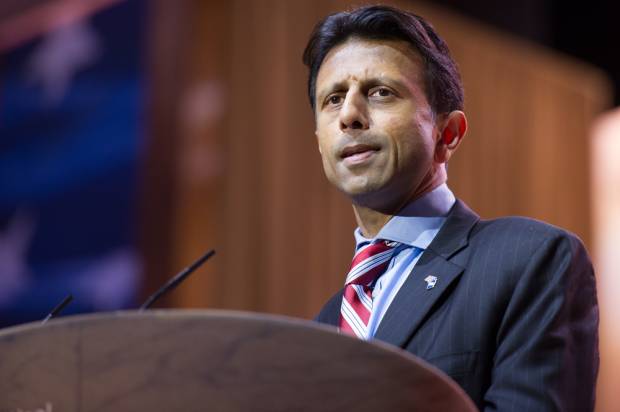
Defying state legislators who rejected a measure that sought to protect “the right of conscience as it relates to marriage,” Louisiana Gov. Bobby Jindal acted on his own Tuesday.
“I’m going to do anything I can to protect religious liberty,” the Republican governor told The Daily Signal in a phone interview on Wednesday.
His executive order, issued after state legislators voted down the Louisiana Marriage and Conscience Act, prohibits “all departments, commissions, boards, agencies, and political subdivision of the state” from discriminating against people or businesses with deeply held religious beliefs about marriage.
“My executive order accomplishes the intent of the [Louisiana Marriage and Conscience Act]. It prevents the state from discriminating against people or their business with deeply held religious beliefs,” Jindal said.
The measure builds on a Religious Freedom Restoration Act that was enacted during Jindal’s first term as governor. The state of Louisiana, under a Constitutional amendment, also defines marriage strictly as the union between a man and a woman.
[…]“Even if you don’t agree with me on the definition of marriage … you still should want those folks to have their rights—our rights to live the way we want,” he said.
Jindal, who is exploring a 2016 presidential bid, doesn’t shy away from his support for traditional marriage.
“I believe in the traditional definition of marriage,” he said. “Unlike President Obama and Hillary Clinton, my opinions are not evolving on this issue. But at the end of the day, this is even bigger than marriage.”
[…]“Don’t waste your breath trying to bully me in Louisiana,” he said. “It is absolutely constitutional to have religious liberty and economic freedoms.”
I have actually been saying “Don’t Waste Your Breath” to a lot of people lately, it’s become my motto whenever I am defiant.
Painting: “Courtship”, by Edmund Blair Leighton (1888)
I saw this essay from a young woman named Jordana Narin who is explaining how she feels about not being able to talk seriously to a man she had sex with.
The essay was published in the radically leftist New York Times.
First kiss:
I met [a guy] at summer camp in the Poconos at 14, playing pickup basketball by day and talking in the mess hall late into the night. Back home we lived only 30 minutes apart, but I didn’t see him again until 11th grade, when we ran into each other at a Halloween party in a Lower Manhattan warehouse.
[…]Under the muted flashes of a strobe light, we shared our first kiss.
Why do you think that she kissed a guy she barely knew? It makes no sense to me.
This is how they talked:
We stayed in touch for the rest of high school, mostly by text message.
Oh my goodness. What can you find out about a person in 140-character messages? It makes no sense to me.
More:
Every time his name popped up on my phone, my heart raced.
Still, we were never more than semiaffiliated, two people who spoke and loved to speak and kissed and loved to kiss and connected and were scared of connecting. I told myself it was because we went to different schools, because teenage boys don’t want relationships, because it was all in my head.
Two years after our first kiss, we were exchanging “I’ve missed you” messages again. It was a brisk Friday evening in our first semesters of college when I stepped off a train and into his comfortable arms.
He had texted weeks earlier on Halloween (technically our anniversary) to ask if I would visit. We had not talked since summer, and I was trying to forget him. We had graduated from high school into the same inexpressive void we first entered in costume, where an “I’ve missed you” was as emotive as one got. I decided to leave him behind when I left for college.
But he wouldn’t let me. Whenever I believed he was out of my life, I’d get a text or Facebook comment that would reel me back in.
And I wouldn’t let me, either. His affection, however sporadic, always loomed like a promise. So I accepted his invitation, asking myself what I had to lose.
She had sex with him, losing her virginity, and then:
Naïvely, I had expected to gain clarity, to finally admit my feelings and ask if he felt the same. But I couldn’t confess, couldn’t probe. Periodically I opened my mouth to ask: “What are we doing? Who am I to you?” He stopped me with a smile, a wink or a handhold, gestures that persuaded me to shut my mouth or risk jeopardizing what we already had.
On the Saturday-night train back to Manhattan, I cried. Back in my dorm room, buried under the covers so my roommates wouldn’t hear, I fell asleep with a wet pillow and puffy eyes.
The next morning I awoke to a string of texts from him: “You get back OK?” “Let’s do it again soon :)”
Yes. She had sex with him because of text messages, Facebook comments and because he “missed her”. Not because he had presented his resume and balance sheet to her father, then bought her an engagement ring, then a wedding ring, then walked down the aisle with her. And of course that opened her up for hurt. Sex binds people together. It’s supposed to be for people who first commit to each other, self-sacrificially, for life – through all trials and hardships.
They had a lot more sex, but never talked about why or to what end:
I’m told my generation will be remembered for our callous commitments and rudimentary romances. We hook up. We sext. We swipe right.
All the while, we avoid labels and try to bury our emotions. We aren’t supposed to want anything serious; not now, anyway.
“Swipe right” refers to a hooking-up app called Tinder. Who would use that? It makes no sense to me.
She praises the “control” that the Sexual Revolution gave her:
To this day, if I ever let a guy’s name slip out to my father, his response is always, “Are you two going steady?”
He means to ask if we’re dating exclusively, if I have a boyfriend. I used to hate it.
“People don’t go steady nowadays,” I explain. “No one says that anymore. And almost no one does it. Women today have more power. We don’t crave attachment to just one man. We keep our options open. We’re in control.”
Anyway, there’s also an interview that goes with it on the radically leftist NPR web site, but I saved a copy of the MP3 file here in case it disappears.
I wouldn’t have understood the full scope of what this young woman is saying in her essay without the interview, which is short. In the segment, Narin says that men and women in her generation don’t have actual romantic relationships anymore. It’s all casual, non-committal sex. “Nobody knows whether their own feelings are real,” she says.
Our generation doesn’t have relationships anymore. Nobody to call their own. Just casual. Nobody knows whether their own feelings are real.
She tells the interviewer that there’s lots of making out and sex, but nobody wants to be emotionally vulnerable to anybody else.
[…]“Everyone in college uses Tinder,” she said, referring to the wildly popular dating and hook-up app. “You can literally swipe right and find someone just to hang out for the night. There’s no commitments required, and I think that makes committing to someone even harder, because it’s so normal, and so expected even, to not want to commit.”
“In a different time, my grandparents, my great grandparents, they might have thought they were missing out on casual sex,” she says. “But since my generation has been saddled down with that, we kind of look to the past and say well, wasn’t that nice. I think both are optimal. I’m a huge feminist, and I think women should be able to do whatever they want to do. If a woman wants to have tons of casual sex, she totally should. But I think that there should be the option. And they shouldn’t be gendered, women and men. But there should be the option of being in a relationship.”
Right. Young women like her who have swallowed radical feminism hook, line and sinker don’t want to miss out on casual sex right now, but they want to get married “some day”.
But what do they think marriage is? I think this popular song sheds some light on it.
I heard this popular song by Meghan Trainor being deconstructed on the Ben Shapiro show last week – look at the lyrics:
You got that 9 to 5
But, baby, so do I
So don’t be thinking I’ll be home and baking apple pies
I never learned to cook
After every fight
Just apologize
And maybe then I’ll let you try and rock my body right
Even if I was wrong
You know I’m never wrong
Make time for me
Don’t leave me lonely
And know we’ll never see your family more than mine
Even when I’m acting crazy
Tell me everything’s alright
This is what women today understand marriage to be. They expect to be pursuing their own careers, not supporting their husbands and raising children. An independent flow of money is important to feminists, because it allows them to insulate themselves from the husband’s vision of stewardship, which is important to his primary goal of making the marriage serve God above all. I have also heard that women want to work because they view the roles of wife and mother as demeaning, and they don’t trust men to provide. Well, that’s why they ought to be choosing men who 1) have a resume with long-term commitments, 2) are used to sharing with others and donating to causes. But I personally know two women who chose men 5 years younger than they were, students who had never earned a dime – presumably because they were easier to manipulate and control. (One of the women has chosen younger, unemployed, penniless men three times in a row, and then she complains that men are not financially prepared for marriage!) The lyrics also say that wives don’t do cooking, and probably implies not being domestic at all.
And in marriage, women expect to win every disagreement. One woman told me that her opinions about financial matters were as good as mine. I have a BS, MS and a very high net worth. She is in debt 25K in her 30s, is living at home with her parents and working an easy minimum wage job. She expects to win any disagreements about career and money, because, like the song says, she is never wrong. The lyrics also say that sex is conditional on whether the woman feels validated and happy. But men are expected to go to work regardless of whether their needs are met. When it comes to visiting family and holidays – two frequent disagreements even in complementarian couples – she lets us know that her family is more important than his. And she is allowed to act crazy, which could involve a whole host of selfish, wasteful, narcissistic behaviors, (e.g. – skydving, ziplining, surfing), and he is just supposed to accept it – and pay for it. For the rest of his life. How does any of this craziness help him in his plan to build a marriage that serves God? But even Christian women often think that relationships and marriage are about their needs, not serving God. It’s very important to understand that women today are only able to sustain relationships with men by giving them sex and then shutting up about what it means and where the relationship is headed – they have nothing that a man wants with respect to the role of wife, so there will be no marriage.
So is it worth it for a man to make a lifelong commitment to provide for a woman like this?
Let me explain to you why men are not interested in committing to, or discussing commitment with, radical feminists. Men will have sex with a radical feminist, but they will never commit to them. Why not? If a man’s role is just to please the “huge feminist”, then there is no reason to commit to her. Because of no-fault divorce laws, a man loses all leverage in negotiations the minute he marries a radical feminist. The only leverage he has with her is before the marriage. Radical feminists believe that relationships are about their plans and their needs. They are not interested in responsibilities, expectations or obligations to men or to children. But men, even secular men, understand that they must not marry a woman who thinks that relationships should impose no obligations on her. Men play dumb with women to keep the sex coming, but there is no way they would commit to such women.
Let me speak about the men who are interested in commitment. A man marries a woman if she is interested in supporting his plan to change the world. For Christian men, that means making sure that the marriage and children will build up the Kingdom of God. Although you might think that every woman who claims to be a Christian would be interested in a man who has a plan to build the Kingdom of God, that is not a common view of relationships, even among Christian women. Every Christian woman needs to be evaluated to understand what they expect marriage to be like. If they don’t show evidence in their own choices that they are used to self-denial, self-sacrifice, etc. (which all Christians ought to be), then it’s not a good idea to marry her.
The problem with feminism is that it makes women think that marriage is about them getting their needs met, with no obligations to men or children. That’s what the sexual revolution and abortion taught women. Relationships should be recreational. You get a man to pay attention to you with sex, not with support or love. If a baby arrives, don’t let it impose obligations on you – just kill it. But marriage – lifelong commitment to have a home and raise kids – requires that women have a certain character. Marriage is hard work, especially with kids. Men who are interested in marriage will prefer a woman who thinks less of herself (“hugely feminist”), and more about others (husbands and children), and who accepts that the needs of others create obligations on her, which she is responsible for. That’s why I recommend women who go into STEM fields in college and have solid resumes. STEM helps to break the selfishness of women. (Jordana has a degree in creative writing) But many women will not want to be led to do hard things that prepare her for marriage, and that’s why commitment-minded men don’t talk to them. If a woman is not interested in the obligations that a life-long commitment imposes on her, then she will be stuck with men who are only interested in sex with her.
Now there is one exception to this rule, and that’s young, naive men. If a woman is a “huge feminist” then she might be able to get attention from a doormat man without having to give him sex. Typically, these men have no work experience, no savings, are much younger, and are so desperate for attention that they do what Meghan Trainor says in the song: apologize, grovel, condone craziness and selfishness, etc. Although a woman may think she wants a man like that in the short-term, in the long-term, those men prove unattractive and unsatisfactory. In order to be masculine, a man needs to be a good moral leader and a good spiritual leader. And that means that he needs to call a woman higher, away from her self-centeredness, so she can serve God and serve other people. He cannot just agree with whatever crazy, emotional thing that she thinks up that is fun, thrilling and bound to fail. A good leader has experience as a provider, protector and leader that he brings to bear on decision-making, and proven ability achieving and leading others to greatness. I think women with low self-esteem will be interested in men who are doormats, but that is not the solution to the commitment problem. The real solution is for them to let themselves be led by a good man into doing harder and harder things – graduate school, non-trivial work (if there are no young children at home), organizing Christian speakers on campus, teaching classes in apologetics, defending the unborn, defending marriage, getting herself out of debt, moving out of her parents’ house, etc. The self-esteem she needs has to come from doing hard work – that is what builds her into the kind of person who can handle responsibilities, expectations and obligations in a marriage. There is no shortcut to an effective, influential marriage that goes through a doormat man.
I saw this editorial on the leftist Washington Post and thought it was useful in case you get this question.
It says:
Broadly speaking, American churches are incredibly generous to the needs of a hurting world.
As noted by The Philanthropy Roundtable:
“In 2009, overseas relief and development supported by American churches exceeded $13 billion, according to path-breaking calculations by the Hudson Center for Global Prosperity. (This includes not just evangelical churches but also Catholic and mainline Protestant congregations, and covers both direct missions work and donations to private relief groups.) That compares to $5 billion sent abroad by foundations in the same year, $6 billion from private and voluntary relief organizations apart from church support, and $9 billion donated internationally by corporations. The $13 billion in religious overseas philanthropy also compares impressively to the $29 billion of official development aid handed out by the federal government in 2009.”
[…]In 2012 alone, the evangelical relief group World Vision spent “roughly $2.8 billion annually to care for the poor,” according to World Vision U.S. President Richard Stearns. “That would rank World Vision about 12th within the G-20 nations in terms of overseas development assistance.”
World Vision is only one such major evangelical ministry. Groups such as Samaritan’s Purse, Food for the Hungry, World Relief and many others provide hundreds of millions of dollars in anti-poverty programs at home and abroad.
The gold-standard accountability group for evangelical ministries, the Evangelical Council for Financial Accountability, represents groups that provide food, medical care, education, adoption services, orphan care, post-prison assistance, substance abuse help and other critical services at home and abroad. In aggregate, the more than 600 evangelical ministries represented in the ECFA provide more than $9.2 billion in relief assistance.
Catholic ministries, too, here and abroad are vibrant: How many Americans, of every faith and every economic status, have received world-class health care in Catholic hospitals? In total, The Economist magazine’s assessment of the Catholic Church’s estimated $170 billion total U.S. income finds that about 57 percent (roughly $97 billion) goes to “health-care networks, followed by 28 percent on colleges, with parish and diocesan day-to-day operations accounting for just 6 percent, with the remaining $4.6 billion going to ‘national charitable activities.’”
[…]What about some hard numbers? Of the major national conservative Christian groups that are involved in the political arena, here is a representative sampling of various financial reports:
Susan B. Anthony List: $7 million
Americans United for Life: $4.5 million
Family Research Council: $15.2 million
National Right to Life: $6.4 million
National Organization for Marriage: $1.7 million
Focus on the Family: $94.5 million
Alliance Defending Freedom: $38.2 million
For the sake of argument, let’s add in the roughly 40 state Family Policy Councils and, generously, surmise their budgets, together, total $100 million.
[…]If you want to be generous, the national/state combo is about $270 million.
I am actually not in favor of Christians focusing so much on alleviating poverty through these massive organizations. This is especially true now, when it’s pretty clear that religious liberty is at stake, even to the degree that our schools, universities and churches are going to lose their tax-exempt status. I think now, we should probably thinking a lot more about apologetics in the churches, better schools and universities, raising influential kids, and political action. This is a crisis situation, survival is more important to me than helping others. We can get back to helping others if we are still here in 25 years.


 WINTERY KNIGHT