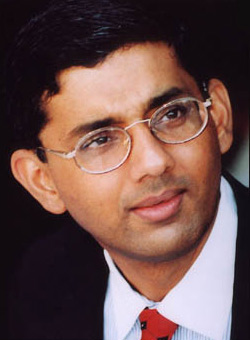
Here is the essay, which provides an immigrant’s perspective on America (Dinesh is the son of East Indian immigrants).
Excerpt:
Is America worthy of a reflective patriotism that doesn’t mindlessly assert, “My country, right or wrong,” but rather examines the criticisms of America and finds them wanting? As an immigrant who has chosen to become an American citizen, I believe that it is. Having studied the criticisms of America with care, my conclusion is that the critics have a narrow and distorted understanding of America. They exaggerate American faults, and they ignore what is good and even great about America.
The immigrant is in a good position to evaluate American society because he is able to apply a comparative perspective. Having grown up in a different society-in my case, Mumbai, India-I am able to identify aspects of America that are invisible to people who have always lived here. As a “person of color,” I am competent to address such questions as what it is like to be a nonwhite person in America, what this country owes its minority citizens, and whether immigrants can expect to be granted full membership in this society. While I take seriously the issues raised by the critics of America, I have also developed an understanding of what makes America great, and I have seen the greatness of America reflected in my life. Unlike many of America’s homegrown dissidents, I am also acutely conscious of the daily blessings that I enjoy in America.
Here, then, is my list of what makes America great.
The best book to read about the Revolutionary War is David McCullough’s “1776”, which I highly recommend. The audio book version is awesome.
George Washington and the American Revolution
Washington Crossing the Delaware
To really understand the founding of the United States, you should read about the story of Washington crossing the Delaware. At this point in the Revolutionary War, the British commanders had achieved a stunning series of victories against the Americans. They had even sent word home to the King that the war was over, and that the Americans would be forced to surrender. But Washington did not give up. He attacked the British forces and took them by surprise – and he won the Battle of Trenton! That was the turning point of the war. There almost never was a United States of America – that’s how close the revolution came to failing.
I’ve spoken of the shining city all my political life, but I don’t know if I ever quite communicated what I saw when I said it. But in my mind it was a tall proud city built on rocks stronger than oceans, wind-swept, God-blessed, and teeming with people of all kinds living in harmony and peace, a city with free ports that hummed with commerce and creativity, and if there had to be city walls, the walls had doors and the doors were open to anyone with the will and the heart to get here. That’s how I saw it, and see it still.
And how stand the city on this winter night? More prosperous, more secure, and happier than it was eight years ago. But more than that; after two hundred years, two centuries, she still stands strong and true on the granite ridge, and her glow has held steady no matter what storm. And she’s still a beacon, still a magnet for all who must have freedom, for all the pilgrims from all the lost places who are hurtling through the darkness, toward home.
This is no ordinary nation.
Songs of America
Whenever I drive on long trips, I always practice singing “The Star-Spangled Banner” and “America the Beautiful”.
Even if you are not an American, you can be an honorary American, just for today, if you sing the songs below. God knows that there are other people in the world that love freedom and look to the United States as the model.
If we fall now, then you other freedom-loving people abroad must be ready to pick up the torch!
“Oh, say can you see by the dawn’s early light
What so proudly we hailed at the twilight’s last gleaming?
Whose broad stripes and bright stars thru the perilous fight,
O’er the ramparts we watched were so gallantly streaming?
And the rocket’s red glare, the bombs bursting in air,
Gave proof through the night that our flag was still there.
Oh, say does that star-spangled banner yet wave
O’er the land of the free and the home of the brave?
On the shore, dimly seen through the mists of the deep,
Where the foe’s haughty host in dread silence reposes,
What is that which the breeze, o’er the towering steep,
As it fitfully blows, half conceals, half discloses?
Now it catches the gleam of the morning’s first beam,
In full glory reflected now shines in the stream:
‘Tis the star-spangled banner! Oh long may it wave
O’er the land of the free and the home of the brave!
And where is that band who so vauntingly swore
That the havoc of war and the battle’s confusion,
A home and a country should leave us no more!
Their blood has washed out their foul footsteps’ pollution.
No refuge could save the hireling and slave
From the terror of flight, or the gloom of the grave:
And the star-spangled banner in triumph doth wave
O’er the land of the free and the home of the brave!
Oh! thus be it ever, when freemen shall stand
Between their loved home and the war’s desolation!
Blest with victory and peace, may the heav’n rescued land
Praise the Power that hath made and preserved us a nation.
Then conquer we must, when our cause it is just,
And this be our motto: “In God is our trust.”
And the star-spangled banner in triumph shall wave
O’er the land of the free and the home of the brave!”
“O beautiful for spacious skies,
For amber waves of grain,
For purple mountain majesties
Above the fruited plain!
America! America!
God shed his grace on thee
And crown thy good with brotherhood
From sea to shining sea!
O beautiful for pilgrim feet
Whose stern impassioned stress
A thoroughfare of freedom beat
Across the wilderness!
America! America!
God mend thine every flaw,
Confirm thy soul in self-control,
Thy liberty in law!
O beautiful for heroes proved
In liberating strife.
Who more than self their country loved
And mercy more than life!
America! America!
May God thy gold refine
Till all success be nobleness
And every gain divine!
O beautiful for patriot dream
That sees beyond the years
Thine alabaster cities gleam
Undimmed by human tears!
America! America!
God shed his grace on thee
And crown thy good with brotherhood
From sea to shining sea!
O beautiful for halcyon skies,
For amber waves of grain,
For purple mountain majesties
Above the enameled plain!
America! America!
God shed his grace on thee
Till souls wax fair as earth and air
And music-hearted sea!
O beautiful for pilgrims feet,
Whose stem impassioned stress
A thoroughfare for freedom beat
Across the wilderness!
America! America!
God shed his grace on thee
Till paths be wrought through
wilds of thought
By pilgrim foot and knee!
O beautiful for glory-tale
Of liberating strife
When once and twice,
for man’s avail
Men lavished precious life!
America! America!
God shed his grace on thee
Till selfish gain no longer stain
The banner of the free!
O beautiful for patriot dream
That sees beyond the years
Thine alabaster cities gleam
Undimmed by human tears!
America! America!
God shed his grace on thee
Till nobler men keep once again
Thy whiter jubilee!”
Remember to be grateful for the Founding Fathers, and other patriots, who risked everything for liberty in the Revolutionary war. Be grateful to those men and women still fighting abroad to keep those freedoms safe from evil. And most of all, be grateful to God that America is still the beacon of liberty.
Here’s an article from the UK Telegraph about Iain Duncan-Smith.
Excerpt:
I’ve known Iain for many years since my days working for Lady Thatcher back when he was party leader. Few British politicians understand the Special Relationship as well as IDS, and he has made a concerted effort to cultivate ties with leaders in the United States, frequently visiting Washington over the past decade both in opposition and in government.
It was refreshing to see a British official showing leadership on an issue that few Washington politicians have seriously addressed since the reforms of the 1990s. His message was a compelling one – that Britain (and for that matter the West as a whole) is facing up to the biggest cultural challenge of the early 21st Century – dealing with “entrenched and intergenerational worklessness and welfare dependency.” In his speech he attacked “an obsession with inputs – with pouring money into social programmes so that governments are seen to be doing something,” a sentiment that tens of millions of Americans would heartily agree with:
So we are now faced with a fundamental challenge. Levels of social breakdown high and rising. Millions of people stuck out of work on benefits. Millions not saving nearly enough for their retirement. And politicians – of all hues – addicted to spending levels as a measurement of success, rather than life change as a measurement of success.
These are areas ripe for reform – but how do you reform when there is no money? The answer – you change the way you reform. Not just cheese-slicing, but recalibrating whole systems so that you change behaviours, and change the culture that allowed spending to get out of control in the first place.
With good reason IDS consistently ranks at the top of ConservativeHome’s poll of cabinet ministers, with an approval rating in the latest survey of 84 per cent. Together with Michael Gove (who currently ranks second), he has been the most consistently impressive minister in Cameron’s government. It is not hard to see why he is so popular with the grassroots. Duncan Smith is a conviction politician offering clear-cut conservative solutions to major problems, emphasising individual responsibility, a strong work ethic, and traditional values as opposed to big government meddling. His welfare reforms are a major step in the right direction, and the most radical since the system’s creation in the 1940s. They deserve widespread support, on both sides of the Atlantic.
Iain Duncan-Smith stands for pro-family policies and welfare reform. What does Michael Gove stand for?
Here’s an article about him in the UK Daily Mail. (H/T Dina)
Excerpt:
One Cabinet minister is increasingly standing apart from the crowd. Yesterday, this newspaper revealed that Education Secretary Michael Gove wants to bring back O-level-style exams.
Although this brave proposal is popular with parents across England, it is not uncontroversial. It takes us back to a system that separated academically gifted children from those with different aptitudes.
But I would argue that the abolition of O-levels in the Eighties was actually an early sign of the culture of dishonesty in our national life.
Britain fell into the grip of a dishonest kindness. We started to hand out good exam results like sweeties — regardless of whether pupils had really learnt anything at school.
We told ourselves that it didn’t matter whether parents spent their time working with their children or just letting them lounge in front of the TV.
We allowed school-leavers to think that a life on benefits was socially acceptable when it’s actually a place where they would easily rot and never fulfil their potential.
The statistics that poured out of the schools system suggested that all was well, however.
Like tractor production data from the old Soviet Union the latest exam grades were always better than last summer’s.
We were told to rejoice but employers and universities saw through the big lie. They complained that the children graduating from Britain’s schools lacked basic literacy and numeracy skills. Britain started sliding down the international league tables that compared the abilities of children in China, Germany, Korea and Britain.
Michael Gove is the first Education Secretary to say that enough is enough. He has said he’s not afraid to preside over a drop in exam grades. They’ll look less good, he concedes, but they’ll be more honest.
The teaching unions that have presided over the ‘All Must Have Prizes’ system will fight him tooth and nail. They want to protect their jobs-for-life regime where bad teachers are rarely sacked but are instead allowed to damage countless pupils’ life chances, year after year.
Gove is undeterred. He’s ready to close down a system where children who can’t manage their times tables are studying for exactly the same exams as those who are on track to study physics at Oxbridge.
[…]The compassionate politician who cares about equality of opportunity won’t accept this status quo, and will point out that the current system is dishonest. It puts children with very different abilities through the same sausage machine and then pretends that those who get ‘F’ or ‘G’ grades have still passed.
Michael Gove wants academically gifted children to be stretched by studying O-levels.
He wants other children to have a more appropriate educational experience, albeit an equally rigorous and demanding one.
This Government’s investment in high-quality apprenticeships and a new generation of technical colleges is early proof that it is serious about restoring the standing of vocational education.
Michael Gove’s specialty is education reform – he wants to stop the left from bashing kids into the same mold, regardless of their individual abilities and aptitudes.
Those are the two guys to watch. They’re not perfect, but they are the two best in the UK, in my opinion.



 WINTERY KNIGHT