
Tag Archives: Liberation

Remembering Lt. Richard Winters on D-Day: The Battle of Brecourt Manor

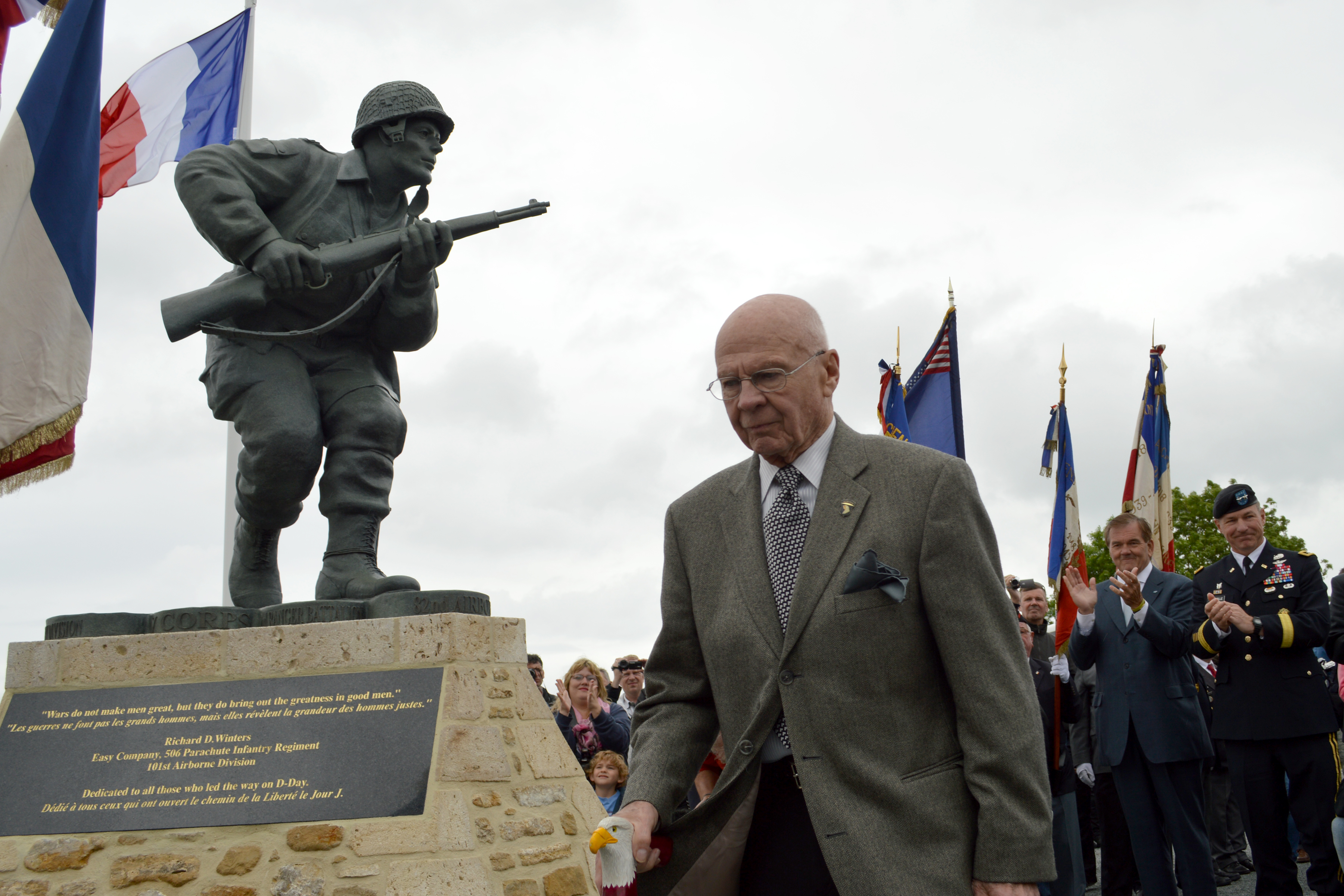
Richard D. Winters Monument

The caption says, “Wars do not make men great, but they do bring out the greatness in good men.” Now let’s see what Dick Winters did during World War II.

MIssion: locate and destroy artillery
Mission: locate and destroy enemy artillery

Brecourt Manor

I want to link to this article from Investors Business Daily about Lt. Winters action at Brecourt Manor.

Here’s the summary of what Dick Winters did on the morning of June 6th, 1944:

First Lt. Dick Winters leapt into leadership on D-Day, June 6, 1944. His commander’s aircraft was shot down as the men parachuted at 600 feet. When Winters headed to earth, he was in charge of a small platoon.

When he landed, he had to command Company E with 148 men, because his commander had been lost along with the plane.

Yet in the chaos, Winters could locate only a dozen other soldiers for their first task: take out a 50-man German artillery battery.

“Winters ordered his assault force to strip down to only essential weapons — guns and grenades — to use against the well-prepared defenses, then deployed his machine guns to cover his advances,” Keith Huxen, senior director of research at the National WWII Museum in New Orleans, told IBD. “Waiting for the proper moment, he led a charge across an open field, gaining the first gun placement, and then they moved down the trenches, systematically destroying each gun.

“In the process, Winters discovered a map detailing all German gun positions to kill American soldiers coming up from Utah Beach, which saved many lives.”

Joined by five reinforcements during the fight, Winters lost four dead and six wounded. The Yanks managed to kill 15 Nazis, capture 11 and wound many others.

Winters’ maneuvers are still studied at West Point as a case of successfully attacking a fixed position, despite being outnumbered.

Winters (1918-2011) was born in Ephrata, Pa., and the family moved to Lancaster when he was 8.

He later attributed his character and desire to go to church regularly to his mother.

Winters attended local Franklin & Marshall College and earned an economics degree with top honors in 1941. He enlisted in the Army in August to shorten his service time, rather than wait to be drafted if America was to join the war.

The diagram below shows where everything was positioned. The Rangers attacked through the trenches containing the four guns, while being raked with fire from multiple MG42 heavy machine guns across the open field.
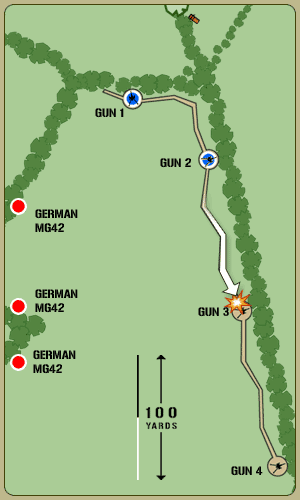
Assaulting the guns at Brecourt Manor

The operation was one of the most famous actions in the Normandy invasion, and you may have seen it portrayed in the Band of Brothers DVD series.  But the article notes that when Dick Winters read the script for that series, “he asked that the profanity be cut from the dialogue of his character, since he never swore”. When the producers told him it was too late to change it, he wrote them a letter of resignation from the production, because “I don’t want these boys and girls thinking it is acceptable using profanity”. In the end, the movie makers removed the swearing by the actor portraying Winters.

If you are looking for a reason to buck the culture and stop swearing, there’s a good reason for you right there – Dick Winters never used profanity.

You can watch the scene from Band of Brothers in low resolution here:

If you play Combat Mission, like I do, you can watch a 28 minute AAR from the simulation of the battle.

Operation Market Garden

More from the article I linked above, this time from Operation Market Garden:

Near Nijmegen on Oct. 5, Winters’ platoon was a position where any movement carried risks. Rather than retreat when fired on by a larger force behind a dike, he led a charge to the top and on the other side discovered a company of 150 Nazi SS troops. Despite having only 40 men, the Americans opened up with everything they had, then shot up a company of enemy reinforcements.

The fray ended with 50 Germans dead, 11 POWs and countless wounded, with few casualties among the Americans.

“This was Easy Company’s crowning achievement of the war and my apogee as a company commander,” Winters told Kingseed. “This demonstrated its overall superiority, of every soldier, of every phase of infantry tactics: patrol, defense, attack using a base of fire, withdrawal and, above all, superior marksmanship with rifles, machine guns and mortar fire.”

Dick Winters is a brave man, someone I admire him very much. And I am grateful for men like him.

I blogged about another hero of the 101st Airborne Division, Ronald Speirs, in a previous post.

Remembering Lt. Richard Winters on D-Day: The Battle of Brecourt Manor

Richard D. Winters Monument

The caption says, “Wars do not make men great, but they do bring out the greatness in good men.” Now let’s see what Dick Winters did during World War II.

MIssion: locate and destroy artillery
Mission: locate and destroy enemy artillery

Brecourt Manor

I want to link to this article from Investors Business Daily about Lt. Winters action at Brecourt Manor.

Here’s the summary of what Dick Winters did on the morning of June 6th, 1944:

First Lt. Dick Winters leapt into leadership on D-Day, June 6, 1944. His commander’s aircraft was shot down as the men parachuted at 600 feet. When Winters headed to earth, he was in charge of a small platoon.

When he landed, he had to command Company E with 148 men, because his commander had been lost along with the plane.

Yet in the chaos, Winters could locate only a dozen other soldiers for their first task: take out a 50-man German artillery battery.

“Winters ordered his assault force to strip down to only essential weapons — guns and grenades — to use against the well-prepared defenses, then deployed his machine guns to cover his advances,” Keith Huxen, senior director of research at the National WWII Museum in New Orleans, told IBD. “Waiting for the proper moment, he led a charge across an open field, gaining the first gun placement, and then they moved down the trenches, systematically destroying each gun.

“In the process, Winters discovered a map detailing all German gun positions to kill American soldiers coming up from Utah Beach, which saved many lives.”

Joined by five reinforcements during the fight, Winters lost four dead and six wounded. The Yanks managed to kill 15 Nazis, capture 11 and wound many others.

Winters’ maneuvers are still studied at West Point as a case of successfully attacking a fixed position, despite being outnumbered.

Winters (1918-2011) was born in Ephrata, Pa., and the family moved to Lancaster when he was 8.

He later attributed his character and desire to go to church regularly to his mother.

Winters attended local Franklin & Marshall College and earned an economics degree with top honors in 1941. He enlisted in the Army in August to shorten his service time, rather than wait to be drafted if America was to join the war.

Here’s where everything was, and the Rangers attacked through the trenches containing the four guns, while being raked with fire from multiple MG42 heavy machine guns across the open field.

Assaulting the guns at Brecourt Manor

If this sounds familiar, it’s because he led one of the most famous actions in the Normandy invasion, and you may have seen it portrayed in the Band of Brothers DVD series.  But the article notes that when Dick Winters read the script, “he asked that the profanity be cut from the dialogue of his character, since he never swore”. When the producers told him it was too late to change it, he wrote them a letter of resignation from the production, because “I don’t want these boys and girls thinking it is acceptable using profanity”. In the end, the cleaned up his swearing.

If you are looking for a reason to buck the culture and stop swearing, there’s a good reason for you right there – Dick Winters never used profanity.

You can watch the scene from Band of Brothers in low resolution here:

If you play Combat Mission, like I do, you can watch a 28 minute AAR from the simulation of the battle.

The article talks about a lot of the actions that Winters participated in during World War II.

Operation Market Garden

More from the article, this time Operation Market Garden:

Near Nijmegen on Oct. 5, Winters’ platoon was a position where any movement carried risks. Rather than retreat when fired on by a larger force behind a dike, he led a charge to the top and on the other side discovered a company of 150 Nazi SS troops. Despite having only 40 men, the Americans opened up with everything they had, then shot up a company of enemy reinforcements.

The fray ended with 50 Germans dead, 11 POWs and countless wounded, with few casualties among the Americans.

“This was Easy Company’s crowning achievement of the war and my apogee as a company commander,” Winters told Kingseed. “This demonstrated its overall superiority, of every soldier, of every phase of infantry tactics: patrol, defense, attack using a base of fire, withdrawal and, above all, superior marksmanship with rifles, machine guns and mortar fire.”

Dick Winters is a brave man, someone I admire him very much. And I am grateful for men like him.

I blogged about another hero of the 101st Airborne Division, Ronald Speirs, in a previous post.

What happens to your children when they arrive at university?

This Philadelphia Inquirer editorial is from famous ethics professor Robert P. George.

He writes:

When many of the flower children and new-left activists of the ’60s became professors and university administrators in the ’70s and ’80s, they did not entirely overthrow the idea of liberal-arts education. Many proclaimed themselves its loyal partisans.Now, it is true that many think it their mission to create soldiers in the battle for “social change” – aspiring ACLU lawyers, Planned Parenthood volunteers, and “community organizers.” But others resist the idea that learning should be instrumentalized. They profess allegiance to the idea that the point of liberal education is to enrich and even liberate the student-learner. That’s what is supposed to be “liberal” about liberal-arts learning – it is supposed to convey the knowledge and impart the intellectual skills and habits of mind that are liberating.Still, there is a chasm between the idea of liberal-arts education as classically conceived, and the conception promoted by some (mercifully, not all) in positions of influence in academic departments today. Many of today’s academic humanists and social scientists have a different view of what students need liberation from.In their view (what I will call the revisionist conception), it is liberation from traditional social constraints and moral norms – beliefs, principles, and structures by which earlier generations of Americans and people in the West generally had been taught to govern themselves for the sake of personal virtue and the common good. For them, it has become a dogma that these traditional norms and structures are irrational – “hang ups” that stifle our personalities by impeding desire-fulfillment.

Liberal-arts learning is thus seen as a way to undermine whatever is left of the old norms and structures. Teaching and scholarship are meant either (1) to expose the texts and traditions once regarded as the intellectual treasures of our civilization – the Bible, Plato, Augustine, Dante, Aquinas, Chaucer, Shakespeare, Austen, Locke, Gibbon, the authors of The Federalist, etc. – as mere propaganda propping up unjust (racist, sexist, classist, homophobic) social orders, or still worse (2) to show how they can be “reappropriated” to subvert allegedly unjust contemporary social orders.

Beyond this, liberal-arts learning is meant to enable students to become “authentic” – true to themselves – which means, to these liberal-arts revisionists, acting on one’s feelings and desires. For the self is understood precisely as a bundle of feelings and desires, to be acted on without regard to supposedly outmoded moral and social norms.

On the revisionist conception of personal authenticity, whatever impedes one from doing what one most wants (unless what one happens to want would be politically incorrect) is a mere hang-up. So religious convictions and traditional moral ideals are to be transcended for the sake of the free and full development of one’s personality – for example, by acting on sexual desires that one might have been “repressing.”

This is something I often encounter when dealing with college kids, especially with women who went to college and fell under the influence of feminism. Even if they come back to the faith later and want to get serious about it, there is a lingering effect of their indoctrination in college that causes them to doubt the traditional virtues and prefer to make decisions on the basis of feelings. They really, really believe in being true to their feelings, and deciding what to do on the basis of these feelings, rather then thinking about virtues like stewardship, or moral obligations in general. We are not good at loving other people, and focusing on ourselves above all does not help us to do that.