NDP Leader Jack Layton, who’s campaigning as the defender of public health care, had surgery at a private clinic in the 1990s, The Canadian Press has learned.
Layton had hernia surgery at the Shouldice Hospital, a private facility in the Toronto suburb of Thornhill, while he was serving as a Toronto city councillor. The NDP leader said he wasn’t aware the clinic was private when he went for his surgery in the mid-1990s.
Earlier in the campaign, Layton said he would not go to a private clinic nor would he send a loved one to a private clinic, even if he could get faster treatment.
He would have had a longer wait at a public hospital, and he didn’t want to wait in line behind ordinary people.
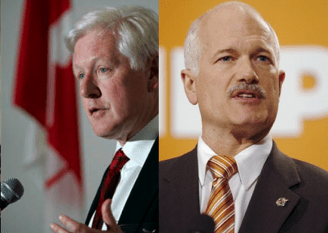
How did former NDP leader Bob Rae govern in Ontario?
The Liberal government had forecast a small surplus earlier in the year, but a worsening North American economy led to a $700 million deficit before Rae took office. In October, the NDP projected a $2.5 billion deficit for the fiscal year ending on March 31, 1991.[40] Some economists projected soaring deficits for the upcoming years, even if the Rae government implemented austerity measures.[41] Rae himself was critical of the Bank of Canada’s high interest rate policy, arguing that it would lead to increased unemployment throughout the country.[42] He also criticized the 1991 federal budget, arguing the Finance Minister Michael Wilson was shifting the federal debt to the provinces.[43]
The Rae government’s first budget, introduced in 1991, increased social spending to mitigate the economic slowdown and projected a record deficit of $9.1 billion. Finance Minister Floyd Laughren argued that Ontario made a decision to target the effects of the recession rather than the deficit, and said that the budget would create or protect 70,000 jobs. It targeted more money to social assistance, social housing and child benefits, and raised taxes for high-income earners while lowering rates for 700,000 low-income Ontarians.[44]
A few years later, journalist Thomas Walkom described the budget as following a Keynesian orthodoxy, spending money in the public sector to stimulate employment and productivity. Unfortunately, it did not achieve its stated purpose. The recession was still severe. Walkom described the budget as “the worst of both worlds”, angering the business community but not doing enough to provide for public relief.
[…]Rae’s government attempted to introduce a variety of socially progressive measures during its time in office, though its success in this field was mixed. In 1994, the government introduced legislation, Bill 167, which would have provided for same-sex partnership benefits in the province. At the time, this legislation was seen as a revolutionary step forward for same-sex recognition.
[…]The Rae government established an employment equity commission in 1991,[49] and two years later introduced affirmative action to improve the numbers of women, non-whites, aboriginals and disabled persons working in the public sector.
[…]In November 1990, the Rae government announced that it would restrict most rent increases to 4.6% for the present year and 5.4% for 1991. The provisions for 1990 were made retroactive. Tenants’ groups supported these changes, while landlord representatives were generally opposed.
Be careful who you vote for, Canada. We voted for Obama, and now we have a 14.5 trillion dollar debt and a 1.65 trillion deficit – TEN TIMES the last Republican budget deficit of 160 billion under George W. Bush in 2007. TEN TIMES WORSE THAN BUSH.
If NDP Leader Jack Layton wins a minority government May 2, supported by the Liberals and Bloc Quebecois, he plans to make Canadians pay a new charge estimated at $21.5 billion over the next four years for the right to emit man-made carbon dioxide into the atmosphere.
Under Layton’s proposed cap-and-trade plan, this money will be paid by ordinary Canadians in higher retail costs for goods and services, along with job layoffs and lower salaries and benefits for workers.
Layton’s plan is to impose cap-and-trade on us soon after the NDP takes power.
We know this because in outlining his proposal during the election, the NDP estimated it will collect $3.6 billion from cap-and-trade in this fiscal year alone, which started April 1 and ends March 31, 2012…
If you haven’t opened your September hydro bill yet, you’re in for a shock. Rates have risen 18 per cent this year to date, and that’s just the start. By this time next year – election time – Ontario power consumers will be forking over about twice as much (in nominal terms) as they did when Dalton McGuinty took office in 2003.
[…]Power expert Tom Adams may know more about this subject than any other living being. And he’s steamed. Ontario’s rates, he says, have already surpassed the U.S. average and are headed for European levels – “just because of public policy.”
The policy is to go all out on renewables – wind and solar– whether or not it makes sense. The province is paying sky-high rates for power it doesn’t need so we can have wind turbines marching on and on to the horizon, just like Denmark does. “Power demand has been dropping since 2005,” says Mr. Adams. In fact, we have so much excess supply that, from time to time, it threatens to crash the system. Because of this, we’re even paying the neighbours to take the power off our hands.
“Ontario will need new power supplies in the future,” Mr. Adams says. “But why not buy it when we need it?” Instead of waiting, the power authority is signing long-term contracts at the rate of about $1-billion a week, while paying enormous premiums to attract wind and solar producers. In other words, it’s making 20-year commitments to pay stunningly high prices for power we don’t need.
On top of that, the province is building new transmission lines to nowhere while neglecting to ensure that Toronto’s hospitals and banks can keep the lights on. In July, Toronto experienced what Mr. Adams calls “Ontario’s first green blackout.” That blackout occurred because the city’s downtown core is badly underpowered. It has the weakest power system of any financial centre in the developed world.
Why haven’t we done anything about it? Because the green lobby has been campaigning for conservation, instead. And so, when the government started picking sites for transmission upgrades, it decided to build a power line up the shore of Lake Nipigon to connect remote wind turbines to Thunder Bay.
Ever since the days of Adam Beck, the father of public power in Ontario, the province’s energy policy has been linked to economic policy. The motto was reliable power at cost. Now energy policy has been entirely decoupled from economic policy and attached to the runaway train of environmental policy. Everyone in the power system knows it. But they’re so terrified to raise their hands, most of the public is still in the dark.
The Swedish retail giant IKEA announced yesterday it will invest $4.6-million to install 3,790 solar panels on three Toronto area stores, giving IKEA the electric-power-producing capacity of 960,000 kilowatt hours (kWh) per year. According to IKEA, that’s enough electricity to power 100 homes. Amazing development. Even more amazing is the economics of this project. Under the Ontario government’s feed-in-tariff solar power scheme, IKEA will receive 71.3¢ for each kilowatt of power produced, which works out to about $6,800 a year for each of the 100 hypothetical homes. Since the average Toronto home currently pays about $1,200 for the same quantity of electricity, that implies that IKEA is being overpaid by $5,400 per home equivalent.
Welcome to the wonderful world of green economics and the magical business of carbon emission reduction. Each year, IKEA will receive $684,408 under Premier Dalton McGuinty’s green energy monster — for power that today retails for about $115,000. At that rate, IKEA will recoup $4.6-million in less than seven years — not bad for an investment that can be amortized over 20.
No wonder solar power is such a hot industry. No wonder, too, that the province of Ontario is in a headlong rush into a likely economic crisis brought on by skyrocketing electricity prices. To make up the money paid to IKEA to promote itself as a carbon-free zone, Ontario consumers and industries are on their way to experiencing the highest electricity rates in North America, if not most of the world.
The government’s regulator, the Ontario Energy Board, has prepared secret forecasts of how much Ontario consumers are going to have to pay for electricity over the next five years. The government won’t allow the report to be released. The next best estimate comes from Aegent Energy Advisors Inc., in a study it did for the Canadian Manufactures and Exporters group. Residential rates are expected to jump by 60% between 2010 and 2015. Industrial customers will be looking at a 55% increase.
Going back to 2003, based on numbers dug up by consultant Tom Adams, the price of residential electricity in Ontario hovered around 8.5¢ a kWh in 2003 — the first year of the McGuinty Liberal regime. By 2015, Aegent Energy estimates the price will be up to 21¢, an increase of 135%. Doubling the price of electricity in a decade is no way to spur growth and investment. In this age of global economic competition IKEA may end up with fewer sales of its Billy bookshelves in Toronto because its customers will be bogged down with soaring power bills and a sliding economy.
A $200-million wind farm in northern New Brunswick is frozen solid, cutting off a potential supply of renewable energy for NB Power.
The 25-kilometre stretch of wind turbines, located 70 kilometres northwest of Bathurst, N.B. has been completely shutdown for several weeks due to heavy ice covering the blades.
[…]Wintery conditions also temporarily shutdown the site last winter, just months after its completion. Some or all of the turbines were offline for several days, with “particularly severe icing” blamed.
The accumulated ice alters the aerodynamics of the blades, rendering them ineffective as airfoils. The added weight further immobilizes the structures.
[…]Melissa Morton, a spokeswoman for the utility, says the contract isn’t based on power delivered during a specific period, but rather on an annual basis.
“Our hopes is that it will balance out over the 12-month period and, historically, that has been the case.”
Despite running into problems in consecutive winters, Ms. Morton says NB Power doesn’t have concerns about the reliability of the supply from the Caribou Mountain site.
And messing with energy production doesn’t just hurt consumers, it hurts businesses who have to pay more for electricity. They deal with those additional costs by laying off workers and raising the prices of their goods and services. These alternative energy sources simply to not work as well (YET) as current methods of generating power, and it costs a lot of taxpayer money to experiment with them. This is real money folks – YOUR MONEY.
The Wall Street Journal has more on the economic effects of cap-and-trade laws. Even with a Democrat-run House, a Democrat-run Senate, and a Democrat president, the anti-business left was not able to get the cap-and-trade carbon tax passed in the United States. Everybody, including Democrats, knew that a tax on energy production will cost the energy sector jobs, and raise prices on consumer energy.
The Liberal government had forecast a small surplus earlier in the year, but a worsening North American economy led to a $700 million deficit before Rae took office. In October, the NDP projected a $2.5 billion deficit for the fiscal year ending on March 31, 1991.[40] Some economists projected soaring deficits for the upcoming years, even if the Rae government implemented austerity measures.[41] Rae himself was critical of the Bank of Canada’s high interest rate policy, arguing that it would lead to increased unemployment throughout the country.[42] He also criticized the 1991 federal budget, arguing the Finance Minister Michael Wilson was shifting the federal debt to the provinces.[43]
The Rae government’s first budget, introduced in 1991, increased social spending to mitigate the economic slowdown and projected a record deficit of $9.1 billion. Finance Minister Floyd Laughren argued that Ontario made a decision to target the effects of the recession rather than the deficit, and said that the budget would create or protect 70,000 jobs. It targeted more money to social assistance, social housing and child benefits, and raised taxes for high-income earners while lowering rates for 700,000 low-income Ontarians.[44]
A few years later, journalist Thomas Walkom described the budget as following a Keynesian orthodoxy, spending money in the public sector to stimulate employment and productivity. Unfortunately, it did not achieve its stated purpose. The recession was still severe. Walkom described the budget as “the worst of both worlds”, angering the business community but not doing enough to provide for public relief.
[…]Rae’s government attempted to introduce a variety of socially progressive measures during its time in office, though its success in this field was mixed. In 1994, the government introduced legislation, Bill 167, which would have provided for same-sex partnership benefits in the province. At the time, this legislation was seen as a revolutionary step forward for same-sex recognition.
[…]The Rae government established an employment equity commission in 1991,[49] and two years later introduced affirmative action to improve the numbers of women, non-whites, aboriginals and disabled persons working in the public sector.
[…]In November 1990, the Rae government announced that it would restrict most rent increases to 4.6% for the present year and 5.4% for 1991. The provisions for 1990 were made retroactive. Tenants’ groups supported these changes, while landlord representatives were generally opposed.
Be careful who you vote for, Canada. We voted for Obama, and now we have a 14.5 trillion dollar debt and a 1.65 trillion deficit – TEN TIMES the last Republican budget deficit of 160 billion under George W. Bush in 2007. TEN TIMES WORSE THAN BUSH.
As Canada’s New Democratic Party (NDP) surges in the polls in the lead up to Monday’s federal election – raising the once-unimaginable specter of a coalition government headed by NDP leader Jack Layton – the party has emphasized their plan to push Canada beyond the status quo of state-funded abortion-on-demand, promising to actually promote greater access to abortion across the country.
NDP leader Jack Layton emphasized the party’s commitment to abortion – and questioned the Conservative party’s commitment – in Gatineau, Quebec on Monday as part of a pitch to win over women voters. “The cabinet of the prime minister is still questioning the right of women to choose,” said Layton, according to the Toronto Star.
In a statement to Campaign Life Coalition, the political arm of Canada’s pro-life movement, the NDP said they are committed as a party to “universal access to abortion services and guaranteed reproductive freedoms for all Canadian women, regardless of income or where they live.”
The party emphasized that this is a position demanded of all NDP candidates. “All New Democrat candidates agree to adhere to these principles when they agree to accept the nomination from their riding association,” said the statement.
Notably, last year every NDP Member of Parliament, except four who did not vote, opposed Bill C-510 (Roxanne’s Law), which would have protected women who choose to keep their unborn babies from being coerced into abortion.
[…]The polling firm suggests the party could win as many as 100 seats, allowing them to team up with the Liberals to form a coalition government that would make Layton Canada’s Prime Minister. They report that the NDP’s popularity has particularly surged in Quebec, where they say there has been “a wholesale transfer of Bloc Quebecois supporters.”
Though Layton did not give details at the Gatineau rally on the party’s plan to promote abortion, an NDP policy official told the Toronto Star that the party would negotiate with the provinces and territories to make abortion easily accessible to every woman who wants one. The official suggested this could involve adding to the number of hospitals and family doctors committing abortions.
Two provinces that would likely be affected are New Brunswick and Prince Edward Island, frequent targets of abortion advocates. New Brunswick has successfully avoided funding private abortion facilities so far, and P.E.I. residents must currently obtain abortions in other provinces. Both would undoubtedly come under pressure from an NDP-led government.
Social conservatives should not be voting for Jack Layton. He is a pro-abortion radical.
How did former NDP leader Bob Rae govern in Ontario?
The Liberal government had forecast a small surplus earlier in the year, but a worsening North American economy led to a $700 million deficit before Rae took office. In October, the NDP projected a $2.5 billion deficit for the fiscal year ending on March 31, 1991.[40] Some economists projected soaring deficits for the upcoming years, even if the Rae government implemented austerity measures.[41] Rae himself was critical of the Bank of Canada’s high interest rate policy, arguing that it would lead to increased unemployment throughout the country.[42] He also criticized the 1991 federal budget, arguing the Finance Minister Michael Wilson was shifting the federal debt to the provinces.[43]
The Rae government’s first budget, introduced in 1991, increased social spending to mitigate the economic slowdown and projected a record deficit of $9.1 billion. Finance Minister Floyd Laughren argued that Ontario made a decision to target the effects of the recession rather than the deficit, and said that the budget would create or protect 70,000 jobs. It targeted more money to social assistance, social housing and child benefits, and raised taxes for high-income earners while lowering rates for 700,000 low-income Ontarians.[44]
A few years later, journalist Thomas Walkom described the budget as following a Keynesian orthodoxy, spending money in the public sector to stimulate employment and productivity. Unfortunately, it did not achieve its stated purpose. The recession was still severe. Walkom described the budget as “the worst of both worlds”, angering the business community but not doing enough to provide for public relief.
[…]Rae’s government attempted to introduce a variety of socially progressive measures during its time in office, though its success in this field was mixed. In 1994, the government introduced legislation, Bill 167, which would have provided for same-sex partnership benefits in the province. At the time, this legislation was seen as a revolutionary step forward for same-sex recognition.
[…]The Rae government established an employment equity commission in 1991,[49] and two years later introduced affirmative action to improve the numbers of women, non-whites, aboriginals and disabled persons working in the public sector.
[…]In November 1990, the Rae government announced that it would restrict most rent increases to 4.6% for the present year and 5.4% for 1991. The provisions for 1990 were made retroactive. Tenants’ groups supported these changes, while landlord representatives were generally opposed.
Be careful who you vote for, Canada. We voted for Obama, and now we have a 14.5 trillion dollar debt and a 1.65 trillion deficit – TEN TIMES the last Republican budget deficit of 160 billion under George W. Bush in 2007. TEN TIMES WORSE THAN BUSH.

 WINTERY KNIGHT