
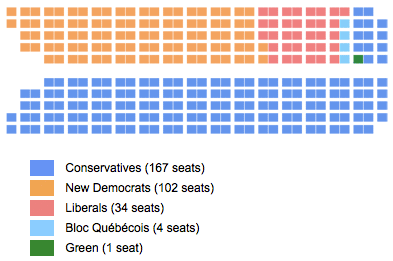
Andrew sent me this article from the Chronicle Herald.
Excerpt:
To protect freedom of expression in Canada, sometimes you need a majority government in Ottawa.
That’s the moral of the story of a Conservative backbencher’s private member’s bill — which has now cleared second reading in the House of Commons and gone to committee — seeking to repeal Section 13 of the Canadian Human Rights Act.
Let’s recall the exact wording of that infamous clause. Hate messages, according to Section 13 (1), are communications “likely to expose a person or persons to hatred or contempt by reason of the fact that that person or those persons are identifiable on the basis of a prohibited ground of discrimination.”
In other words, if I were to write something critical about Islam, for example, and someone reading my column felt it “likely” that my words could provoke “contempt” towards Muslims, they could lodge a complaint against me with one of Canada’s government-created human rights commissions.
Truth would not be a defence. Neither would my intent. And the person complaining wouldn’t even have to be a Muslim.
That’s because, on top of the appallingly loose wording of this section of federal human rights law — a clause echoed in its provincial counterparts — any complaints are adjudicated by government-appointed tribunals, where the standard protections afforded any accused in a court of law don’t necessarily apply.
When complainants’ cases go forward, taxpayers pick up the tab. Meanwhile, those accused must pay to defend themselves out of their own pockets.
It’s a system ripe for abuse. And that’s exactly what has happened. We’ve seen comics fined for insulting hecklers (B.C. human rights tribunal), former publishers spend $100,000 in legal fees over three years to defend themselves for printing “offensive” cartoons (Alberta human rights commission), and Maclean’s magazine investigated by three human rights bodies (federal, Ontario and B.C.) for running an article on Muslim demographics in Europe.
The Conservatives have long opposed Section 13, but didn’t feel they had the support they needed from the other parties, as a minority government, to push the issue legislatively.
They also were concerned, with good reason, that some opponents might twist the issue for political advantage, slamming the Tories for being soft on hate.
Yes, Bill C-304, which aims to repeal Sections 13 and 54 (dealing with penalties under S.13), was put forward by Alberta MP Brian Storseth (Westlock-St. Paul) and is a private member’s bill, but the legislation has the justice minister’s endorsement. So there’s a good chance the bill will be back in the Commons this spring for final reading, then on to the Senate and, hopefully, passage and royal assent.
The bill, if made law, would take effect a year after receiving royal assent.
Canada does not protect free speech right now. Repealing Section 13 would be good, but Canada is not a good place for families to raise children. Even if they get Section 13 repealed, there is still the recent unanimous Supreme Court decision affirming that the provincial governments have a right to decide what children will believe – not parents. The Supreme Court was mostly selected by the previous Liberal governments.
 WINTERY KNIGHT