Exactly what country does New York Times columnist Paul Krugman actually reside in?
Before you answer, consider the following sentence from his article Monday:
Although you’d never know it listening to the ranters, the past year has actually been a pretty good test of the theory that slashing government spending actually creates jobs.
For the past year to be a good test of this theory, there would have needed to be a slash to government spending, right?
Was this the case?
Hardly.
In fiscal 2010, total federal outlays were $3.72 trillion. In fiscal 2011 which ends September 30, we’re projected to spend $3.83 trillion. That’s a $111 billion increase.
Yet this Nobel laureate in economics thinks government spending was slashed.
In reality, since the last time such outlays declined year over year was 1965, we should really be testing Krugman, Obama, and the Democrats’ theory that dramatic increases in government spending creates jobs.
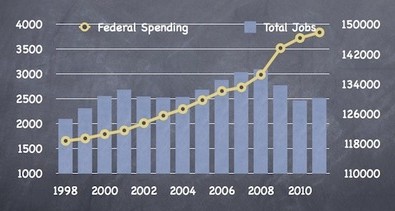
Democrats have been radically increasing outlays since they took over Congress in 2007. During this time, as spending rose by 41 percent, the economy lost roughly seven million jobs sending unemployment skyrocketing from 4.4 percent to 9.1 percent.
If Krugman wasn’t delusional, the above referenced sentence from his Monday column would read, “Although you’d never know it listening to the ranters like Barack Obama, the Democrats, Robert Reich, and me, the past four years have actually been a fabulous test of the theory that exploding government spending actually creates jobs.
Isn’t that really the only conclusion that one could draw given what’s happened since this recent Keynesian experiment began in 2007?
Of course, it’s unfair to expect this Nobel laureate in economics to make such an obvious determination.
He thinks a $111 billion increase in spending is a slash.
I think that Paul Krugman is going beyond mere mendacity these days, as his Keynesian worldview is disproved right before his eyes. The whole country is being treated to a massive disproof of all of his ideas, and this must be causing him some mental strain.
Is Paul Krugman seen as reliable?
I’m not the only one to point out how nutty Krugman has become of late.
Why does the New York Times hire a deluded person? Because they don’t so much report the news as they provide their readers with “confirmation” of a worldview that allows them to feel that they are right without having to care about reality. In short, Krugman is a well-paid writer of fiction.
Employment in the U.S. unexpectedly stagnated in August and the jobless rate held at 9.1 percent as American employers became less confident in the strength of the recovery.
Payrolls were unchanged last month, the weakest reading since September 2010, after an 85,000 gain in July that was less than initially estimated, Labor Department data showed today in Washington. The median forecast in a Bloomberg News survey called for a rise of 65,000. Hourly earnings and hours worked both declined. The August data included a 48,000 drop in information industry jobs, mostly reflecting striking Verizon Communications Inc. workers.
The first U.S. credit downgrade, political squabbling over the budget and mounting fear of a default in Europe caused the Standard & Poor’s 500 Index to plummet 17 percent from July 22 to Aug. 8, prompting companies and consumers to cut back. The lack of hiring is one reason Federal Reserve Chairman Ben S. Bernanke last week said the central bank still has tools available to stimulate growth.
“Net employment flat-lined in August,” Ellen Zentner, a senior U.S. economist at Nomura Securities International Inc. in New York, who forecast a decline of 5,000, said before the report. “When the outlook is uncertain, businesses don’t hire. Calls that we’re on the cusp of a recession or already there are not completely unwarranted.”
Estimates of the 86 economists surveyed by Bloomberg for overall payrolls ranged from a decline of 20,000 to a 160,000 increase. The unemployment rate was projected to hold at 9.1 percent, according to the survey median. Estimates ranged from 9 percent to 9.2 percent.
Only a mouth-breathing, in-bred moron was surprised to learn that President Obama’s policies have put the economy in a stupor. I thought Bloomberg News was a wire service that specialized in commerce. Have they no one at that agency who does anything but kiss-up to the socialists who are now in charge of our government?
What a mess. The month of August began with the first downgrade of America’s credit rating in memory. That failure alone should cost him his job.
Youth unemployment tops 25%. Black unemployment is at 16.7%. Hispanic unemployment is at 11.3%.
14 million people are jobless.
6 million people have not had a job for more than 6 months.
86 million working-age people are not in the job market.
[…]Few companies are expanding as they wonder what in the heck his EPA policies will do to them, what in the heck his health insurance policies will do to them and what in the heck his tax policies will do to them. The 9.1% unemployment rate in August matches July as the economy hits the horse latitudes, where it will stay for about another year until hope of a new regime change begins to take hold.
Barack Obama’s presidency has hurt the poor and minorities the hardest. Their jobs were the first to go and on his watch, 1.5 million fewer Americans have jobs than on his Inauguration Day. This is terrible. He may have inherited a recession but he seems bound and determined to make it a depression.
What does Bloomberg mean by “unexpectedly”. Does letting the government take money from taxpayers and businesses create jobs?
CBS News reports on what the stimulus does:
ABC News reports on more stimulus spending:
And this one features a real economist:
Let’s learn some economics and find out why Obama’s government spending, green jobs, tax the rich, regulate businesses approach hasn’t work to create jobs.
Economics in One Lesson
Perhaps it is time to review Henry Hazlitt’s book on basic economics “Economics in One Lesson”. Let’s look in chapter 4, which is entitled “Public Works Mean Taxes”.
Excerpt from that chapter:
Therefore, for every public job created by the bridge project a private job has been destroyed somewhere else. We can see the men employed on the bridge. We can watch them at work. The employment argument of the government spenders becomes vivid, and probably for most people convincing. But there are other things that we do not see, because, alas, they have never been permitted to come into existence. They are the jobs destroyed by the $10 million taken from the taxpayers. All that has happened, at best, is that there has been a diversion of jobs because of the project. More bridge builders; fewer automobile workers, television technicians, clothing workers, farmers.
And consider Chapter 5 as well, entitled “Taxes Discourage Production”.
In our modern world there is never the same percentage of income tax levied on everybody. The great burden of income taxes is imposed on a minor percentage of the nation’s income; and these income taxes have to be supplemented by taxes of other kinds. These taxes inevitably affect the actions and incentives of those from whom they are taken. When a corporation loses a hundred cents of every dollar it loses, and is permitted to keep only fifty-two cents of every dollar it gains, and when it cannot adequately offset its years of losses against its years of gains, its policies are affected. It does not expand its operations, or it expands only those attended with a minimum of risk. People who recognize this situation are deterred from starting new enterprises. Thus old employers do not give more employment, or not as much more as they might have; and others decide not to become employers at all. Improved machinery and better-equipped factories come into existence much more slowly than they otherwise would. The result in the long run is that consumers are prevented from getting better and cheaper products to the extent that they otherwise would, and that real wages are held down, compared with what they might have been.
There is a similar effect when personal incomes are taxed 50, 60 or 70 percent. People begin to ask themselves why they should work six, eight or nine months of the entire year for the government, and only six, four or three months for themselves and their families. If they lose the whole dollar when they lose, but can keep only a fraction of it when they win, they decide that it is foolish to take risks with their capital. In addition, the capital available for risk-taking itself shrinks enormously. It is being taxed away before it can be accumulated. In brief, capital to provide new private jobs is first prevented from coming into existence, and the part that does come into existence is then discouraged from starting new enterprises. The government spenders create the very problem of unemployment that they profess to solve.
And the results we see today are consistent with the predictions of basic economic theory.
A federal stimulus grant of nearly $500,000 to grow trees and stimulate the economy in Nevada yielded a whopping 1.72 jobs, according to government statistics.
In 2009, the U.S. Forest Service awarded $490,000 of stimulus money to Nevada’s Clark County Urban Forestry Revitalization Project, aimed at revitalizing urban neighborhoods in the county with trees, plants, and green-industry training.
According to Recovery.gov, the U.S. government’s official website related to Recovery Act spending, the project created 1.72 permanent jobs. In addition, the Nevada state Division of Forestry reported the federal grant generated one full-time temporary job and 11 short-term project-oriented jobs.
[…]Repeated calls by FoxNews.com to the U.S. Forest Service were not returned.
[…]”Looking at the failure of the stimulus to live up to its promises, not just in Nevada, but throughout America, I think the question becomes ‘is there any good use of stimulus money?'” said Douglas Kellogg, communications manager for National Taxpayers Union, in an email to FoxNews.com.
[…]”The president may well propose new stimulus efforts when Congress returns from recess,” said Kellogg, “and those who learn from past stimulus debacles will not be fooled again.”
Indeed, President Obama’s stimulus bill failed by its own standards. In a January 2009 report, White House economists predicted that the stimulus bill would create (not merely save) 3.3 million net jobs by 2010. Since then, 3.5 million more net jobs have been lost, pushing the unemployment rate above 10 percent.[1] The fact that government failed to spend its way to prosperity is not an isolated incident:
During the 1930s, New Deal lawmakers doubled federal spending–yet unemployment remained above 20 percent until World War II.
Japan responded to a 1990 recession by passing 10 stimulus spending bills over 8 years (building the largest national debt in the industrialized world)–yet its economy remained stagnant.
In 2001, President Bush responded to a recession by “injecting” tax rebates into the economy. The economy did not respond until two years later, when tax rate reductions were implemented.
In 2008, President Bush tried to head off the current recession with another round of tax rebates. The recession continued to worsen.
Now, the most recent $787 billion stimulus bill was intended to keep the unemployment rate from exceeding 8 percent. In November, it topped 10 percent.[2]
Why is this? It’s because the government never spends money as efficiently as the private sector. Private sector firms have to stay lean and mean in order to stay afloat – because they have competitors who are always trying to sell better goods and services for less money. In a capitalist economy, the consumer is king – all the businesses fight to earn the customers’ money. But the government has no competitors, and so they neither care about efficiency, nor pleasing their customers.
CBS News reports:
ABC News reports:
And this one features a real economist:
We shouldn’t let the government take money out of the private sector and let the public sector spend it on “stimulus”. Stimulus means taking money away from your boss, or your possible bosses, and spending it on trees. It’s how you lose jobs – and that’s what we have today.

 WINTERY KNIGHT