
From the Pittsburgh Post-Gazette. (H/T Reuben, indirectly)
Excerpt:
Americans are angry and with good reason. They are hurting from unemployment, uncertainty in stock market investments and declining retirement funds. And they are weary of waiting for a real workable plan to get us out of this rut.
This is not a time to try the same failed policies of borrowing, debt and calls for tax increases. So we offer these ideas as President Barack Obama prepares to address Congress Thursday if he really wants to make some major bipartisan moves to get our country moving again.
[…]First, allow U.S. employers to repatriate $1 trillion sitting in overseas banks. The current tax rate of 35 percent is a huge barrier blocking those dollars from being invested in jobs, boosting the stock market and raising the value of retirement funds.
Some companies use armies of attorneys and accountants to find ways to cut those taxes, followed by the Internal Revenue Service tracking them down. Stop the nonsense. Offer a lower tax rate, perhaps 15 percent, for a limited time (maybe even a lower rate if the money is invested in job creation or in purchasing U.S. goods).
[…]Second, freeze the massive number of proposed regulations until Congress can review and approve them. Regulations cost U.S. employers more than $1.75 trillion per year. Federal agencies are moving forward with more than 4,257 new regulations that will add tens of billions in regulatory costs — more than tripling the burden of agency mandates from 2009.Employers are worried how this tsunami of new regulations will overwhelm their businesses so they are holding back on growth and hiring. Unless a regulation is absolutely necessary to protect the public’s health and safety, it should be stopped now. Enactment of House Resolution 10, the REINS Act, would require congressional review and approval for any mandate costing the economy more than $100 million annually.
Third, pass our bipartisan Infrastructure Jobs and Energy Independence Act (H.R. 1861), to expand safe offshore oil and gas exploration, create 1.2 million new jobs annually and launch $8 trillion in economic output. Our bipartisan bill dedicates a portion of up to $3.7 trillion in federal oil and gas revenues from the new exploration for investments in new energy technologies, power generation and grid modernization to help put us on a path to energy independence.
[…]Finally, to preserve a free global market for trade, we must hold foreign nations accountable to abide by international agreements. This year, America will lose its position as the global manufacturing leader to China, in large part because Beijing illegally gives its exports a 20 percent to 40 percent discount by manipulating and devaluing its currency.
Another good idea would be to sign the free trade deals with Panama, South Korea and Colombia. Heritage explains what would happen if we did.
Excerpt:
The Obama Administration—after allowing U.S. free trade agreements (FTAs) with South Korea, Colombia, and Panama to languish unapproved for nearly four years—lately appears eager to push Congress to ratify all three soon. The problem now is that some in Congress are trying to make their approval contingent upon an extension of the Trade Adjustment Act (TAA).
That would be a mistake. The three FTAs are intrinsically worth passing without any strings. Congress should act on them without further delay.
The Korea-U.S. Free Trade Agreement (KORUS) would be America’s largest free trade agreement in Asia. It would increase U.S. exports by an estimated $10 billion annually, increase U.S. gross domestic product (GDP) by $11 billion, and add 70,000 U.S. jobs—all without a dime in federal government spending.[1] The accord would also serve as a powerful statement of the U.S. commitment to East Asia at a time when many perceive declining American interest, presence, and influence in the region. The FTA would strengthen U.S. commercial ties and expand the bilateral relationship with South Korea beyond traditional military ties or the North Korean threat.
[…]Rejecting KORUS would disadvantage U.S. companies by locking in discriminatory trade barriers. During the four years the agreement was held hostage by special interest groups and congressional protectionists, the U.S. lost $40 billion in potential exports. American companies continued to lose market share to foreign competitors. The U.S. used to be South Korea’s largest trade partner, but in less than a decade it has been displaced by China, the European Union, and Japan. As Korea’s market opens further, it will be foreign competitors and not U.S. companies that will benefit.
[…]Until this year, the Obama Administration and congressional leadership took its orders on the U.S.–Colombia FTA from protectionist U.S. labor unions and U.S. anti-globalization groups, joined by far-left allies in the region, who succeeded in delaying congressional approval of the FTA. The cost of delay has been significant. So far, according to the Latin America Trade Coalition’s “Colombia Tariff Ticker,”[2] U.S. companies have paid $3.5 billion (as of this writing) in unnecessary duties to the Colombian treasury in the more than 1,600 days since the FTA was signed.
That $3.5 billion has translated into higher prices in Colombia for U.S. goods and services, which are now at a competitive disadvantage in the Colombian market. It has also meant reduced profits for U.S. companies and lost jobs at home.
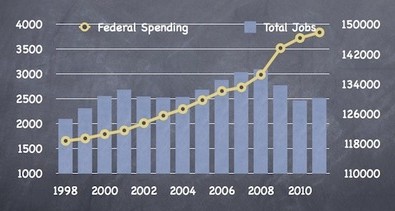
There are plenty of good ideas from people who live in the real world where real economic laws apply. Keynesianism has been tried since Pelosi and Reid were elected in 2007. It has failed. We need to move on to what works.
 WINTERY KNIGHT