Tag Archives: Job Creation

In Canada, a revolt against global warming socialism creates an economic boom

Before we look at Canada, let’s first look at how Barack Obama has decided to appease his green socialism supporters by rejecting the Keystone XL pipeline.

Excerpt:

The Obama administration rejected the long-delayed TransCanada oil sands crude project, a decision welcomed by environmental groups but blasted by the domestic energy industry.

After delaying the project past the November 2012 election, President Barack Obama was compelled by Congress to decide by Feb. 21 on whether to approve the pipeline that would sharply boost the flow of oil from Canada’s oil sands.

[…]Republicans, in turn, blasted Obama for breaking his promise to create jobs by scuttling the $7 billion pipeline.

House Speaker John Boehner, R.-Ohio, said Republicans will keep fighting for the Keystone pipeline because it is “good for the U.S. economy because it would create thousands of jobs.”

“All options are on the table” for fighting for the sands pipeline between the western province of Alberta and Houston, Boehner told reporters. “This is not the end of the fight.”

Republicans in the Senate have said they could legislate an approval of the pipeline that could get around any rejection by President Obama.

Just to be clear, this pipeline would be paid for with billions of dollars from a Canadian company based in Calgary, Alberta – the Houston of the North. They would pay for the pipeline, they would create the jobs here, and it would cost us nothing to take their money. This would not only cut gas prices for consumers, but it would help us to stop sending money abroad to countries that don’t like us very much.

How are the Canadians responding to Obama’s stupidity? They are already talking about building the pipeline to the west coast and selling their oil to China.

Canadian conservatives have no time for global warming nonsense.

Excerpt:

It is a cliché in journalism to declare metaphorical wars at the drop of a news release. In this case, it looks like war is exactly what Natural Resources Minister Joe Oliver launched Monday in an unprecedented open letter warning that Canada will not allow “environmental and other radical groups” to “hijack our regulatory system to achieve their radical ideological agenda.”

[…]Mr. Oliver took straight aim at a troubling trend in Canadian environmentalism — the foreign funding of Canadian green activist groups with the express purpose of shutting down Canadian resource development…  “These groups,” said Mr. Oliver, “seek to exploit any loophole they can find, stacking public hearings with bodies to ensure that delays kill good projects. They use funding from foreign special interests to undermine Canada’s national economic interest. They attract jet-setting celebrities with some of the largest personal carbon footprints in the world to lecture Canadians not to develop our natural resources.”

And they pulled out of the Kyoto Accord.

Excerpt:

Canada will formally withdraw from the Kyoto Protocol on climate change, the Minister of the Environment has said.

Peter Kent said the protocol “does not represent a way forward for Canada” and the country would face crippling fines for failing to meet its targets.

[…]The protocol, initially adopted in Kyoto, Japan, in 1997, is aimed at fighting global warming.

[…]He said meeting Canada’s obligations under Kyoto would cost $13.6bn (10.3bn euros; £8.7bn): “That’s $1,600 from every Canadian family – that’s the Kyoto cost to Canadians, that was the legacy of an incompetent Liberal government”.

They want jobs. They don’t have money to burn on a dozen Solyndras. They don’t pass job-killing regulations on energy companies.

Since 2006, the Canadians have been electing and re-electing Conservative prime minister Stephen Harper. The man has a BA and MA in economics, and he comes from the same fold as Reagan and Thatcher on fiscal conservativism and foreign policy. He has no patience for leftist community organizers like Obama. The Conservatives were re-elected again in 2011, this time with a majority government. Their House of Commons is majority conservative. Their Senate is majority conservative. And Harper has been packing the Supreme Court with fresh conservatives, every time there’s a vacancy. Canada’s economy is booming. And Canadians know how to keep it booming – they are cutting corporate taxes to 15% – less than half of our 35% corporate tax rate. We could be taking their money for the Keystone XL pipeline right now, but we’re not, because we elected an anti-business ideologue instead of an economist.

Related posts

Wow: Ezra Klein admits the real unemployment rate is 11 percent

From the left-leaning Washington Post, of all places.

Excerpt:

Typically, I try to tie the beginning of Wonkbook to the news. But today, the most important sentence isn’t a report on something that just happened, but a fresh look at something that’s been happening for the last three years. In particular, it’s this sentence by the Financial Times’ Ed Luce, who writes, “According to government statistics, if the same number of people were seeking work today as in 2007, the jobless rate would be 11 percent.”

Remember that the unemployment rate is not “how many people don’t have jobs?”, but “how many people don’t have jobs and are actively looking for them?” Let’s say you’ve been looking fruitlessly for five months and realize you’ve exhausted every job listing in your area. Discouraged, you stop looking, at least for the moment. According to the government, you’re no longer unemployed. Congratulations?

Since 2007, the percent of the population that either has a job or is actively looking for one has fallen from 62.7 percent to 58.5 percent. That’s millions of workers leaving the workforce, and it’s not because they’ve become sick or old or infirm. It’s because they can’t find a job, and so they’ve stopped trying. That’s where Luce’s calculation comes from. If 62.7 percent of the country was still counted as in the workforce, unemployment would be 11 percent. In that sense, the real unemployment rate — the apples-to-apples unemployment rate — is probably 11 percent. And the real un- and underemployed rate — the so-called “U6” — is near 20 percent.

There were some celebrations when the unemployment rate dropped last month. But much of that drop was people leaving the labor force. The surprising truth is that when the labor market really recovers, the unemployment rate will actually rise, albeit only temporarily, as discouraged workers start searching for jobs again.

Yeah, because taking money away from private sector job creators costs jobs. That is straight out of Henry Hazlitt’s “Economics in One Lesson”: Public Works Means Taxes.

Look:

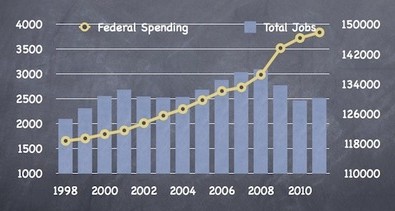
More stimulus spending means fewer jobs

From the Weekly Standard.

Excerpt:

When the Obama administration releases a report on the Friday before a long weekend, it’s clearly not trying to draw attention to the report’s contents. Sure enough, the “Seventh Quarterly Report” on the economic impact of the “stimulus,” released on Friday, July 1, provides further evidence that President Obama’s economic “stimulus” did very little, if anything, to stimulate the economy, and a whole lot to stimulate the debt.

The report was written by the White House’s Council of Economic Advisors, a group of three economists who were all handpicked by Obama, and it chronicles the alleged success of the “stimulus” in adding or saving jobs. The council reports that, using “mainstream estimates of economic multipliers for the effects of fiscal stimulus” (which it describes as a “natural way to estimate the effects of” the legislation), the “stimulus” has added or saved just under 2.4 million jobs — whether private or public — at a cost (to date) of $666 billion. That’s a cost to taxpayers of $278,000 per job.

In other words, the government could simply have cut a $100,000 check to everyone whose employment was allegedly made possible by the “stimulus,” and taxpayers would have come out $427 billion ahead.

When the government takes a dollar from a job creator, they take half of it for themselves, and then they often give the other half to some favored group, like a “green energy” company or Planned parenthood or a labor union.  Then they who turns around and give half of that handout right back to Obama as a campaign donation. The only way to stop them from doing more of this stimulus is to stop giving them money.

Do you know what has been proven to create jobs, though? TAX CUTS FOR THE RICH.

Consider this article by the Cato Institute, which discusses how the Reagan tax cuts affected the unemployment rate.

Excerpt:

In 1980, President Carter and his supporters in the Congress and news media asked, “how can we afford” presidential candidate Ronald Reagan’s proposed tax cuts?

Mr. Reagan’s critics claimed the tax cuts would lead to more inflation and higher interest rates, while Mr. Reagan said tax cuts would lead to more economic growth and higher living standards. What happened? Inflation fell from 12.5 percent in 1980 to 3.9 percent in 1984, interest rates fell, and economic growth went from minus 0.2 percent in 1980 to plus 7.3 percent in 1984, and Mr. Reagan was re-elected in a landslide.

[…]Despite the fact that federal revenues have varied little (as a percentage of GDP) over the last 40 years, there has been an enormous variation in top tax rates. When Ronald Reagan took office, the top individual tax rate was 70 percent and by 1986 it was down to only 28 percent. All Americans received at least a 30 percent tax rate cut; yet federal tax revenues as a percent of GDP were almost unchanged during the Reagan presidency (from 18.9 percent in 1980 to 18.1 percent in 1988).

What did change, however, was the rate of economic growth, which was more than 50 percent higher for the seven years after the Reagan tax cuts compared with the previous seven years. This increase in economic growth, plus some reductions in tax credits and deductions, almost entirely offset the effect of the rate reductions. Rapid economic growth, unlike government spending programs, proved to be the most effective way to reduce unemployment and poverty, and create opportunity for the disadvantaged.

The Heritage Foundation describes the effects of the Bush tax cuts.

Excerpt:

President Bush signed the first wave of tax cuts in 2001, cutting rates and providing tax relief for families by, for example, doubling of the child tax credit to $1,000.

At Congress’ insistence, the tax relief was initially phased in over many years, so the economy continued to lose jobs. In 2003, realizing its error, Congress made the earlier tax relief effective immediately. Congress also lowered tax rates on capital gains and dividends to encourage business investment, which had been lagging.

It was the then that the economy turned around. Within months of enactment, job growth shot up, eventually creating 8.1 million jobs through 2007. Tax revenues also increased after the Bush tax cuts, due to economic growth.

In 2003, capital gains tax rates were reduced. Rather than expand by 36% as the Congressional Budget Office projected before the tax cut, capital gains revenues more than doubled to $103 billion.

The CBO incorrectly calculated that the post-March 2003 tax cuts would lower 2006 revenues by $75 billion. Revenues for 2006 came in $47 billion above the pre-tax cut baseline.

Here’s what else happened after the 2003 tax cuts lowered the rates on income, capital gains and dividend taxes:

  • GDP grew at an annual rate of just 1.7% in the six quarters before the 2003 tax cuts. In the six quarters following the tax cuts, the growth rate was 4.1%.
  • The S&P 500 dropped 18% in the six quarters before the 2003 tax cuts but increased by 32% over the next six quarters.
  • The economy lost 267,000 jobs in the six quarters before the 2003 tax cuts. In the next six quarters, it added 307,000 jobs, followed by 5 million jobs in the next seven quarters.

The timing of the lower tax rates coincides almost exactly with the stark acceleration in the economy. Nor was this experience unique. The famous Clinton economic boom began when Congress passed legislation cutting spending and cutting the capital gains tax rate.

It worked for Reagan and it worked for Bush – they made unemployment go down, while Obama’s public works spending has made unemployment go up. Those are the facts. And we have to live in the world as it is. We may not like it, it may not be intuitive to us, it may not line up with our feelings, but that is the way the world is. When you let people with capital keep more of the money they earn, they hire more people and they try to make more money. When the rich risk their capital, they take the rest of us up with them – either by giving us jobs, or by offering us things that we are free to buy or not. Things like iPods, laptops and kitchen appliances. And the more competition there is among sellers in a free market, the lower the prices go, and the higher the quality gets.

Women in business report that regulatory uncertainty hurts job growth

The Independent Women’s Forum explains what happened at a panel discussion of women CEOs.

Excerpt:

Rep. Cathy McMorris-Rodgers hosted a panel discussion on Capitol Hill today that focused on the economy and job creation.  All of the panelists were CEOs.  All of them were women.

In their opening remarks, one word was mentioned by every panelist: uncertainty.

Another word, that went hand-in-hand with the uncertainty that America’s job creators are facing was “regulations.”  This word was also mentioned by every panelist.

Sandra Parrillo, President & CEO of Providence Mutual Fire Insurance, said that, as a property and casuality insurance company, they are very familiar with risk.  This year has been unprecedented in the amount of claims they’ve paid out due to an usually high number of natural disasters.  But Parrillo said her company faces enough uncertainty from nature; they don’t need uncertainty coming from Washington, DC, where hundreds of new rules are being written – often to solve problems that don’t really exist.

Lisa Hook, President & CEO, Neustar, Inc., said, “The outcome of the budget is less important to us than that there is a budget.”  Her company is traded on the stock market, and she says that the uncertainty fueling the ups and downs of the market, often driven by headlines from D.C., affects her business and her borrowing costs.

Several of the panelists derided Congress for failing to pass a budget for FY 2011.  They want to know that Congress is working to get its fiscal house in order.   They want to know what to expect from the executive branch as well, rather than having to readjust their budgets to deal with costly new regulations as soon as they are written.

Alison Brown, President & CEO, NAVSYS Corporation, went on to explain how difficult it is for small businesses to find access to working capital.  She said, “I have had to become my own bank.”  Her company isn’t publicly traded, and she pointed to Dodd-Frank and Sarbanes-Oxley as two laws that have wrestled working capital from the hands of small business.

Catherine Heigel, President of Duke Energy South Carolina, echoed the sentiments of the other panelists.  She also pointed out Duke Energy would like to repatriate their foreign earnings, but without reform, they would face an effective tax rate of over 50 percent.  All of the panelists agreed that certainty (that often comes from having more cash available) could be restored to the American economy with regulatory reform, tax reform, and health care reform.  They pointed to these three areas as the areas that currently are most burdensome to businesses.

In many ways the panel today was depressing.  All of the CEOs recognized that we are in a tough time, and all of them expressed disappointment that they could not expand and add more jobs in the current business climate.

There is a problem on the left where they have this idea that they can seize profits, control businesses, impose politically correct agendas, and engage in judicial activism and businesses will just keep hiring, producing and so on. It’s the ultimate narcissism. Bureaucrats are so busy spending other people’s money and making speeches about how generous they are that they completely forget who is paying the bill.