

Tag Archives: Jesus

Did Jesus appeal to evidence when reaching out to skeptics?

Investigation in progress

From Eric Chabot of Ratio Christi – Ohio State University.

He lists eight ways that Jesus makes his case.

Here’s one of the ways:

2. Jesus Appealed to Evidence

Jesus knew He could not show up on the scene and not offer any evidence for His Messiahship. In his book On Jesus, Douglas Groothuis notes that Jesus appealed to evidence to confirm His claims. John the Baptist, who was languishing in prison after challenging Herod, sent messengers to ask Jesus the question: “Are you the one who was to come, or should we expect someone else?” (Matt. 11:3). This may seem an odd question from a man the Gospels present as the prophetic forerunner of Jesus and as the one who had proclaimed Jesus to be the Messiah. Jesus, however, did not rebuke John’s question. He did not say, “You must have faith; suppress your doubts.” Instead, Jesus recounted the distinctive features of His ministry:

“Go back and report to John what you hear and see: The blind receive sight, the lame walk, those who have leprosy are cured, the deaf hear, the dead are raised, and the good news is preached to the poor. Blessed is the man who does not fall away on account of me.” (Matt. 11:4-6; see also Luke 7:22).

Even in the Messiah Apocalypse, which is dated between 100 and 80 B.C.E mentions a similar theme as seen in Matt.11: 4-6: “He [God] frees the captives, makes the blind see, and makes the bent over stand straight…for he will heal the sick, revive the dead, and give good news to the humble and the poor he will satisfy, the abandoned he will lead, and the hungry he will make rich.”

Jesus’ works of healing and teaching are meant to serve as positive evidence of His messianic identity, because they fulfill the messianic predictions of the Hebrew Scriptures. What Jesus claimed is this:

1. If one does certain kinds of actions (the acts cited above), then one is the Messiah.
2. I am doing those kinds of actions.
3. Therefore, I am the Messiah.

And:

5. The Miracles of Jesus

In the Bible, miracles have a distinctive purpose: they are used for three reasons:
1. To glorify the nature of God (John 2:11; 11:40)
2. To accredit certain persons as the spokesmen for God (Acts 2:22; Heb. 2:3–4)
3. To provide evidence for belief in God (John 6:2, 14; 20:30–31). (3)

Nicodemus, a member of the Jewish ruling council, the Sanhedrin, told Jesus, “‘Rabbi, we know you are a teacher who has come from God. For no one could perform the miraculous signs you are doing if God were not with him’ ” (Jn. 3:1–2). In Acts, Peter told the crowd that Jesus had been “accredited by God to you by miracles, wonders and signs, which God did among you through him” (Acts 2:22).

In Matthew 12:38-39, Jesus says, “A wicked and adulterous generation asks for a miraculous sign! But none will be given it except the sign of Jonah the prophet.” In this Scripture, God confirmed the Messianic claim when Jesus said the sign that would confirm his Messiahship was to be the resurrection.

It is important to note that not all witnesses to a miracle believe. Jesus did not do His miracles for entertainment. They were done to evoke a response. So perhaps Paul Moser is right on target in what he calls “kardiatheology” – a theology that is aimed at one’s motivational heart (including one’s will) rather than just at one’s mind or one’s emotions. In other words, God is very interested in moral transformation.

We see Jesus’ frustration when His miracles did not bring the correct response from his audience. “Even after Jesus had done all these miraculous signs in their presence, they still would not believe in him” (John 12:37). Jesus himself said of some, “They will not be convinced even if someone rises from the dead” (Luke 16:31). One result, though not the purpose, of miracles is condemnation of the unbeliever (cf. John 12:31, 37). (4)

I am forever pointing this out to people. Jesus didn’t get people to follow him because he was nice. And he didn’t just talk to people who agreed with him. He even promised “a wicked generation” his resurrection as evidence for his claims. He called his resurrection “the sign of Jonah”, and it was meant for people who were looking for a “sign”. This is the way we should be – using whatever evidence we can dig up from science, history, law, and even the social sciences (when arguing moral issues).

Read the rest here. Surprise! Jesus loves to convince people, and not just by quoting the Bible to people who already accept the Bible, either.
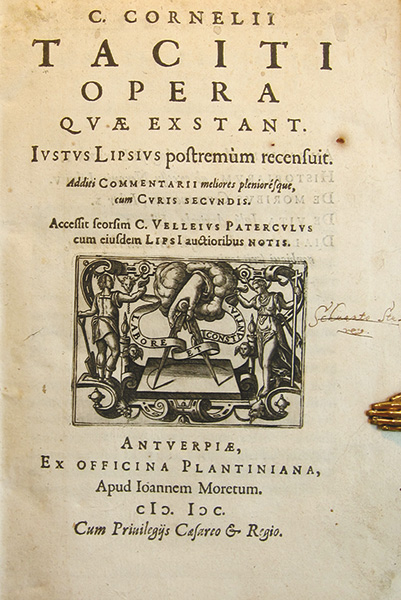
What do ancient non-Christian sources tell us about the historical Jesus?

The Annals, by Roman historian Tacitus

This article from Biblical Archaeology covers all the non-Christian historical sources that discuss Jesus.

About the author:

Lawrence Mykytiuk is associate professor of library science and the history librarian at Purdue University. He holds a Ph.D. in Hebrew and Semitic Studies and is the author of the book Identifying Biblical Persons in Northwest Semitic Inscriptions of 1200–539 B.C.E. (Atlanta: Society of Biblical Literature, 2004).

Here are the major sections:

  • Roman historian Tacitus
  • Jewish historian Josephus
  • Greek satirist Lucian of Samosata
  • Platonist philosopher Celsus
  • Roman governor Pliny the Younger
  • Roman historian Suetonius
  • Roman prisoner Mara bar Serapion

And this useful excerpt captures the broad facts about Jesus that we get from just the first two sources:

We can learn quite a bit about Jesus from Tacitus and Josephus, two famous historians who were not Christian. Almost all the following statements about Jesus, which are asserted in the New Testament, are corroborated or confirmed by the relevant passages in Tacitus and Josephus. These independent historical sources—one a non-Christian Roman and the other Jewish—confirm what we are told in the Gospels:31

1. He existed as a man. The historian Josephus grew up in a priestly family in first-century Palestine and wrote only decades after Jesus’ death. Jesus’ known associates, such as Jesus’ brother James, were his contemporaries. The historical and cultural context was second nature to Josephus. “If any Jewish writer were ever in a position to know about the non-existence of Jesus, it would have been Josephus. His implicit affirmation of the existence of Jesus has been, and still is, the most significant obstacle for those who argue that the extra-Biblical evidence is not probative on this point,” Robert Van Voorst observes.32 And Tacitus was careful enough not to report real executions of nonexistent people.

2. His personal name was Jesus, as Josephus informs us.

3. He was called Christos in Greek, which is a translation of the Hebrew word Messiah, both of which mean “anointed” or “(the) anointed one,” as Josephus states and Tacitus implies, unaware, by reporting, as Romans thought, that his name was Christus.

4. He had a brother named James (Jacob), as Josephus reports.

5. He won over both Jews and “Greeks” (i.e., Gentiles of Hellenistic culture), according to Josephus, although it is anachronistic to say that they were “many” at the end of his life. Large growth
in the number of Jesus’ actual followers came only after his death.

6. Jewish leaders of the day expressed unfavorable opinions about him, at least according to some versions of the Testimonium Flavianum.

7. Pilate rendered the decision that he should be executed, as both Tacitus and Josephus state.

8. His execution was specifically by crucifixion, according to Josephus.

9. He was executed during Pontius Pilate’s governorship over Judea (26–36 C.E.), as Josephus implies and Tacitus states, adding that it was during Tiberius’s reign.

Some of Jesus’ followers did not abandon their personal loyalty to him even after his crucifixion but submitted to his teaching. They believed that Jesus later appeared to them alive in accordance with prophecies, most likely those found in the Hebrew Bible. A well-attested link between Jesus and Christians is that Christ, as a term used to identify Jesus, became the basis of the term used to identify his followers: Christians. The Christian movement began in Judea, according to Tacitus. Josephus observes that it continued during the first century. Tacitus deplores the fact that during the second century it had spread as far as Rome.

I remember reading the 1996 book by Gary Habermas entitled “The Historical Jesus: Ancient Evidence for the Life of Christ“. This book is a little before the time of most of you young Christian apologists, but back before the time of Lee Strobel and J. Warner Wallace, this is the stuff we all read. Anyway, in the book he makes a list of all that can be known about Jesus from external sources. And fortunately for you, you don’t have to buy the book because you can read chapter 9 of it right on his web site.

From Tacitus he gets this:

From this report we can learn several facts, both explicit and implicit, concerning Christ and the Christians who lived in Rome in the 60s A.D. Chronologically, we may ascertain the following information.

(1) Christians were named for their founder, Christus (from the Latin), (2) who was put to death by the Roman procurator Pontius Pilatus (also Latin), (3) during the reign of emperor Tiberius (14 37 A.D.). (4) His death ended the “superstition” for a short time, (5) but it broke out again, (6) especially in Judaea, where the teaching had its origin.

(7) His followers carried his doctrine to Rome. (8) When the great fire destroyed a large part of the city during the reign of Nero (54 68 A.D.), the emperor placed the blame on the Christians who lived in Rome. (9) Tacitus reports that this group was hated for their abominations. (10) These Christians were arrested after pleading guilty, (11) and many were convicted for “hatred for mankind.” (12) They were mocked and (13) then tortured, including being “nailed to crosses” or burnt to death. (14) Because of these actions, the people had compassion on the Christians. (15) Tacitus therefore concluded that such punishments were not for the public good but were simply “to glut one man’s cruelty.”

And from Josephus he gets this:

(1) Jesus was known as a wise and virtuous man, one recognized for his good conduct. (2) He had many disciples, both Jews and Gentiles. (3) Pilate condemned him to die, (4) with crucifixion explicitly being mentioned as the mode. (5) The disciples reported that Jesus had risen from the dead and (6) that he had appeared to them on the third day after his crucifixion. (7) Consequently, the disciples continued to proclaim his teachings. (8) Perhaps Jesus was the Messiah concerning whom the Old Testament prophets spoke and predicted wonders. We would add here two facts from Josephus’ earlier quotation as well. (9) Jesus was the brother of James and (10) was called the messiah by some.

So when you are reading the New Testament, these facts are the framework that you read within. It’s a good starting point when dealing with people who have never looked into who Jesus was and what he taught and what his followers believed about him, right from the start.

Mike Licona lectures on historical methods and the New Testament

Here’s a quick overview of Michael Licona’s latest book on the resurrection, entitled “The Resurrection of Jesus“.

60 minutes of lecture, 20 minutes of Q&A.

Summary:

  • Dr. Licona’s background and education
  • The definition of history and philosophy of history
  • Postmodern approaches to history
  • Historical bedrock: facts that are historically demonstrable
  • Historical criterion 1: Explanatory scope
  • Historical criterion 2: Explanatory power
  • Historical criterion 3: Plausibility
  • Historical criterion 4: Ad Hoc / Speculation / non-evidenced assumptions
  • Inference to the best explanation
  • Investigating miracle claims: is it possible? How?
  • Objection of James D.G. Dunn
  • Objection of Bart Ehrman
  • New Testament sources: Gospels and Paul’s letters
  • The Gnostic gospels: are they good sources?
  • The minimal facts
  • The hallucination hypothesis
  • The best explanation

While watching this lecture, it struck what good preparation it was for understanding debates. This lecture is more about historical methods, but if you’re interested in Mike’s minimal facts case for the resurrection, here’s a video on that:

This is the case he uses in his debates with Richard Carrier, Dale Allison, Bart Ehrman, etc.

Mike Licona’s ministry is here: Risen Jesus.

If you are looking for a good book to read on the resurrection of Jesus, the best introductory book on the resurrection is “The Case for the Resurrection of Jesus” and the best comprehensive book is “The Resurrection of Jesus“.